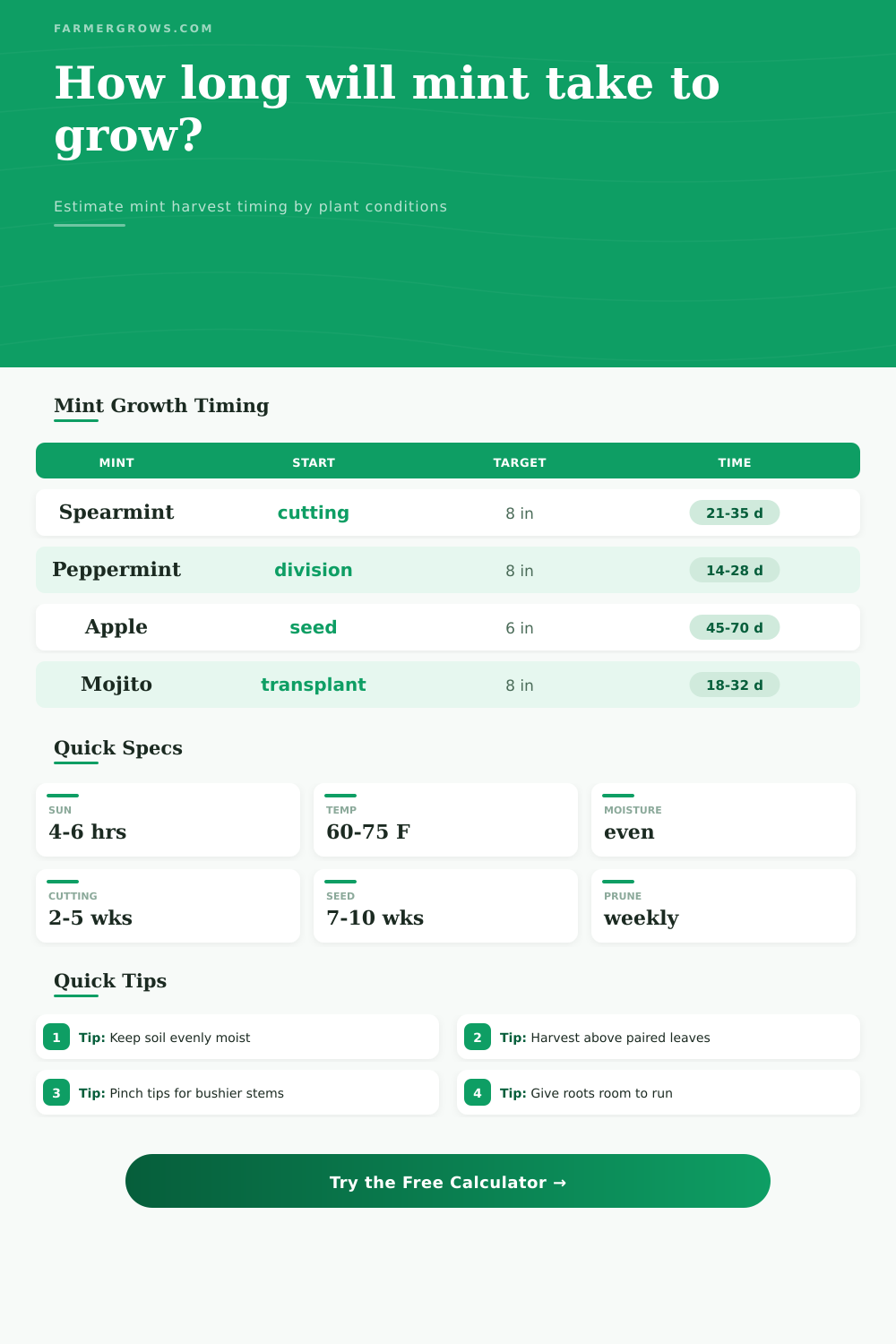
Mint Growth Time Calculator
Estimate how many days your mint needs to reach a harvest height from mint type, propagation method, plant age, container size, sun, temperature, moisture, fertility, and pruning.
Choose a real mint-growing situation, then adjust the plant age, pot or bed size, sunlight, temperature, moisture, fertilizer, target height, and pruning rhythm.
Mint Growth Estimate
Adjust the inputs to estimate how quickly your mint can reach a harvestable height.
Often the quickest kitchen mint for fresh cuttings, with vigorous runners and easy regrowth after pinching.
Produces sturdy stems and rebounds quickly from divisions when moisture and root space are steady.
A productive spearmint type with medium-fast growth and a good target height around 8 to 10 inches.
Softer, fuzzy leaves and broader stems can take a little longer, especially in small pots.
Usually moderate in pots and benefits from bright light before repeated harvests.
Good container mint with a dependable pace when kept evenly moist through warm afternoons.
Variegated leaves can grow more slowly than green-leaf mints and dislike stress from drying.
A creeping mint grown as a mat, so height targets should stay low compared with upright types.
| Propagation method | Establishment delay | Typical first harvest | Best use |
|---|---|---|---|
| Seed | 14 to 21 days before steady growth | 45 to 70 days in warm, bright conditions | Starting many plants where variety uniformity is less important |
| Rooted cutting | 5 to 10 days after potting | 21 to 35 days once roots fill the starter mix | Kitchen pots, balcony planters, and quick replacement plants |
| Root division | 3 to 7 days after replanting | 14 to 28 days if divided with healthy roots | Fastest restart from an established mint patch |
| Nursery transplant | 4 to 9 days after transplanting | 18 to 32 days depending on pot size and pruning | Reliable container or raised-bed planting |
| Condition | Fast range | Slow range | Calculator effect |
|---|---|---|---|
| Sun or bright light | 4 to 6 hours daily | Under 3 hours daily | Low light can add 20% to 45% more time |
| Temperature | 60 to 75°F | Under 55°F or over 88°F | Cool roots or heat stress slows internode growth |
| Moisture | Evenly moist | Dry swings or soggy soil | Root stress reduces the weekly height gain |
| Fertility | Light to moderate feed | Depleted mix or excessive nitrogen | Balanced feeding supports leafy harvests |
| Harvest target | Good for | Best pruning move | Growth note |
|---|---|---|---|
| 3 to 4 inches | Corsican mint or tiny garnish pinches | Snip lightly; avoid scalping the crown | Short target can be ready quickly but yields little bulk |
| 6 to 8 inches | First kitchen harvest from most upright mints | Cut above a leaf pair to trigger branching | Best balance of speed, tenderness, and regrowth |
| 9 to 12 inches | Bunches, tea, drying, or recipe batches | Harvest the top third and leave leafy stems | Needs more root space and light to avoid weak stems |
| Over 12 inches | Large outdoor patches before bulk cutting | Cut in sections so plants keep photosynthesizing | May become woody or flower if harvest waits too long |
| Scenario | Inputs | Target height | Expected timing |
|---|---|---|---|
| Rooted spearmint cutting | Medium pot, 5 sun hours, even moisture | 8 inches | About 3 to 5 weeks after potting |
| Peppermint root division | Raised bed, 6 sun hours, moderate feed | 8 inches | About 2 to 4 weeks after replanting |
| Apple mint from seed | Tray or small pot, warm room, bright light | 6 inches | About 7 to 10 weeks from sowing |
| Shady balcony mint | Planter, 2.5 sun hours, slightly dry soil | 8 inches | Often 5 to 8 weeks, sometimes longer |
Harvest timing: For tender leaves, harvest once stems are leafy and sturdy but before flower buds form. Cutting just above a paired leaf node usually speeds branching for the next harvest.
Container control: Mint roots fill pots quickly. If the calculator shows slow progress in good light and moisture, a crowded root ball may be the limiting factor.
Sometimes a mint looks healthy, with shiny foliage… but it stops growing. No matter how much you think you’re doing right, light? Check. Soil? Your mint is not getting any bigger. Why? Mint’s got particular needs; if you miss one of them, your mint will stop developing.
The calculator at the top break down what temperature, what kind of light, and what size of pot to give mint to get real results, including when to harvest the leaves. It separates actualy neglect from normal development.
Why Your Mint Stops Growing
The other variable that confuses people is propagation method. If you start with a seed, it has to spends weeks rooting itself underground before it can push up toward the light, whereas a division might hit harvest height in just two weeks. With a division or rooted cutting, you skip the establishment phase; it’ll get to harvest size in two weeks’ time versus two months if you started with a seedling. The calculator factor in this wait time to help you set realistic expectations about how your start date affects reaching your goal. Understanding where your plant came from is first step to knowing how fast it will go.
Once the roots are established, amount of root space regulates growth rate. For instance, mint will grow very fast and spread out, but if you keep it in a small pot (less than eight inches across), its roots becomes crowded and go around on themselves. Since they can’t expand their resource base, this physical constraint signal the plant to slow down its vertical growth. Knowing about the pot size allows the tool to consider that a bigger one would support a fuller, taller shoot. When the plant stops growing even when well-cared-for, this might mean there’s something wrong with rootball. It’s not a weakling; it’s imprisoned.
Growing mint is temperature- and light-driven, but those conditions needs to be in a tight range. Mint likes it from sixty to seventy-five degrees. Above eighty-eight degrees, it feel heat stress and stops making tender leaves. In fact, it can bolt to flower. Which puts a stop to the season for quality leaves. The calculator will alert you when growing conditions is pushing the mint outside its comfort zone. Mint will tolerate some shade, but does not grow as fast then. For quick leaf production, give it four to six hours of direct sun daily. Anything less makes it hard to grow.
It is how moist the soil is, rather than how much moisture there is, that counts. Mint will struggle if it goes from bone dry to soaked in the soil. Metabolic processes are humming along better when things are evenly moist. On the other hand, if you do have swings (dry then soak again) the mint will stall out (the same way that too much water rot the roots). The tool allows you to estimate what your watering schedule mean for how long the countdown will last. The longer the mint is allowed to go without any moisture at all, the longer the countdown will be. It can change that final total a lot.
The last thing to do is pruning. Each stem may be a bit shorter because you pinch the tips. However, the plant will branch out and have more stems to pick from. More total stems mean more harvest. The plant takes some time to recover from heavy cutback… The calculator adjust that time for you on the timeline. If the plant hasn’t had time to rebuild itself, there’s nothing to harvest. For instance, a prompt pinch now means waiting a few extra days for a big haul, but twice as many leaves next month. This tradeoff gets missed by many, who sacrifice future yields for quick results.
With mint: It’s an exercise in patience (biology vs. Tool). The tool tells you the date, now it’s up to you to create the environment where that date can become a reality. Give the roots plenty of room, consistent moisture, and moderate temperatures. If there are signs of flowers coming on, pinch them off. By timing yourself to match the plant’s naturaly rhythm, things grow well, quickly. Don’t worry about progress slowing down; instead, plan for what you have too much of. Let the green come.