Coriander Seed Germination Time Calculator
Estimate coriander or cilantro sprout timing from seed age, split seed preparation, soak time, soil temperature, planting depth, moisture, light exposure, texture, days since sowing, and row cover.
Load a common cilantro sowing situation, then fine tune the seed age, rubbing or splitting, soak time, depth, moisture, texture, and row cover for your bed.
Coriander Germination Estimate
Adjust the inputs to estimate the sprout window for your cilantro row.
Simple direct sowing, but the round seed coat often adds a few days before moisture reaches both seed halves.
Light rubbing cracks the fruit enough to improve water entry while keeping the two seed halves easy to sow.
Splitting plus a short soak usually gives the quickest stand when the seedbed stays moist after sowing.
Shade cloth can protect a summer row; clear plastic may help cool weather but can overheat warm beds.
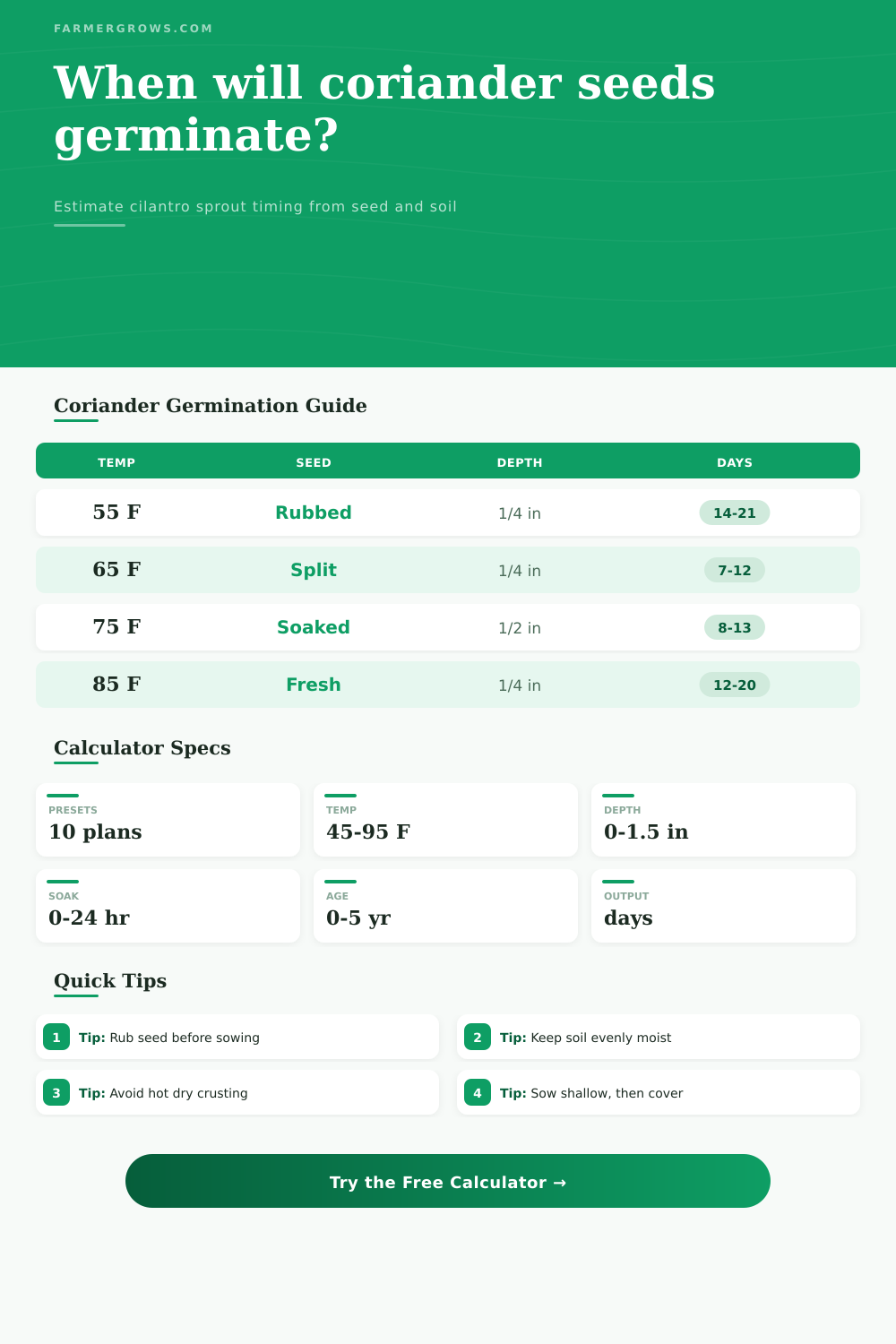
| Average soil temperature | Expected sprout window | Germination effect | Best adjustment |
|---|---|---|---|
| 45 to 49°F | 18 to 28 days | Very slow and uneven | Use row cover and fresh seed |
| 50 to 55°F | 14 to 21 days | Slow but workable | Rub seed and keep bed covered |
| 56 to 64°F | 10 to 16 days | Reliable spring range | Sow shallow with steady moisture |
| 65 to 75°F | 7 to 12 days | Fastest typical window | Keep the surface from crusting |
| 76 to 82°F | 8 to 14 days | Still good if moist | Water lightly and mulch thinly |
| 83 to 90°F | 12 to 20 days | Heat stress may thin stand | Use shade cloth or sow cooler |
| Condition | Best range | Delay risk | What to watch |
|---|---|---|---|
| Planting depth | 1/4 to 1/2 inch | Deep sowing adds 2 to 8 days | Seedlings struggle below 1 inch |
| Moisture | Evenly moist | Dry cycles stop imbibed seed | Surface dries before root emerges |
| Light exposure | Covered or dappled | Full sun can dry soil fast | Bare rows heat and crust |
| Soil texture | Fine loam | Clay, crust, or loose compost delay | Poor contact or capped surface |
| Row cover | Fleece in cool weather | Plastic can overheat warm beds | Vent or remove after sprouts show |
| Seed lot | Prep choice | Timing effect | Stand expectation |
|---|---|---|---|
| Fresh seed | Rubbed or split | Normal to 2 days faster | High and even if moist |
| 1 to 2 years old | Rubbed plus short soak | Often 1 to 2 days slower | Good with extra seed density |
| 3 years old | Split a sample first | Usually 2 to 4 days slower | Thin spots more likely |
| 4 years old | Test before planting | May be 4 to 7 days slower | Resow gaps early |
| 5 years or older | Use only as backup | Slow and uncertain | Fresh seed is safer |
| What you see | Likely cause | Timing clue | Next step |
|---|---|---|---|
| No sprouts by day 7 | Often normal in cool soil | Check calculated window | Keep moist and wait |
| No sprouts by day 14 | Cold soil, old seed, or deep sowing | May still emerge slowly | Scratch-check one small spot |
| Patchy row | Drying, crust, or uneven depth | Scattered sprouts over several days | Mist and fill gaps |
| Seed rots | Soggy soil or long soak | Soft seed with sour smell | Resow in better drainage |
| Sprouts then fail | Heat, crust, or dry surface | Emergence starts then stalls | Shade and water gently |
Rub, then sow shallow: Roll coriander seed gently between two boards, a rolling pin, or your palms until some balls split. Cover with fine soil at about 1/4 to 1/2 inch so seed stays dark and damp.
Manage moisture, not just days: If the surface dries after soaking or sowing, coriander may pause or fail. Use a fine rose, light fleece, or shade cloth to hold even moisture without making the bed soggy.
Anxiety is A GARDENER’S constant companion, and so it was when I stared into an empty row and realized: Did my coriander seeds fail? Watered and covered, they’d gone in and never sprouted. Not a hint of green. Cilantro, or coriander, is finicky; we’ve all been there. Often the cause isn’t carelessness, but timing, and temperature, generally.
So getting to know roughly when yours will sprout can help. It’s just that when calculator does it for you, knowing the variables lets you trust the number. The biggest variable are the temperature of your soil (the seed’s engine). When it’s around fifty degrees, things goes very slowly. It takes weeks, maybe even three. No, the seed isn’t dead, no, no, it’s inching along because there’s no heat inside its coat to get biological processes going.
How to Help Coriander Seeds Grow
In the mid-sixties to mid-seventies range, though, all those conditions is just right for sprouting in under a couple weeks. Any warmer than eighty or so, and it starts to become a problem (dangerous), not because that high temperature “cooks” the seed, but because it dries up top layer of soil too fast for the tender root to ever find water.
Gardeners can save time another way by preparing their seed. If you plant coriander (the other name for cilantro) seeds whole, they will take days longer to grow. Instead, rub them gently in your palms or against a board to crack outer shell. This allows water to go right into embryo instead of having to work its way through the outer part. A few minutes with your hands can save you a week or more waiting for them to germinate.
To account for this, tool will adjust the estimate depending on how you sowed your seeds, whole, rubbed, or fully split. It also realizes that the quicker they gets water, the quicker they’ll sprout. Most gardeners get this one wrong: They don’t manage moisture well. Coriander seeds is small and do not have much stored energy to crack a crust. If they drink up but then face a semi-dry layer above them, it can stop their germination or put it on hold until things improve again. Keeping the surface uniformly moist (not soaking but never allowing it to dry) is better than just splashing it around sometimes. That’s why the calculator takes into account how you plan to keep things wet. It deducts points from estimates based off dryness or other inconsistent conditions. These thing mess up the seedling development cycle.
Here’s one more wrinkle: the age of your seeds. Three-year-old seed may or may not be viable, but even if it is, its vigor is probably diminished. The estimator takes into account seed age. It alerts you that older lots will come up less uniformly and slower. Some might pop within a week or two, while others take longer. This means you get a scatter of seedlings over a few weeks instead of a clean stand. So when the tool says your germination score is lower, go ahead and sow thicker then usual to make up for any empty spots you suspect could result.
So ultimately: Coriander germinates when it has enough mechanical advantage, water and warmth. Avoid crusting; crack the seed open; maintain moisture in the soil and warmth in the mid-sixties to mid-seventies, and you’re doing right by the little guy from day one. And that’s all laid out in the reference table on the page, how the various factors change the expected date. No guessing about whether to reseed or not. Just read the numbers, keep the soil damp, and know the green will come.