Clover Seed Germination Time Calculator
Estimate clover sprouting time from clover type, soil temperature, moisture consistency, planting depth, scarification, inoculation, seed age, seeding method, soil pH, and rainfall or irrigation.
Use this calculator as a field planning estimate. Clover seed emergence still depends on seed lot germination, soil crusting, seed-to-soil contact, seedbed firmness, disease pressure, and local weather swings after planting.
Small seed that needs shallow placement, firm contact, and steady surface moisture. Excellent for lawns, pastures, wildlife plots, and living mulch.
Good cool-season forage types. They tolerate slightly deeper cover than white clover, but crusting soil can still slow emergence.
Fast annual clovers when soil is warm and moist. They are common in cover crops, pollinator strips, and seasonal forage mixes.
Hard seed can delay sprouting, especially in sweet clover. Scarification and correct inoculation improve early stand reliability.
Clover Germination Estimate
Results will update after calculation.
| Clover type | Typical sprout time | Best soil temperature | Preferred depth | Special note |
|---|---|---|---|---|
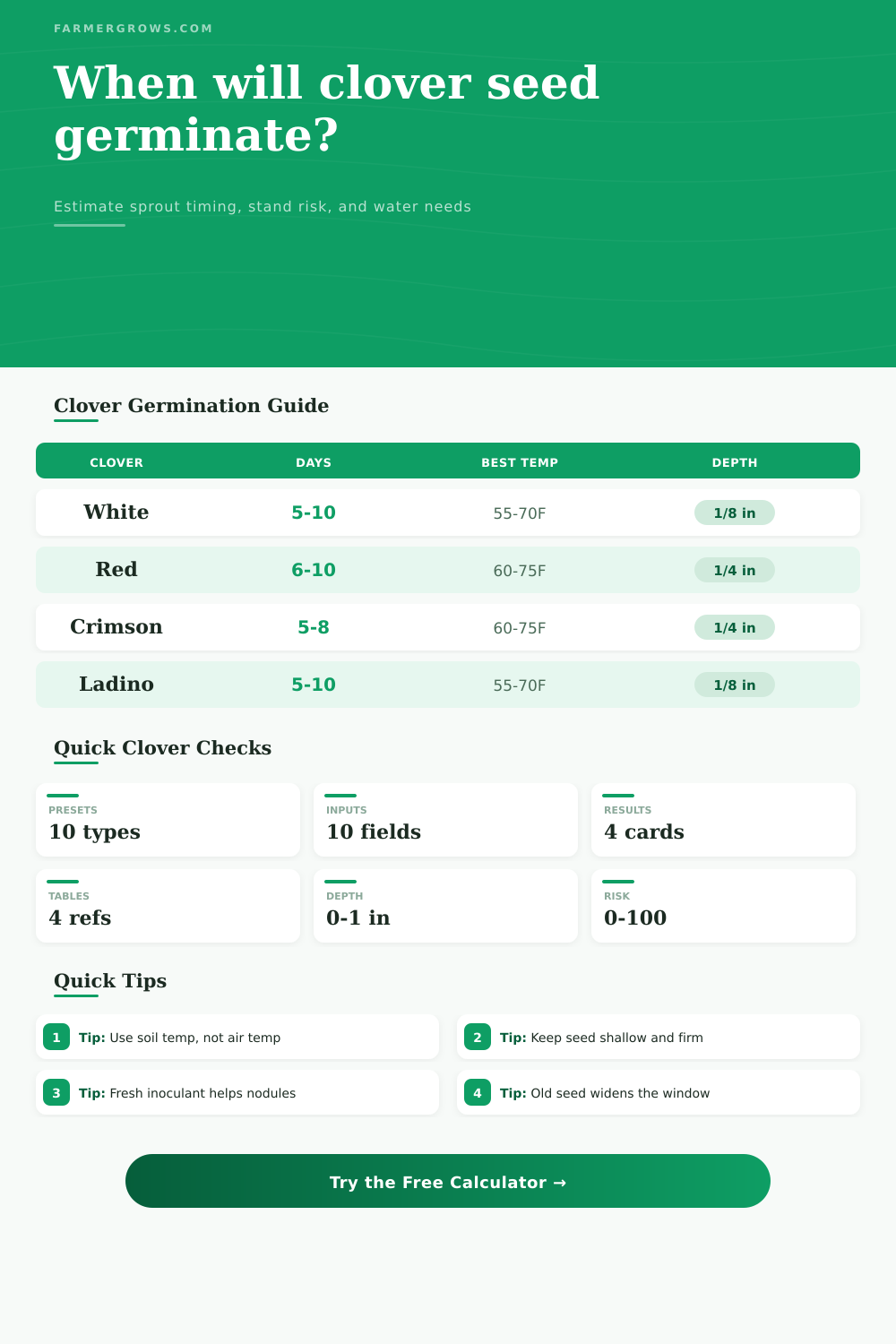
| White / Dutch white | 5 to 10 days | 55 to 70°F | 1/8 inch | Excellent shallow-sown lawn and pasture clover. |
| Ladino white | 5 to 10 days | 55 to 70°F | 1/8 inch | Large-leaf white clover; needs firm contact. |
| Red clover | 6 to 10 days | 60 to 75°F | 1/8 to 1/4 inch | Forage type with steady cool-season emergence. |
| Crimson clover | 5 to 8 days | 60 to 75°F | 1/4 inch | Fast annual cover when planted into warm moisture. |
| Alsike clover | 7 to 12 days | 55 to 70°F | 1/8 to 1/4 inch | Useful in wetter or cooler forage settings. |
| Sweet clover | 7 to 18 days | 60 to 75°F | 1/4 inch | Hard seed often responds to scarification. |
| Berseem clover | 4 to 8 days | 65 to 80°F | 1/4 inch | Warm, moist seedbeds produce quick emergence. |
| Subterranean clover | 7 to 14 days | 55 to 70°F | 1/4 inch | Often used in mild-winter pasture systems. |
| Soil temperature | Expected effect | Timing adjustment | Stand risk | Field reading |
|---|---|---|---|---|
| Below 45°F | Very slow metabolism | Add 5 to 10 days | High | Wait or expect delayed emergence. |
| 45 to 54°F | Cool but workable | Add 2 to 5 days | Moderate | Works for frost seeding and cool spring starts. |
| 55 to 75°F | Best range for most clovers | No added delay | Low | Keep surface moisture steady. |
| 76 to 85°F | Fast if moist | Subtract up to 1 day | Moderate | Watch drying and heat stress. |
| Above 85°F | Heat stress and drying | Add 2 to 6 days | High | Shade, water lightly, or delay planting. |
| Factor | Best target | Delay trigger | What to adjust | Why it matters |
|---|---|---|---|---|
| Moisture consistency | Evenly damp | Dry crust or puddles | Use light frequent watering | Clover seed must imbibe water without losing oxygen. |
| Planting depth | 1/8 to 1/4 inch | Over 1/2 inch deep | Press shallow seed into firm soil | Small seed has limited reserves to push upward. |
| Rainfall pattern | Gentle rain or irrigation | Washout or no rain | Repair moved seed or water lightly | Seed contact changes quickly after hard rain. |
| Seedbed firmness | Footprint under 1/4 inch | Loose fluffy surface | Roll or cultipack after seeding | Firm soil improves contact and moisture transfer. |
| Condition | Emergence effect | Stand effect | Best use | Watch point |
|---|---|---|---|---|
| Commercial scarification | More uniform start | Lower hard-seed delay | Sweet, arrowleaf, subterranean | Avoid damaging seed with rough handling. |
| Fresh inoculation | Little direct timing change | Better early nodulation | New fields or long rotations | Use correct rhizobium group for clover. |
| Drilled seed | Usually steadier timing | Better contact | Pasture and cover crop stands | Keep openers shallow for clover. |
| Broadcast and packed | Good if rolled firm | Moderate to strong | Lawns, frost seed, pasture repair | Do not leave seed on fluffy residue. |
| Old or humid seed | Wider window | Lower potential stand | Use only after germ test | Increase patience before reseeding. |
Local extension guides and seed tags should override any generic estimate when they provide variety-specific germination, hard seed, or coated seed information.
For the first week, the goal is a damp seed zone rather than deep soaking. Short, gentle irrigation helps shallow clover seed stay hydrated without floating away.
Cold soil, hard seed, old seed, or frost seeding can make clover look late. Check the stand after the calculator recheck window before disturbing the seedbed.
Clover seeds, like other things in nature, are not magic; put them on the ground, and presto: green appears. This is why we sow them. A nice thick mat of nitrogen-fixing plant will make our soil happy and save us cash buying fertilizer. But somewhere between dropping a packet on the ground and having green things sprout from said drop, most people gets cold feet.
What happened? Did I miss a place? Was the rain so hard it washed it all out? Maybe the seed expire? Actualy, it’s usually simpler then that. Yes, clover is impatient. And yes, it’s fickle. It require certain conditions to awaken…and when those aren’t met, it throws in the towel.
Why Your Clover Seeds Do Not Grow
Once you plug in your local soil conditions (saving you from having to do any conversions or coefficients yourself), the calculator above takes care of the math for you. It consider ten different variables and provides a realistic window for emergence. While most of us focus on when we planted, this tool focuses on what the seed experience.
The first big driver is soil temperature. Air temperature lies to you. Sure, the sun may be blazing eighty degrees, but after a cold night, that top inch of soil where the seed resides could still be chilly fifty-five degrees. In the cold, clover metabolism dramatically slows down. If your soil are below forty-five degrees, you’re not just waiting for germination. You’re waiting for the seed to simply survive till it warm up. This delay adds days to your timeline and also increase the risk of disease or rot.
Depth is the other quiet assassin. White clover seed is realy small, more like dust versus something as big as a soybean or corn seed. It has almost no reserve of energy. What does this mean? Don’t plant it deep. The machine handles this with lower expectations depending on how deep you say you’ve planted. Planting white clover a half-inch deep? That may be digging its grave. It just doesn’t have enough gas in the tank to work itself through all that soil. It might be better to broadcast it on top and roll it in rather than drilling too deeply. It wants to get close to moisture up top, and light will help trigger some of the germination processes.
Consistent moisture is more important. Do not give it too much moisture, but do not flood it. Just a damp sponge. A crust of soil can form when it’s really wet and rains hard making it like a hard shell, impossible for even a small stem of clover to break through. Or a flood can wash the seed down in the mud or thatch where it drowns, out of air. The calculator include this potential for damage in the likelihood of how well it will stand.
Steady, gentle is best. If you water by hand, do it short and often rather than one long soak. That keeps things going in surface zone but doesn’t wash the seed away…or smother it.
The geeky part is how to get a thick stand, rather than just a patch of thin stuff. That’s scarification and inoculation. Certain clovers has hard coats, including subterranean sweet clover. They will ignore you if they are sitting in soil for years. Scratch up that coat with scarification; let water in. And then there is fresh inoculation, which doesn’t hasten germination per se; but once that root form, it pairs up right away with the bacteria that start fixing nitrogen. The seedling get off to a quick start, establishing vigorously enough to outcompete some weed. This gives it a fighting chance.
One question about seed age is, “Is old seed a crapshoot? Absolutely,” says Jim. If you left a couple years’ worth in your hot garage, as I’ve done with mine, you’re spreading out when they sprout.” In five days, some will have sprouted. In three weeks, others might emerge. This can lead to a chaotic mix of sizes that make it hard to judge your stand; you think it has failed, then late bloomers appear, and then you reseed. The tool takes seed age into account, to widen or shrink that likely window.
When should you stop worrying and wait? It’ll tell you. Stand check date. Not the first leaf you see, but the date you should walk the field and count plants. Accounts for slowest germinating seed and lets them have their day (so to speak). Panic reseeding is bad. Weed competition is also bad. Data-informed patience is the name of the game. You’re managing the moisture. You’re respecting the depth. And you’re letting the soil do its job. Green follows.