Urea Per Acre for Corn Calculator
Estimate corn urea rates from acres, yield goal, target nitrogen, soil nitrate credit, previous crop or manure credits, 46-0-0 analysis, volatilization loss, inhibitor use, split timing, and rain or incorporation timing.
Pick a corn scenario, then tune the acre count, yield goal, credits, timing, and loss assumptions to match your field and local nutrient recommendation.
Application package
Corn Urea Recommendation
Your urea plan will appear here after calculation.
Best surface urea protection when tillage, banding, or irrigation moves urea into moist soil quickly.
Often close to incorporation when enough rain dissolves and carries urea below residue and surface pH zones.
Works in many corn programs, but warm residue-covered soils can still lose part of the surface-applied N.
Use an inhibitor, incorporate, irrigate, or shift more N to sidedress when rain is not expected soon.
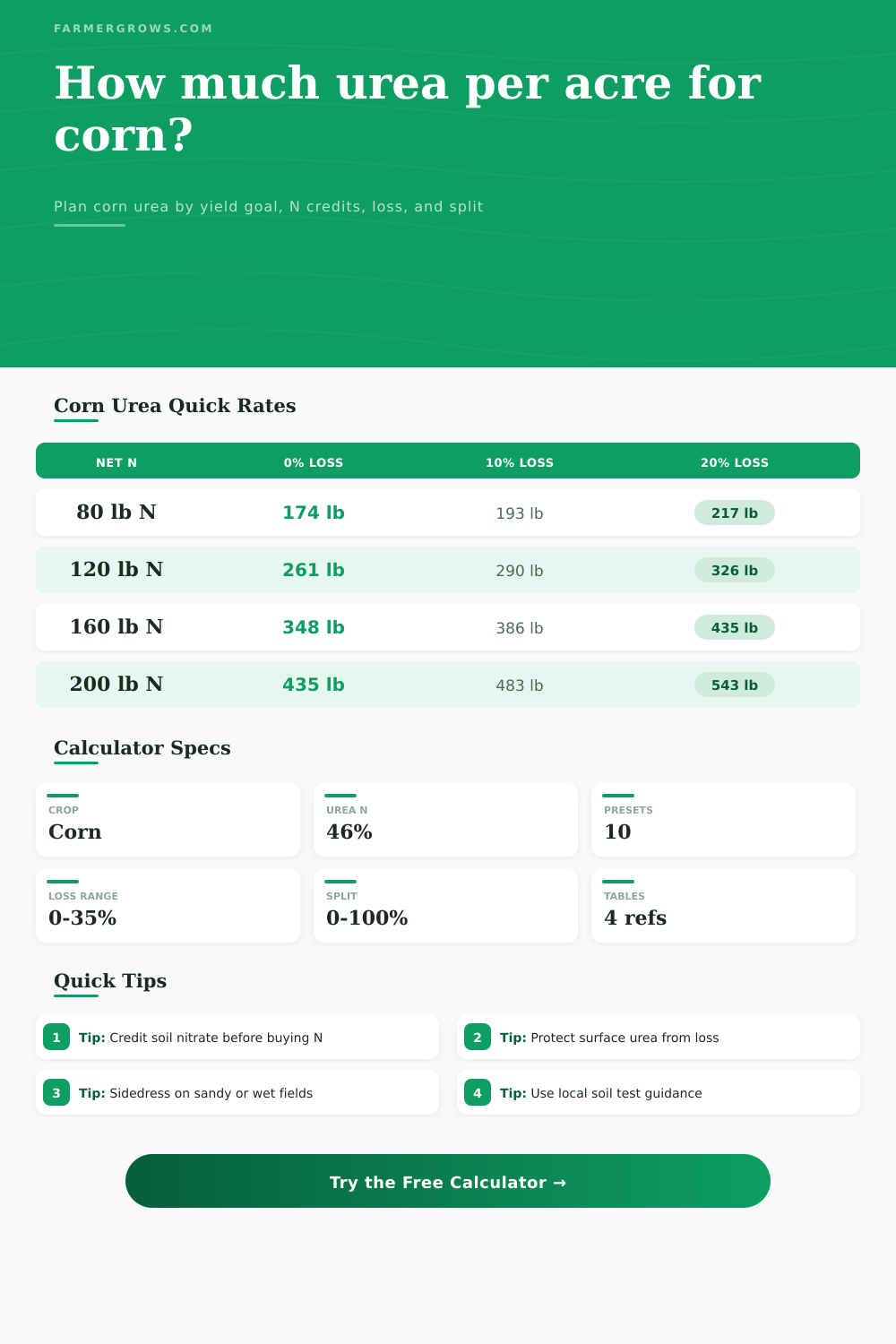
| Net N need | Urea with 0% loss | Urea with 10% loss | Urea with 20% loss |
|---|---|---|---|
| 80 lb N/ac | 174 lb/ac | 193 lb/ac | 217 lb/ac |
| 120 lb N/ac | 261 lb/ac | 290 lb/ac | 326 lb/ac |
| 160 lb N/ac | 348 lb/ac | 386 lb/ac | 435 lb/ac |
| 200 lb N/ac | 435 lb/ac | 483 lb/ac | 543 lb/ac |
| Rain or incorporation timing | Typical loss range | Inhibitor fit | Corn management note |
|---|---|---|---|
| Incorporated same day | 0-3% | Usually optional | Good for preplant N when soil erosion risk is managed. |
| Rain within 24 hours | 2-6% | Optional to useful | Works well when rainfall is enough to dissolve prills. |
| Rain in 2-3 days | 5-12% | Often useful | Watch high residue, high pH, and warm surface soils. |
| No rain, warm surface | 15-35% | Strongly useful | Consider sidedress, injection, irrigation, or incorporation. |
| Previous crop or source | Common N credit | When to use | Calculator entry |
|---|---|---|---|
| Soybeans before corn | 20-40 lb N/ac | Many rotations with good nodulation | Crop or manure credit |
| Established alfalfa | 80-150 lb N/ac | Good stand terminated before corn | Crop or manure credit |
| Manure applied | Lab test based | Use available first-year N | Crop or manure credit |
| Spring nitrate test | Test based | Fields with measurable nitrate carryover | Soil nitrate credit |
| Corn system | Yield goal | Starting N target | Common split |
|---|---|---|---|
| Dryland rotation corn | 140-170 bu/ac | 120-170 lb N/ac | 40% preplant, 60% sidedress |
| Irrigated corn | 200-260 bu/ac | 180-240 lb N/ac | 30% preplant, 70% sidedress |
| Corn after alfalfa | 160-220 bu/ac | Lower after credit | Starter plus sidedress check |
| High residue no-till corn | 150-220 bu/ac | Local MRTN or test | More protected sidedress N |
Protect the surface application: Urea is most vulnerable when broadcast on warm, moist residue and left without rain, irrigation, incorporation, or a urease inhibitor. Shift more N to sidedress if the weather window looks poor.
Credits matter: Soil nitrate, manure, starter fertilizer, and legume credits can change the urea rate dramatically. Use local soil test guidance before locking in a corn N program.
It is mid-March. A field’s edge, a spreader held in hand, an uncertain prediction: It can seem like a choice between two options, either apply urea right this minute and pray it rains, or hold off for better weather, and risk falling behind the early-growth curve.
In truth? Not exactly. With nitrogen, it’s less about getting to a number than it is about working the window, before Mother Nature take her cut. That’s why it makes such a difference to have a calculator that models multiple what-if situation before turning the spreader knob.
How to Save Urea and Money
So how do you fight nature? Urea’s biggest issue is…well…urea leaves. In warmer, moist soils with lots of organic matter, the urease enzyme break down urea very rapidly into ammonia gas as soon as you apply it to the surface. Ammonia doesn’t want to hang out in the soil profile. So it goes up…and then all over the place in the form of ammonia gas. You’re battling both physics and biology here.
After you establish what level of risk you’re comfortabley taking, the calculator will crunch some numbers for you so you don’t have to guess if delaying application cost you more than a loss percentage of product/urea. It takes a hidden risk associated with weather and makes it into a real adjustment to your product.
Consider nitrogen credits. When you grow a crop like corn following an alfalfa or other legume crop (or even soybean), your soil probably contain some residual nitrogen. You’ve already paid for it, even if indirectly, with the act of legume fixation. By having your soil tested, you may find that your nitrate is at sufficient levels to spare yourself up to 50 pounds of urea per acre. If not accounted for, those credits represent money out of your pocket that was spent to replace something you already own. With this tool, you’ll be able to subtract those figures before determining the amount of urea needed. This will force you to account for your on-hand inventory, and not begin with zero each year.
It’s all about timing. Your loss of volatilization is practically nothing if you get that urea in the ground on the same day. Most growers don’t have immediate access to irrigation and perfect tillage conditions. So when it doesn’t rain immediately after application, you’ve got a time bomb above the ground. Look at table on the page for an explanation. It illustrates how delaying your application by two days can increase your needed application rate a lot. You’re not just purchasing urea; you’re purchasing insurance against your own schedule.
Another option is pulling the urea inhibitor lever. That slows the conversion process, so it buys some time. It does not stop it permanently. It extends the timeframe when nitrogen remains available to the plants. You can plug that into the calculator and adjust the effective loss rate accordingly. It is especially helpful in no-till systems where there’s residue on top of soil. That microclimate favors volatilization. The urease inhibitor is a kind of temporary shield from that environment.
Finally, what is the least used tactic? Splitting up your applications. Putting 100 percent of nitrogen in the ground all at once invites risk. You can reduce your risk by splitting your nitrogen application between preplant and sidedress to match when the crop actualy needs the nutrients. The biggest appetite for N in corn come during its fast-growing periods; not when it’s a seed rotting in cool soil. Delaying part of the urea until V6 or beyond not only shortens exposure time, but allows you to see how plants are faring first. This is a smart way to hedge against an uncertain spring.
They aren’t trying to add nitrogen. Instead, they are trying to supply it at the right time in the root zone and at the right place when crop needs it. Every pound wasted in the atmosphere harms the environment more and costs more money.
Precision matters. Preparedness matters. Before the truck rolls, you can see the tradeoffs on paper based off using the calculator. It turns uncertainty into a plan you can manage. By the time you click out of your computer, you’ll know that you’ve considered the biology, weather, and soil.
This is better than any rate suggestion. This is why it’s worth more then any single number. This is the gap between guessing and managing.