Blueberry Bushes To Plant Calculator
Estimate how many blueberry bushes to plant from harvest goals, household use, plant age, berry type, cross-pollination, row spacing, available site area, soil pH, and expected loss.
Load a common blueberry patch plan, then adjust harvest pounds, variety type, spacing, soil pH, and loss for your site.
Blueberry Planting Results
Your blueberry bush plan will appear here after calculation.
Classic home-garden blueberry for colder winter regions. Plant 4 to 6 ft apart, usually with two bloom-overlapping cultivars.
Lower-chill type for mild winter areas. Often planted 4 to 5 ft apart where summers are warm and soils stay acidic.
Large, vigorous bushes for the Southeast and other warm zones. Cross-pollination is especially useful, and rows need more room.
Compact cold-hardy bushes that suit small gardens and snowy sites. Use closer spacing and expect moderate per-plant yield.
Short spreading plants often used as a groundcover-style block. Plant tightly and calculate harvest by many small plants.
Best for patios or raised planters. Keep watering steady because containers limit root volume and summer moisture reserves.
| Blueberry type | Year 2 planning yield | Year 3 planning yield | Mature planning yield |
|---|---|---|---|
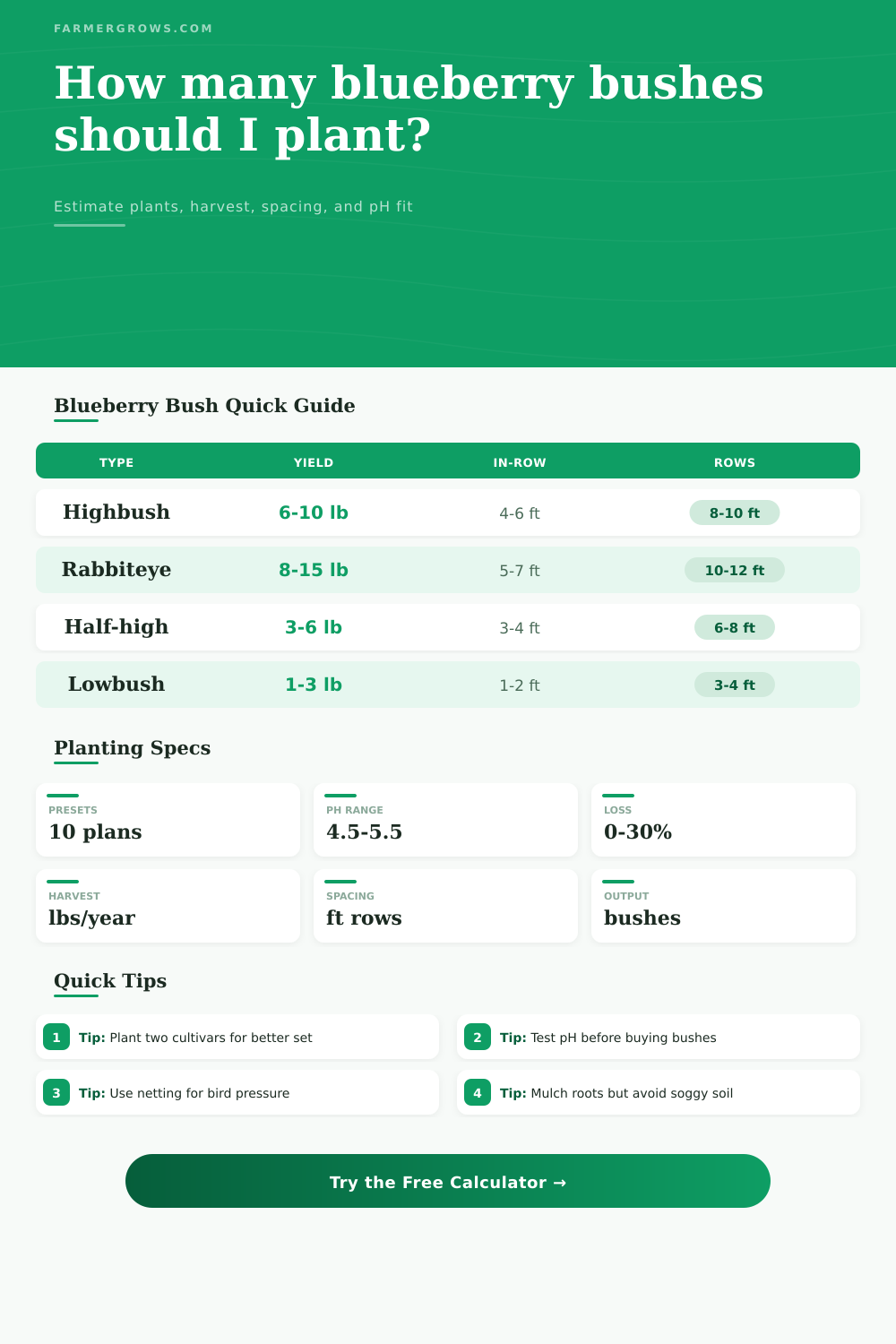
| Northern highbush | 1.5 to 2.5 lb per bush | 3 to 5 lb per bush | 6 to 10 lb per bush |
| Southern highbush | 1.25 to 2.25 lb per bush | 2.5 to 4.5 lb per bush | 5 to 9 lb per bush |
| Rabbiteye | 2 to 3.5 lb per bush | 4 to 7 lb per bush | 8 to 15 lb per bush |
| Half-high | 0.75 to 1.5 lb per bush | 1.5 to 3 lb per bush | 3 to 6 lb per bush |
| Lowbush | 0.25 to 0.75 lb per plant | 0.5 to 1.5 lb per plant | 1 to 3 lb per plant |
| Dwarf container | 0.5 to 1.25 lb per bush | 1 to 2.5 lb per bush | 2 to 5 lb per bush |
| Planting style | In-row spacing | Between-row spacing | Approximate plants per 100 sq ft |
|---|---|---|---|
| Dwarf container grouping | 2.5 to 3 ft | 3 to 4 ft | 8 to 13 bushes |
| Half-high garden row | 3 to 4 ft | 6 to 8 ft | 3 to 6 bushes |
| Highbush home row | 4 to 6 ft | 8 to 10 ft | 2 to 3 bushes |
| Rabbiteye wide row | 5 to 7 ft | 10 to 12 ft | 1 to 2 bushes |
| Lowbush block | 1 to 2 ft | 3 to 4 ft | 13 to 33 plants |
| Factor | Calculator adjustment | Best planning range | What it means |
|---|---|---|---|
| Soil pH 4.5 to 5.5 | 100% yield factor | Ideal | Use the normal mature yield for the selected variety type. |
| Soil pH 5.6 to 6.0 | 85% yield factor | Borderline | Add plants or acidify before planting for stronger long-term crops. |
| Soil pH below 4.2 | 80% yield factor | Too acidic | Growth can slow if acidity is extreme, especially in containers. |
| Single cultivar | 65% to 85% factor | Acceptable, lower set | Some cultivars self-fruit, but mixed bloom usually improves berries. |
| Two or three cultivars | 100% to 108% factor | Preferred | Use compatible cultivars with overlapping bloom and similar chill needs. |
| Example plan | Harvest target | Typical bushes | Spacing note |
|---|---|---|---|
| Small patio containers | 8 to 12 lb | 2 to 4 dwarf bushes | Use two cultivars and large acidic potting mix containers. |
| Fresh eating for two | 20 to 30 lb | 4 to 6 highbush bushes | A single row often fits along a sunny fence or garden edge. |
| Family fresh row | 40 to 60 lb | 6 to 10 highbush bushes | Plan irrigation, mulch, and bird net access before planting. |
| Freezer patch | 80 to 120 lb | 12 to 18 highbush bushes | Multiple rows need wide alleys for picking and pruning. |
| Rabbiteye southern block | 90 to 150 lb | 8 to 14 rabbiteye bushes | Use at least two rabbiteye cultivars for reliable set. |
Start with tested soil, not guesses. Blueberries are unforgiving when pH is high. A soil test lets you size the patch realistically before buying long-lived bushes.
Leave room to pick and net. The calculated plant count only works if row spacing still lets you prune, harvest, irrigate, mulch, and cover berries from birds.
Or maybe you go to the nursery, see a potted blueberry bush that’s attractive, and take it home. You water it…and wait for some fruit. And finally, you get a little crop on there. It tastes great, but you’re a bit disappointed; you’d hoped to have so many berries that you could make a pie from them. Most gardeners struggle with the gap between wanting just a handful of berries and having enough to fill a whole bag for freezing. Why? Because you don’t miscalculate due to poor math skills. You miscalculate because you under-estimate how large a mature shrub will become, not to mention years before it produces anything.
Enter the calculator above: Feed in your site size and what your preferred harvest weight should be, and let it crunch the numbers for you. Avoid the all-too-familiar pitfall of thinking bushes is an annual flower that magically appear overnight, fully formed. Set your yield expectations first.
How to Plan Your Blueberry Garden
A lot of folks think that a bush will bear what it would in year five in year one. No. Blueberries are slow starters. Adjusting for plant age is critical. The tool allow you to do this because a whip (a one-year-old) give you maybe ten percent of what its full output will be when mature.
Plan in terms of how many years you want to eat fresh off your plants (if that’s your plan). For example, if you’re planning on fresh eating for a family of four, think in terms of twenty to thirty pounds per year. Six to ten pounds is about all a single mature highbush plant is likely to produce, so you’ll need at least four or five healthy bush just to reach that baseline. To freeze them to add to smoothies or muffins, of course, you’ll need to multiply by 2 or 3 times what I have listed here. It is better to plan ahead with a definite idea of how much weight you want rather than hope the plants will just fill in nicely into a corner of the yard somewhere.
Healthy berry patches start with healthy soil chemistry. Acidic soil is what blueberries crave: A pH between 4.5 and 5.5. No matter how many bags of fertilizer you feed them, without that acidic environment the plants can’t absorbs iron and manganese. The soil test‘s pH check alerts you to a wrong soil pH. This can’t be corrected by adding mulch on top of the ground. Amend the soil deeply or plant the plants in large containers packed with acid-loving mix. If you don’t do the soil test, you’re essentially purchasing some fancy-looking plants that’ll gradually peter out in a few years. Testing the dirt costs you only a little bit up-front; avoiding doing so would of cost you hundreds of dollars in wasted plants.
Don’t underestimate how important it is to space your bushes. They need to be spaced far enough apart so you can reach in to harvest (good luck with that if they’re not). Also, the closer the bushes are together, the less air circulate around them, which increases the chance of fungal issues. There should be enough walking space between rows for moving a netting system or ladder. The page’s reference table shows exactly how much space each variety requires; rabbiteye bushes require substantially larger spaces then dwarf ones suitable for containers. Squeeze 10 bushes where you would normally plant six and you’ll find yourself with thinner, stretchier plants bearing smaller fruit. Spacing correctly is better than hoping for the best by cramming too many bushes in one area.
Pollination is another factor in yield. Blueberries will self-fruit to some degree, but planting a pair of compatible cultivars (meaning they both bloom at roughly the same time) results in a huge increase in yield. The calculator also include the pollination mix when calculating the yield. Plant just one variety, and you’ll have less. Plant two or three that overlap slightly in their bloom time, and you’ll enjoy bigger berries and better fruit set. Double your efficiency without any extra physical plants. It is a simple strategy.
Finally, plan for loss by leaving some wiggle room. Blueberries are loved nearly as much by birds as they are by people. One bloom week can be lost to frost. Sometimes new plants doesn’t take. Allowing yourself a fifteen or twenty percent cushion of loss means that even when something goes slightly awry, you’ll still make it to goal. It’s not pessimism. It’s called reality in the garden.
Make sure your starting numbers are right; get the soil prepared correctly; and let those plants have some air around them. Patience pays off…the reward is well worth waiting for.