Strawberry Plants Per Person Calculator
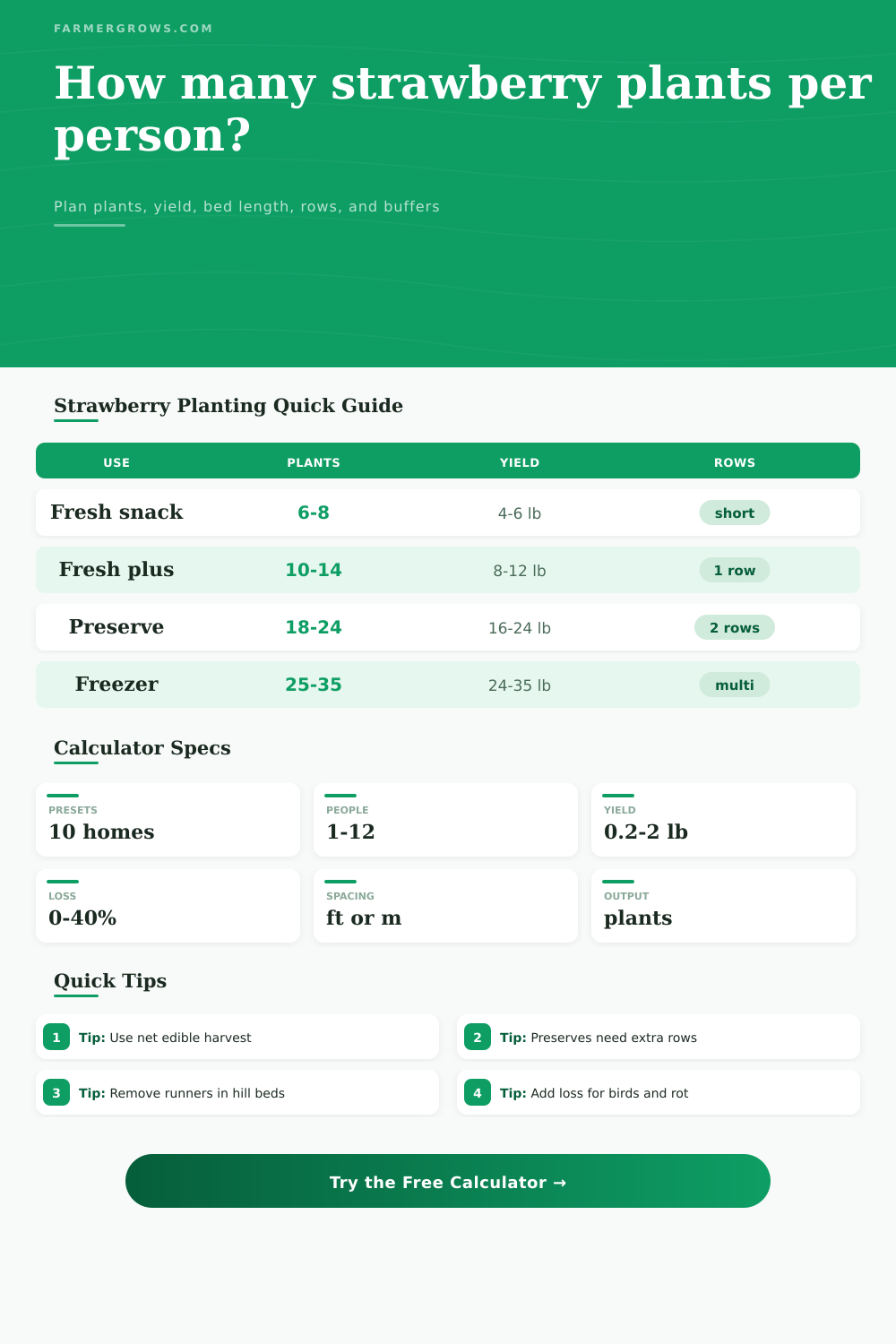
Estimate how many strawberry plants a household needs for fresh eating, freezing, jam, and mixed use, then turn that harvest goal into row feet, bed length, and a planting buffer.
Pick a household pattern, then adjust the harvest goal, expected yield per plant, loss percentage, variety type, runner management, and bed length.
Produces one heavy flush, making it efficient for jam, freezing, and households that want a clear harvest season.
Fruits in smaller waves over a longer season, often with tighter spacing and stronger runner removal.
Usually gives early and late crops with lighter summer production, useful when fresh eating matters most.
Best for snack handfuls and edging beds, but total pounds per plant are lower than garden strawberries.
Your Strawberry Planting Plan
Plant count, harvest, and bed layout will update as you adjust the calculator.
| Preset | People | Use pattern | Typical plants | Planning note |
|---|---|---|---|---|
| Solo fresh snacker | 1 | Fresh snacks | 8 to 10 | Enough for a small bowl every few days in season. |
| Couple breakfast bowls | 2 | Fresh plus desserts | 24 to 32 | A practical raised-bed size with steady picking. |
| Young family fresh patch | 4 | Fresh eating | 45 to 60 | Good for garden snacks without much preserving. |
| Jam weekend household | 3 | Preserve-heavy | 65 to 85 | Plans enough surplus for several jam or sauce days. |
| Freezer berry family | 5 | Fresh and freezer | 90 to 120 | Needs multiple rows or a dedicated strawberry bed. |
| Share with neighbors | 6 | Fresh, freezer, share | 130 to 180 | Best suited to matted rows with renovation space. |
| Plant system | Plant spacing | Row spacing | Runner style | Best fit |
|---|---|---|---|---|
| Matted row garden | 18 to 24 in | 36 to 48 in | Some daughters kept | June-bearing patches, easy renewal, larger gardens. |
| Hill system | 12 to 15 in | 24 to 36 in | Runners removed | High-quality crowns, plasticulture, tidy rows. |
| Raised bed double row | 12 to 18 in | 18 to 24 in | Light thinning | Backyard beds where reach and harvest access matter. |
| Containers or grow bags | 8 to 12 in | 12 to 18 in | Strict removal | Patio harvests, small batches, day-neutral varieties. |
| Annual day-neutral bed | 10 to 14 in | 18 to 30 in | Runners removed | Long picking season with new plants each year. |
| Type | Harvest pattern | Yield planning | Preserve value | Runner note |
|---|---|---|---|---|
| June-bearing | One main crop | Often highest seasonal yield in mature beds | Excellent for jam and freezing | Runners can renew matted rows after harvest. |
| Day-neutral | Repeated flushes | Steady but more dependent on heat and picking | Good for freezer accumulation | Remove runners to keep crowns fruiting. |
| Everbearing | Two to three waves | Moderate harvest over a longer window | Better fresh than bulk jam | Thin lightly to avoid crowding. |
| Alpine | Small ongoing fruit | Low pounds, high snack value | Low for bulk preserving | Often clumps rather than long runners. |
| Goal | Net berries needed | Assumed net yield | Plants before loss | Approximate row length |
|---|---|---|---|---|
| One fresh eater | 6 lb | 0.75 lb/plant | 8 plants | 12 ft at 18 in spacing |
| Two fresh-plus eaters | 18 lb | 0.75 lb/plant | 24 plants | 36 ft at 18 in spacing |
| Family mixed use | 48 lb | 0.80 lb/plant | 60 plants | 75 ft at 15 in spacing |
| Preserve-heavy patch | 90 lb | 0.85 lb/plant | 106 plants | 132 ft at 15 in spacing |
One pound is 0.453592 kg. One foot is 0.3048 m. The calculator rounds plants and rows upward so the plan does not run short.
Base the goal on edible berries. A household that wants 40 lb for eating and freezer bags should enter 40 lb after trimming, soft berries, bird damage, and missed pickings.
Match runner management to the system. Matted June-bearing rows can keep selected daughter plants, while hill and day-neutral beds usually fruit better when runners are removed promptly.
New gardeners are deniers, OF A certain kind. One strawberry plant? That’s going to feed everybody in the family. Birds awake on the first day of June. You discover there was more to that little patch than met the eye. What appeared to be a modest one is actualy a miniature factory that went out of stock.
So start planning your garden: Strawberries are a crop, not mere snacks. And like all crops, there is only so much fruit that one can grows from any patch. Deciding between abundance and a disappointing harvest is simple math before you put a spade in the ground.
How to Plan Your Strawberry Garden
The amount of fruit you will actualy be using (not the size of the plants themselves) is the first thing to nail down. Why? Because this tells you roughly how much room you have to spare, whether you have enough sun and good soil. Do you simply wish to eat them fresh, perhaps as a topping for morning cereal? Six or eight plant per person might do. That’s plenty for enjoying a handful of sweet berries each day. It will ensure you don’t drown yourself in the freezer or overflow the fruit bowl with too much fresh fruit.
Or are you planning to make jam, or sauce, or fill freezer bag full of fruit for eating in the winter? Those figures multiply, double or triple depending on your ambition. Fresh-eating require none of the volume that preserving does.
And this is where the fruit calculator on the page comes in: It does the math for you, turning your desired amount of harvest into real-world plant figures. No guessing how many pounds-per-plant you’ll get, no wondering what a ‘real’ harvest might look like. It forces you to see the reality of it all: In ideal conditions, one plant is unlikely to yield more than a pound or two of actual edible fruit in a season.
The rhythm of your harvest will vary depending on variety choice: A single flush of fruit on some plants (June-bearing) occurs over a few weeks, while other ones (day-neutral) will fruit multiple times over the course of the summer. Great if you want to make jam. June bearers provide plenty of fruit all at once so that you can do it in a pot! And great for fresh eating, if the day-neutral plants keep producing all summer long, you’ll never run out. But they are difficult to use for preserves because you’ll hardly ever have enough ripe berries at one time to even bother boiling up a batch of jam on the stove. Choose the variety that fits your cooking style, not necessarily the one that most impress you in the catalog.
The secret to growing strawberries is managing the runners. Runners, otherwise known as stolons, are the shoots that emerge from the main plant, establishing daughter plants all around. If you’re growing them in a matted row system, you allow those runners to root in. That makes for a higher total yield since there is more ground covered but it creates a denser mat that is harder to manage. If you’re growing in a hill system, you prune off each runner as produced. All the plant’s energy go toward making fruit, not spreading into new territory. So while you get fewer berries, they tend to be bigger and tastier. Because managing runners does affect the amount of ground surface area required, you can account for it in the calculator which will help with determining how many crowns to plant in order to achieve your desired yield.
Then there’s the loss factor: Birds steal some, slugs do, mold gets others, and some just get lost in the leaf litter of any garden. And assuming a perfect crop leads to disappointment. A buffer of fifteen to twenty percent allows for nature’s realities. It is the difference between “just” enough to fill one jar of jam versus “enough” to fill two jars. It is an easy step to skip when you are excited to plant, but it is the most practical adjustment you would of make.
The other thing is how much space there is between them: the tighter they are spaced the more plants per square foot so theoretically the higher yield… But also the more work for you physically. Wider spacing makes them less disease-prone due to less humidity and makes harvesting easier on your body. How wide? Balance what you want against what you can handle. Closer spacing looks nice in photographs, even if it is not as efficient or easy for you. However, you may regret those close-planted rows once the July heat sets in.
Try starting from a sensible place. Adjust according to what you like best. Leave some wiggle room for the birds. And go get the rest of the garden planted, knowing you have the comfort of having the heavy lifting over with. The strawberries will come.