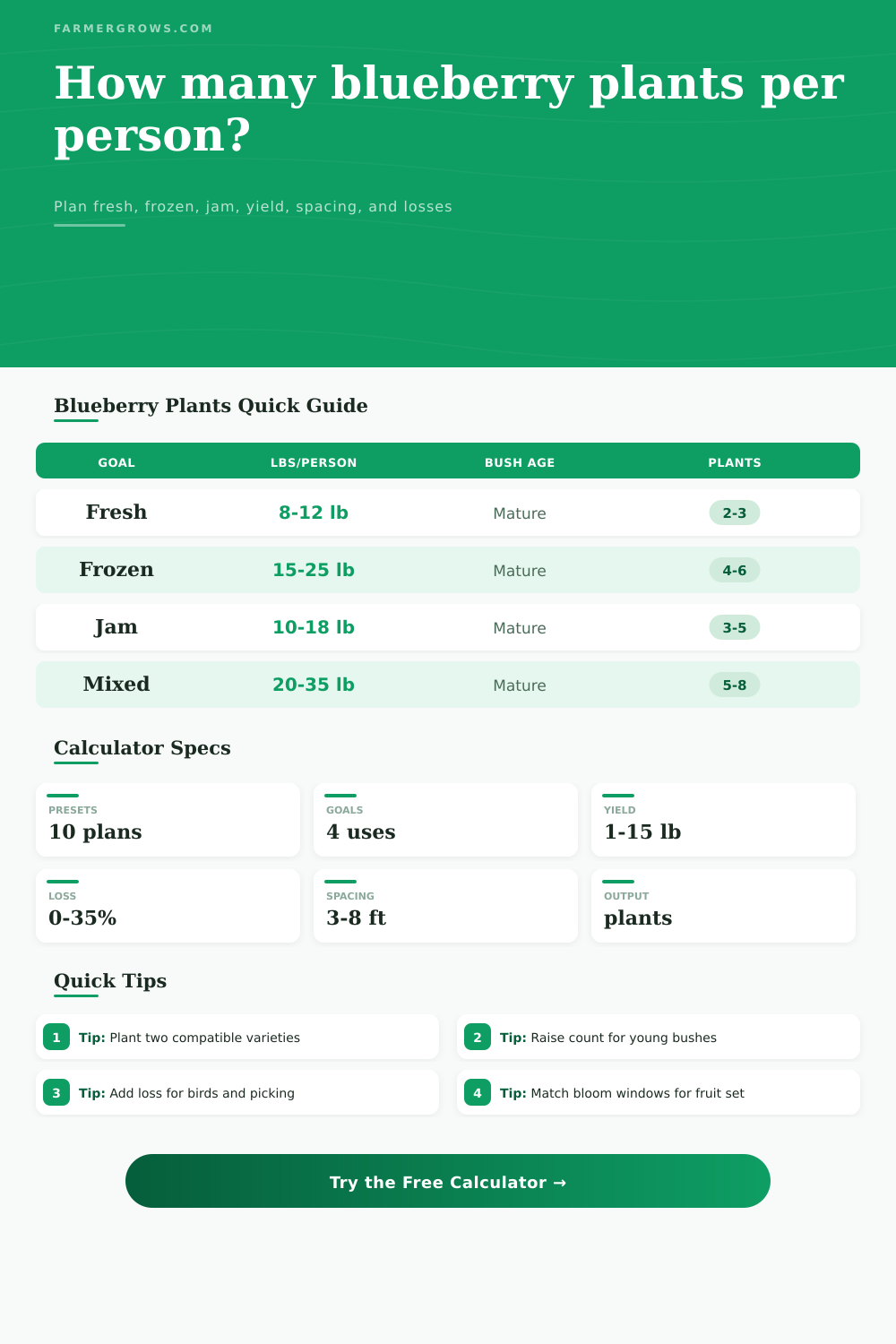
Blueberry Plants Per Person Calculator
Estimate how many blueberry bushes to plant for fresh eating, freezing, jam, or a mixed pantry plan using people, pounds per person, bush age, yield per bush, variety type, pollination, harvest window, loss allowance, and spacing.
Pick a realistic household goal, then fine tune expected yield, harvest losses, pollination partners, and plant spacing for your site.
Best for colder regions with adequate winter chill. Use more than one variety to extend the harvest and improve berry set.
Works in mild winter regions where low-chill cultivars bloom early. Late frost risk can reduce the usable crop.
Often vigorous in warm regions, but cross-pollination is especially important. Plant compatible bloom groups together.
Useful for shorter plants, cold sites, edging, and groundcover-style patches. Expect lower yield per individual plant.
Blueberry Planting Estimate
Your berry plan will appear here after calculation.
| Harvest goal | Planning pounds per person | Typical household use | Notes for plant count |
|---|---|---|---|
| Fresh eating | 6 to 12 lb | Snacking, cereal, salads, and a few desserts | Works well with a short or standard harvest window. |
| Fresh plus freezing | 15 to 25 lb | Fresh bowls plus frozen bags for smoothies or baking | Use an extended harvest window or extra freezer picking days. |
| Jam, syrup, or baking | 10 to 18 lb | Preserve batches, pies, sauces, and baking portions | Choose varieties that ripen in enough volume for batch picking. |
| Mixed pantry plan | 20 to 35 lb | Fresh eating, freezer storage, and several preserve batches | Add a buffer so fresh snacking does not empty the preserving crop. |
| Variety type | Mature yield planning range | Common spacing | Pollination note |
|---|---|---|---|
| Northern highbush | 4 to 10 lb per bush | 4 to 6 ft in row | Self-fruitful, but mixed varieties usually improve berry size and timing. |
| Southern highbush | 3 to 8 lb per bush | 4 to 6 ft in row | Pair bloom-compatible low-chill cultivars for steadier crops. |
| Rabbiteye | 8 to 15 lb per bush | 5 to 8 ft in row | Needs compatible rabbiteye partners for strong fruit set. |
| Half-high or dwarf | 2 to 5 lb per bush | 3 to 4 ft in row | Useful in small gardens, containers, and cold exposed sites. |
| Lowbush | 1 to 3 lb per plant | 1.5 to 3 ft spacing | Plan by patch area because individual plant yield is modest. |
| Bush stage | Yield factor used | Harvest planning window | Planting advice |
|---|---|---|---|
| Planting year | 0% to 10% | Remove most flowers | Plant the full long-term count now, then wait for roots and canes. |
| Young bush, year 2 to 3 | 30% | Light harvest | Do not judge the mature plant count from a young crop alone. |
| Bearing bush, year 4 | 70% | Moderate harvest | Good time to check variety performance and bird pressure. |
| Mature bush, year 5 plus | 100% | Full harvest | Use mature yield per bush for long-term pantry planning. |
| Older bush needing renewal | 75% | Uneven harvest | Renew pruning can restore yield, but keep a temporary buffer. |
| Planting style | In-row spacing | Row or hedge width | Use this when |
|---|---|---|---|
| Container or dwarf patio line | 2.5 to 4 ft | 3 to 5 ft | Small cultivars, pruning access, and pot spacing drive the layout. |
| Highbush garden hedge | 4 to 5 ft | 7 to 9 ft | Good for most home rows with mulch, netting, and walking access. |
| Rabbiteye planting | 5 to 8 ft | 9 to 12 ft | Use wider spacing for vigorous warm-climate bushes. |
| Lowbush patch | 1.5 to 3 ft | 2 to 4 ft | Fits groundcover-style patches where yield is planned by area. |
Footprint estimates use plant count times in-row spacing and row spacing. Leave extra working room for netting, mulch, harvest buckets, and pruning access.
Match bloom windows before counting on full yield. A blueberry row with only one variety may still fruit, but compatible partners usually improve berry set, berry size, and harvest reliability, especially for rabbiteye plantings.
Use the loss percentage honestly. Birds, rain splits, missed pickings, and kitchen trimming can remove a surprising share of the crop. Raising the loss allowance is better than underplanting a pantry patch.
It begins with A BUSH: We all begin this way. It seems like a manageable commitment. And we’re thinking: I’ll wait three years for this plant to get up and going; then I’ll have a quart or two. That’s it, enough for maybe one jar of jam. How little is enough! The math doesn’t work.
To make preserving pay off, you want more than a few plants. You want a lot more, in fact. Counting on good luck won’t help you here. Count plant. This calculator do the math when you set your definition of what your household can stand to eat. No more guesswork, no more diggin around.
How Many Bushes Do You Need?
Which brings us to the first variable: What are you planning to DO with it? If your plan is simply to eat some fresh berries straight from the vine, that’s one thing. It is a low-stakes proposition; a few pound per person will suffice. But if the idea involve freezing, or making jam, the equation becomes different than before. To preserve something, you must have enough to preserve. Two berry don’t yield a jar of jam. The number of plants you choose depend on what you want (whether it’s a snack), a freezer stash, or a mix of both for a pantry supply. That is a big difference in terms of soil, but a tiny difference in terms of words. You will need twice as many bush if you want jars.
The other silent yield-killer is pollination. Unless you’re growing self-fertile blueberries, most will fails to set fruit on their own; they need another nearby compatible bush as a pollinator in order to produce correctly. The calculator asks if you have such partners, which it includes in its calculations. Why? Because planting only one variety mean less efficient pollination, whereas having two compatible types that overlap in bloom time substantially increases yield-per-bush. No magic, but biology. Having neighbors means there is someone to partner up with, and the bees something to do besides just sit around looking cute. Skip that part and you might as well be planting an ornamental shrub that only produces a handful of berry every now and then.
And then there’s the matter of age. The day you add blueberry bush, that bush isn’t producing anything. For the next couple of years at least (three is typical), it’s focused on settling into the earth, not making berries. With this tool you get to choose the age of your blueberries; which dramatically impacts what you can expect right away. If you’re beginning anew, the calculator advises planting some extra now because years one through three will be lean years as the root systems establish themselves. This is a cushion against frustration. You pay for the land and all that work up front, so you won’t go hungry in years two and three.
And then there is the inevitable: Your crop will have losses. A certain part of every outdoor crop are lost to rot or missed pickings, and to birds and rain. Estimate that percentage, usually between ten and twenty percent for a gardener who uses netting well (and put it into the calculator). If you don’t do this, you’ll under-plant. You calculate for a perfect crop but nature rarely provides that. By including a loss allowance, you ensure that whatever ends up on your kitchen table equal what you originally set out to grow. It is enough for the whole winter, not just one pie.
And then there is spacing. Rabbiteye bushes will sprawl more; four to six feet is typical for highbush varieties. That’s plenty of room, but what about space between rows? Once you make that selection, the tool computes the resulting row length. This gives you an exact measure of how much garden space each bush need before you buy one. It is great insurance against the common mistake of cramming too many plants into too small a hole. Doing so can lead to disastrous results like poor air circulation and disease.
All of this comes down to projecting your future self. When you are harvesting in July, that is not the same person who dug a hole today. To please your future self, you should of planted enough bushes so that no store-bought ones are necessary. You might want fresh snacks. You might want them for smoothies. You might even want them to make blueberry muffins. Enter the calculator: It tells you how many. Now go dig.