Fertilizer Per Acre for Tomatoes Calculator
Estimate tomato fertilizer needs by acre, market type, plant stand, yield goal, soil N-P-K credits, fertilizer analysis, drip split, calcium target, pH, and organic matter.
Choose a field pattern, then adjust soil-test credits, fertilizer analysis, pH, organic matter, and fertigation timing to match your tomato block.
Usually carries higher plant population, longer harvest window, and more potassium demand during fruit sizing.
Often uses lower N targets than fresh market so vines finish firm and fruit solids stay strong.
Moves a chosen share of N and K into weekly or staged injections after transplant establishment.
Soil organic matter, compost, and manure credits can reduce purchased product but release timing matters.
Soil-test and manure credits per acre
Main fertilizer analysis
Tomato Fertilizer Plan
Results update from the crop, fertilizer analysis, soil credits, and fertigation settings above.
Field Breakdown
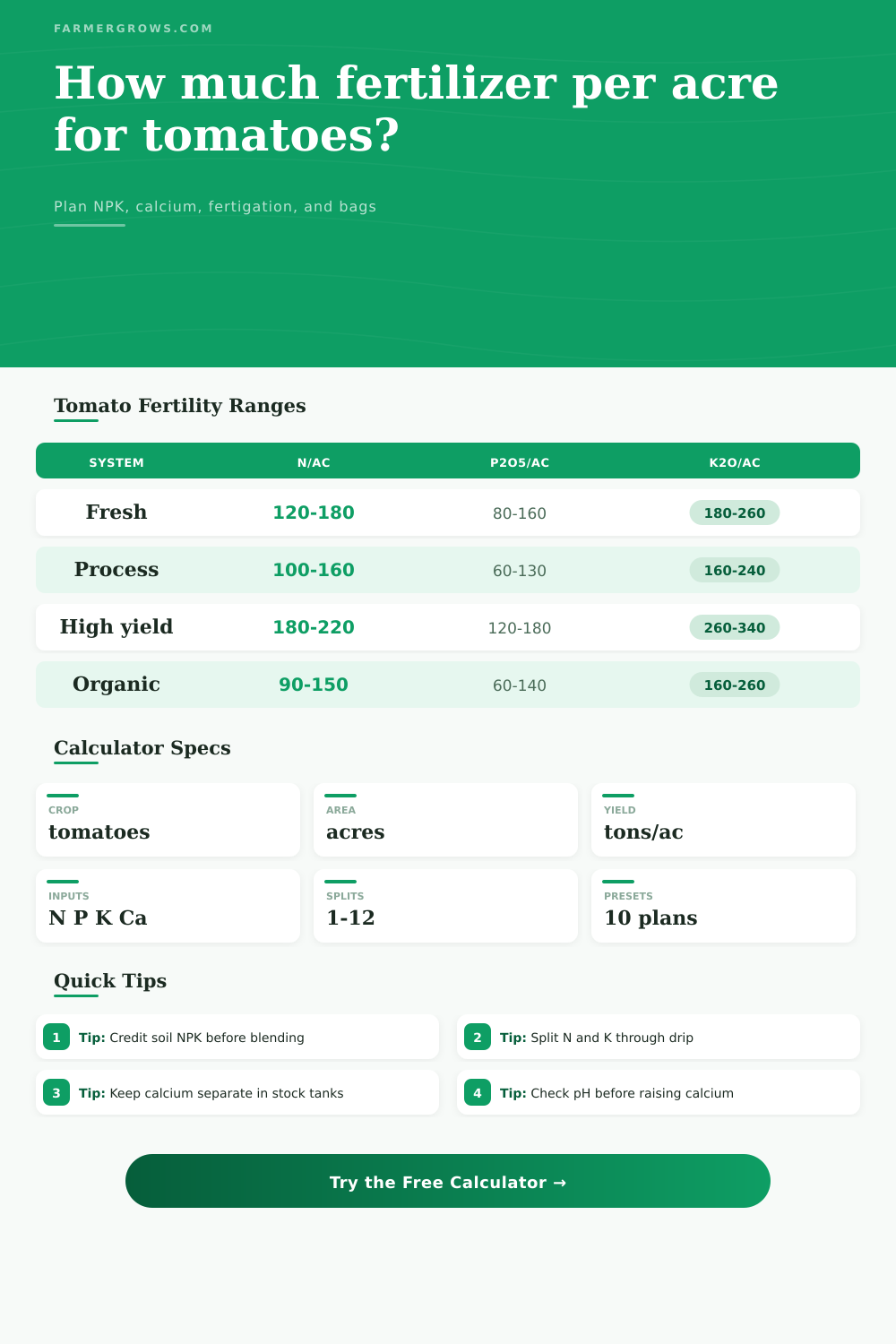
| Tomato system | Typical plants/ac | Yield goal | Season N target | Season K2O target |
|---|---|---|---|---|
| Fresh market staked | 4,000-7,000 | 25-40 tons/ac | 120-180 lb/ac | 180-260 lb/ac |
| Fresh high yield | 6,000-9,000 | 40-60 tons/ac | 170-220 lb/ac | 260-340 lb/ac |
| Processing direct set | 7,000-12,000 | 35-55 tons/ac | 100-160 lb/ac | 160-240 lb/ac |
| Cherry or grape | 7,000-11,000 | 18-32 tons/ac | 140-200 lb/ac | 220-320 lb/ac |
| Fertilizer analysis | Best use | N per 100 lb | P2O5 per 100 lb | K2O per 100 lb |
|---|---|---|---|---|
| 10-10-10 | small balanced acreage | 10 lb | 10 lb | 10 lb |
| 12-12-17 | tomato field blend | 12 lb | 12 lb | 17 lb |
| 4-18-38 | soluble drip blend | 4 lb | 18 lb | 38 lb |
| 15-5-15 | high N and K fertigation | 15 lb | 5 lb | 15 lb |
| 0-0-50 | potassium correction | 0 lb | 0 lb | 50 lb |
| Crop stage | Approx timing | N share | K share | Notes |
|---|---|---|---|---|
| Preplant or transplant | 0-2 weeks | 25-35% | 20-30% | Place starter safely away from roots. |
| Early vegetative | 2-5 weeks | 20-25% | 15-20% | Keep growth steady without excess vine. |
| Flower and fruit set | 5-9 weeks | 25-35% | 30-40% | Priority window for drip-fed N and K. |
| Fruit sizing | 9+ weeks | 15-25% | 25-35% | Avoid late N surges if harvest firmness matters. |
| pH or calcium factor | Low reading | Target band | High reading | Calculator use |
|---|---|---|---|---|
| Soil pH | below 6.0 | 6.2-6.8 | above 7.2 | Flags lime or availability notes. |
| Organic matter | under 2% | 2.5-4.5% | above 5% | Adds a modest N mineralization credit. |
| Calcium need | 0-40 lb/ac | 60-100 lb/ac | 120+ lb/ac | Converts Ca need to material rate. |
| Fertigation share | 0-30% | 45-65% | 75%+ | Splits main product for drip timing. |
Credit first: Enter soil-test, compost, manure, cover crop, and irrigation-water nutrient credits before sizing the fertilizer product. Tomatoes are sensitive to overfeeding, especially late nitrogen.
Split carefully: Keep calcium products compatible with the tank mix, and avoid blending calcium nitrate directly with phosphate or sulfate concentrates unless your fertigation program confirms compatibility.
Your tomato plants look perfectly green right now, but the fruit is starting to turn in at the shoulders. Hmm. Calcium deficiency? But then how to avoid raising the soil pH too much when you add extra lime and thereby locking up other micronutrient?
It’s one of many such garden traps: good intentions meeting messy soil-chemistry. To get everything in balance, you must understand big picture instead of just looking at symptom of mineral-deficient leaves.
How to Feed Tomato Plants Correctly
Now that you know your crop goals (plugging those numbers into the calculator above), it does math for you. You don’t have to guess at conversion factors, or hope that your bag size will match your acres. That tool closes the gap between tractor’s hopper and the soil test report, turning vague nutrient recommendations into pounds of something real: product. All you have to do is get the hang of what they’re measuring first, and then click some buttons.
First define whether you’re growing processing or fresh market tomatoes, since each has differnt physiological requirements. Generally speaking, fresh fruit also requires more of a “potassium push” (to firm up cell walls) at the sizing stage to stay intact during shipment. A processing tomato grows for flavor concentration and solids, meaning it generally get less nitrogen to avoid excess vine growth that will dilute such flavors. This choice causes the tool’s baseline recommendation to change to match the crop; for instance, a large field of paste tomatoes is different than a high-yield row of cherry tomatoes.
Then there’s the question of your soil credits. Is the soil heavy in organic matter? Did you apply compost recently? As it breaks down, it will release some nitrogen through a process called mineralization. Failing to account for that credit is the quickest route to burning up your crop, or washing away those nutrients and sending them down the water table. “The calculator is asking for values of these things because we want to subtract the value of what it gets from the soil,” so you don’t buy more than necessary. That’s where a lot of people go wrong, thinking they must replace everything instead of topping it up where needed.
If you’re irrigating with a drip system, fertigation takes things to the next level. You can split your nitrogen and potassium applications throughout the season rather than all at once when planting, targeting the plant uptake curve: heavy on fruit set, then tapering down near harvest time. The tool allow you to specify what percentage of each nutrient to reserve for splitting throughout the season. The tool lets you set the percentage of nutrients to reserve for these splits, giving you a clear plan for each injection event. As much as anything else, this is about timing.
Let’s look at another one: calcium. This nutrient is immobile in soil. That means it doesn’t move around with water; rather, it requires contact between the roots’ hair-like structure and the calcium source itself to be taken in. There may be plenty of calcium overall, such as in hard water or poor soil pH. However, poor pH can cause a lack of availability. In these cases, you may need extra calcium in the form of a calcium-rich amendment such as calcium nitrate or gypsum. Use the calculator to find out whether this is the case, and how much to add to achieve your target without overdosing.
Calcium nitrate also include some N, which should of been accounted for when considering your total N needs. And then lastly, have a glance through the reference tables on the page. These are there to provide a sense of what’s normal for various systems, a quick check when you compare your calculations with the expected range. Pause if your calculations seem way off the industry norm for your kind of soil. It is easy to over-fertilize if you make small mistakes calculating yield goals or plant populations.
So: Growing great tomatoes boils down to a balance of feeding the plant while honoring the soil it’s in. Give it enough nitrogen to develop structure. Give it some phosphorus to give the roots energy. Provide ample amounts of potassium to ensure good fruit quality. Keep the calcium flowing.
The tool gives you the map, but you’ve got to still read the terrain. Go light on early season nitrogen. Watch your soil test trend. And remember: If you give the roots room to find what they need, they’ll find it. They’ll be healthier for it, too, and your yield will thank you for being patient.