Ryegrass Seed Per Acre For Cattle Calculator
Estimate bulk ryegrass seed for cattle pasture by acres, annual or perennial type, grazing intensity, target live seed rate, seed tag percentages, overseeding condition, placement method, hoof traffic, and nitrogen plan.
Pick a cattle grazing scenario, then tune the acres, seed tag values, and management factors to match your pasture. Presets load real-world starting rates and recalculate immediately.
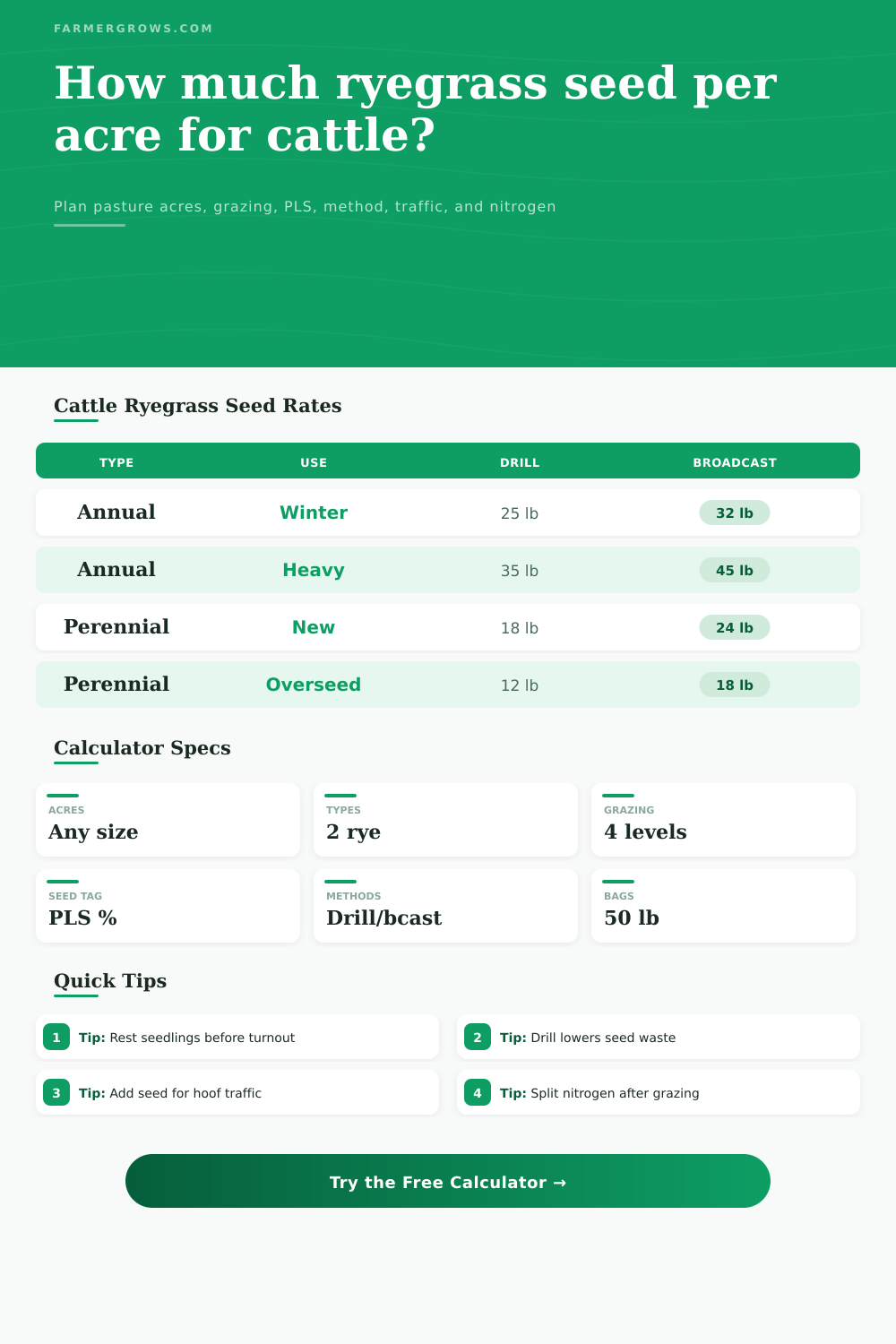
Annual ryegrass is often pushed harder for winter or spring cattle forage, especially when calves or stockers need a dense feed stand.
Perennial ryegrass usually uses a lower seed rate, but establishment needs rest, moisture, and careful first grazing.
Broadcast overseeding into bermuda, bahia, or mixed sod needs extra seed because thatch and hoof traffic reduce soil contact.
Near gates, water, shade, hay rings, and sacrifice areas, use a heavier plan or split paddocks until seedlings anchor.
Cattle Ryegrass Seed Plan
Your PLS-adjusted ryegrass seed plan appears here.
| Ryegrass plan | Typical target | Best fit | Adjustment note |
|---|---|---|---|
| Annual ryegrass drilled for calves | 25 to 35 lb/ac PLS | Winter and spring grazing | Use the upper half for fast canopy and frequent moves. |
| Annual ryegrass broadcast on dormant sod | 32 to 45 lb/ac PLS | Bermuda, bahia, or mixed warm-season base | Broadcast seed needs extra allowance for thatch and lost contact. |
| Perennial ryegrass new pasture | 15 to 25 lb/ac PLS | Cool, moist areas with planned rest | Do not overgraze seedlings before crowns and roots are anchored. |
| Perennial ryegrass pasture repair | 10 to 20 lb/ac PLS | Thin cool-season cattle paddocks | Seed rate rises when the old stand is dense or hoof traffic continues. |
| High traffic sacrifice edge | 40 to 55 lb/ac PLS | Gate, water, hay ring, and lane repairs | Heavy seed cannot fix wet pugging; manage traffic after emergence. |
| Factor | Low pressure | Moderate pressure | High pressure |
|---|---|---|---|
| Seeding method | Drill: 1.00x | Broadcast plus harrow: 1.12x | Broadcast only or aerial: 1.20x to 1.28x |
| Overseed pasture | Clean or prepared: 1.00x | Thin sod or mixed pasture: 1.06x to 1.12x | Rough residue: 1.18x |
| Cattle traffic | Rested: 1.00x | Short managed passes: 1.05x | Normal to high traffic: 1.12x to 1.22x |
| Nitrogen plan | Split after emergence: 1.00x | Starter or delayed: 1.03x to 1.05x | Low nitrogen: 1.10x risk allowance |
| Bulk rate | 5 acres | 20 acres | 50 acres |
|---|---|---|---|
| 20 lb/ac bulk seed | 100 lb, 2 bags | 400 lb, 8 bags | 1,000 lb, 20 bags |
| 30 lb/ac bulk seed | 150 lb, 3 bags | 600 lb, 12 bags | 1,500 lb, 30 bags |
| 40 lb/ac bulk seed | 200 lb, 4 bags | 800 lb, 16 bags | 2,000 lb, 40 bags |
| 50 lb/ac bulk seed | 250 lb, 5 bags | 1,000 lb, 20 bags | 2,500 lb, 50 bags |
| Management goal | First grazing cue | Residual target | Seed rate effect |
|---|---|---|---|
| Light rotational grazing | Plants anchored and 6 to 8 inches tall | Leave 3 to 4 inches | Can stay near base target when cattle are moved often. |
| Moderate cattle rotation | Firm soil, dense tillers, no pulling by hand | Leave 3 inches or more | Use a modest risk bump for missed rest windows. |
| Continuous grazing | Delay turnout longer than rotational paddocks | Avoid scalping below 3 inches | Seed heavier and expect less uniform establishment. |
| High traffic repair | Keep cattle off during wet emergence periods | Protect crowns and soil surface | Higher seed helps only when traffic is controlled. |
PLS check: A high target rate can still underseed if purity and germination are weak. Use the seed tag from the lot you will actually plant.
Grazing check: Plan cattle movement before planting. Seedlings need rest after emergence, especially around gates, water points, hay rings, and wet paddock entrances.
Forage crops like ryegrass grow fast and taste good. Plant it wrong or turn cattle out too soon, and it will die fast. Patience and seed weight is the difference between a lush pasture and a bare patch.
While most farmers know they need to plant grass, few calculate the number of actualy seeds that hit the dirt (aka: “pure live seeds“). Many seed are eaten by birds or get stuck in the thatch. There’s a specific calculation to help with that. Based off field conditions and seed tag quality, you can determine exact amount of bulk weight needed. Once you define your seed purity, acres, and grazing pressure, the tool runs math. That way you won’t spend too much money on broadcast jobs that don’t pay off and you won’t under-seed any thin areas.
How to Plant Ryegrass for Good Pastures
Don’t ignore the seed tag. “Forty pounds” in the bag could mean a lot less then what you think. Eighty percent purity means that only twenty-eight point eight pounds is alive. Even then, they must still have viability. Enter those numbers into calculator. It will adjust the bulk rate upward so that whatever you plant hits desired density. Planting by gross weight, not pure live seed, lead to weak stands. And a weak stand can’t withstand cattle traffic.
How much seed you need depends on grazing intensity. For example, if you use annual ryegrass for a winter-calving setup, you will want a dense stand to resist heavy hoof traffic, so you need more seeds. On the other hand, perennial ryegrass planted for longer-term rotation would requires fewer seeds, as lasting a long time is the aim here. And the calculator takes all this into account. Ditto whether or not you’re planting: Seed broadcast onto dormant bermuda sod will fight gravity, thatch, and irregular soil contact, so it require more seed than drill-seeded (where seed comes in good contact with soil). To make up for loss, the system tacks on a broadcast method‘s multiplier.
New pastures take a beating from traffic. Hay rings, water troughs, and gates become magnets where cattle gather. Hooves pound the areas before the seedlings has a chance to anchor in. If your intention is to immediately move cattle over freshly planted pastures, then a higher seed rate will be needed. That’s why the calculator have a traffic factor. In reality, we don’t live in a world of perfect control. Even with a perfect seedbed, a wet spring can transform a pasture into a mud pit. A little extra buffer added to your seed order takes care of that.
Know when to graze that first bite. Don’t let the cows clip the new ryegrass before its root system has had time to develop. Clip too soon and the roots perish. Wait an additional couple of weeks so you would of not have to reseed next year.
The typical rates are found in reference tables. What happens where you live depends on your weather and soil. Take those figures as a guide. Adjust them based off what you see in the field. Replanting a dead stand costs money and time. Spending a few more pennies per acre on seed is nothing compared to lost income. With careful planning, the grass matures by the time the cows are hungry. That makes for a sure thing instead of just hope.