Sunn Hemp Seed Per Acre Calculator
Estimate sunn hemp seed needed for warm-season cover crop, forage, biomass, or nematode-suppression plantings using acres, seed size, target rate, germination, method, row spacing, inoculation, termination timing, and planting window.
Pick a practical sunn hemp scenario, then fine-tune the acreage, seed tag, warm-season window, inoculation choice, planting method, and target pounds per acre.
Moderate rates build quick canopy, summer biomass, nitrogen, and soil cover when planted after frost danger into warm soil.
Heavier stands close rows faster for leafy forage. Manage cutting or grazing before stems become coarse and woody.
Dense, clean stands are commonly chosen before susceptible vegetables where warm days allow enough growth before termination.
High seeding rates and long warm windows favor taller biomass for chopped residue, mulch, and organic matter return.
Sunn Hemp Seed Plan
Seed estimate updates as inputs change.
Use these tables as planning references beside the calculator. Local extension recommendations, seed tags, and variety notes should override generic ranges.
| Use | Drilled target | Broadcast target | Best fit |
|---|---|---|---|
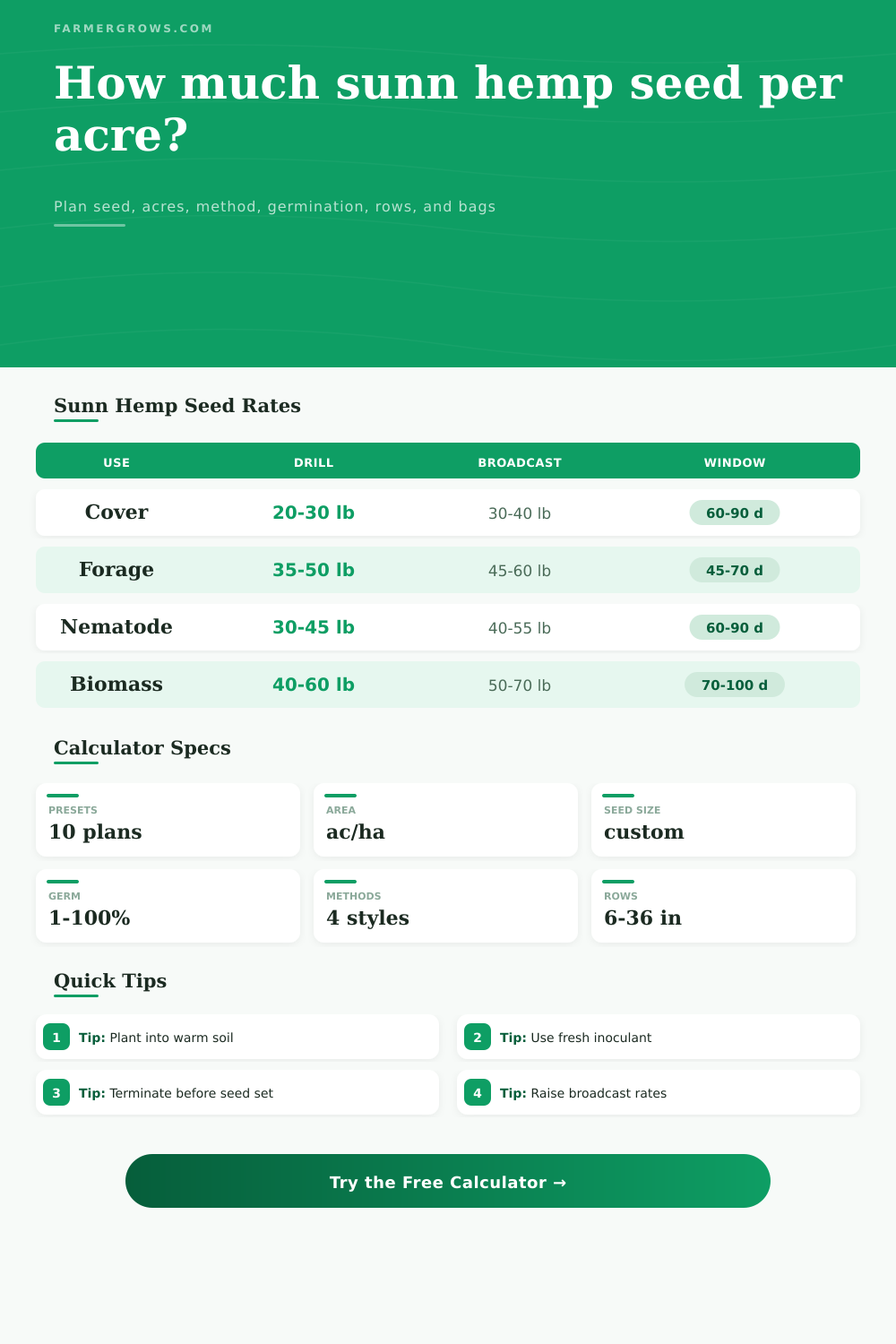
| Cover crop nitrogen and soil cover | 20-30 lb/ac | 30-40 lb/ac | Summer cover before fall crops or winter cover mix |
| Forage or grazing support | 35-50 lb/ac | 45-60 lb/ac | Warm, fast growth where management keeps stems tender |
| Nematode suppression block | 30-45 lb/ac | 40-55 lb/ac | Vegetable rotations with 60 or more frost-free warm days |
| High biomass or mulch | 40-60 lb/ac | 50-70 lb/ac | Long warm window for heavy residue and organic matter |
| Method | Multiplier | Seedbed condition | Calculator use |
|---|---|---|---|
| Drilled or no-till drilled | 1.00 x | Accurate depth and better seed contact | Use target rate as entered |
| Broadcast and cultipacked | 1.18 x | Good packing but less even placement | Add moderate placement allowance |
| Broadcast rough seedbed | 1.32 x | Residue, clods, or uneven coverage | Add heavier placement allowance |
| Aerial or standing residue | 1.45 x | Least seed-to-soil contact | Use only with rainfall and good timing |
| Row spacing | Row ft per acre | At 30 lb/ac, 16k seeds/lb | At 45 lb/ac, 16k seeds/lb |
|---|---|---|---|
| 7.5 inches | 69,696 ft | 6.9 seeds/row ft | 10.3 seeds/row ft |
| 10 inches | 52,272 ft | 9.2 seeds/row ft | 13.8 seeds/row ft |
| 15 inches | 34,848 ft | 13.8 seeds/row ft | 20.7 seeds/row ft |
| 30 inches | 17,424 ft | 27.5 seeds/row ft | 41.3 seeds/row ft |
| Management item | Preferred range | Why it matters | Calculator effect |
|---|---|---|---|
| Germination | 80-95% | Low germination needs more bulk seed to hit live stand | Corrects target rate upward |
| Seed size | 12k-20k seeds/lb | Changes expected plants and seeds per row foot | Changes seed density cards |
| Inoculation | Fresh cowpea group | Supports nodulation and nitrogen fixation potential | Adds management warning |
| Termination | Before seed set | Balances residue quality, regrowth, and crop rotation timing | Adds timing note |
Warm-season check: Plant sunn hemp after frost risk when soils are warm enough for fast emergence. Short, cool windows can lower biomass even when the seed math is correct.
Seed tag check: Recalculate with the actual germination, seed count, and bag weight on the lot you will plant. Small tag changes matter across many acres.
This calculator estimates seed quantity for planning. Follow local extension guidance, pesticide labels, livestock restrictions, and crop rotation rules for your area.
The thing is, sunn hemp (or any other seed) is a commodity: one bag may be full of tiny lightweight seeds, while another are dense and heavy. Planting by the pound, unless you’re first counting out the seed, can mean either gaps in your canopy; or a stand so thick as to be an infestation of its own.
The calculator above do the math for you after you enter all your seed tag info. This way, you don’t have to guess if that twenty-pound bag of seed will hold up to competition.
Why You Should Use the Seed Calculator
First: Seed size matter. A bag of heavy seeds has fewer seeds per pound than a lighter bag, even if they both weigh the same. And sunn hemp seeds also has a wide range of masses. That affects how many seeds there will be per square foot of ground after germination. This is what the tool adjusts for: Enter in the seeds/lb figure from the seed packet tag, and it all gets adjusted based off that. This is what adjusts your actual number of live seeds per square-foot.
You are flying blind using any generic “pound per acre” rate. You get the correct weight, but not the proper plant population.
Germination is the other silent killer of a stand count. Most seed tags report a germination rate in the mid-eighties. Meaning if your seed was only 80 percent viable, then how many bulk seeds do you have to add to reach your desired live stand? The calculator does that for you automatically, and it increase the bulk weight accordingly so you end up with number of plants you intended to plan for.
That’s what most people don’t realize. They buy by the weight, not by the life within the seed.
The way you plant also makes a difference. Drilling provides good seed-to-soil contact and precise placement. Broadcasting creates messy, no-good contact and leaves some seeds lost to birds, wind, or other factors. If you are using broadcast methods, the tool multiplies the target rate by the number you chose, and then includes a buffer for those inevitable losses. It’s practical advice embedded in the math; you don’t have to guess what extra amount to buy.
The system accounts for the mess that is field condition. Before you type some numbers into the tool, think of what you are trying to achieve: suppress nematodes? That’s usually done with a denser stand different than a simple cover crop. Common range goals is built into the tool presets. A clean, thick stand is effective at blocking nematodes; that’s different from a simple green manure cover, which can be a little lighter. You’ll see the difference with this tool, and how much extra seed a forage plot needs versus a nitrogen-building cover. It is a small distinction, but it is a big matter for your bottom line.
Remember the inoculant. Sunn hemp is a legume and therefore will fix nitrogen, but not without the proper bacteria. Your soil must have been home to cowpeas (or other legumes) within recent memory; otherwise, inoculate the seed. And use fresh inoculant. That’s why the tool reminds you to do the inoculating step, which isn’t just seed-counting time. It’s setting up the plant with biological support for growing. No nodules means no fix, just a nitrogen-eating weed.
The last limit is time. Sunn hemp requires warmth; it won’t come up in cool soils. And with a limited window, you want to get your stand going fast. The tool takes into account when you hope to plant, and alerts you if your situation is dicey. It’s an advance warning system for the planning stage. The right seed rate calculation matters little if you sow prematurely.
So take away the guessing. Plug in your actual seed tag information, select how you want to plant, plug in your goal. Click “order.” Now go forth and plant with confidence. Knowing what you’re putting in the ground is more valuable than spending just a couple of minutes on this handy dandy tool. It’s turning a wild mess into something organized. It’s a plan. In farming, a plan should of been better than the weather.