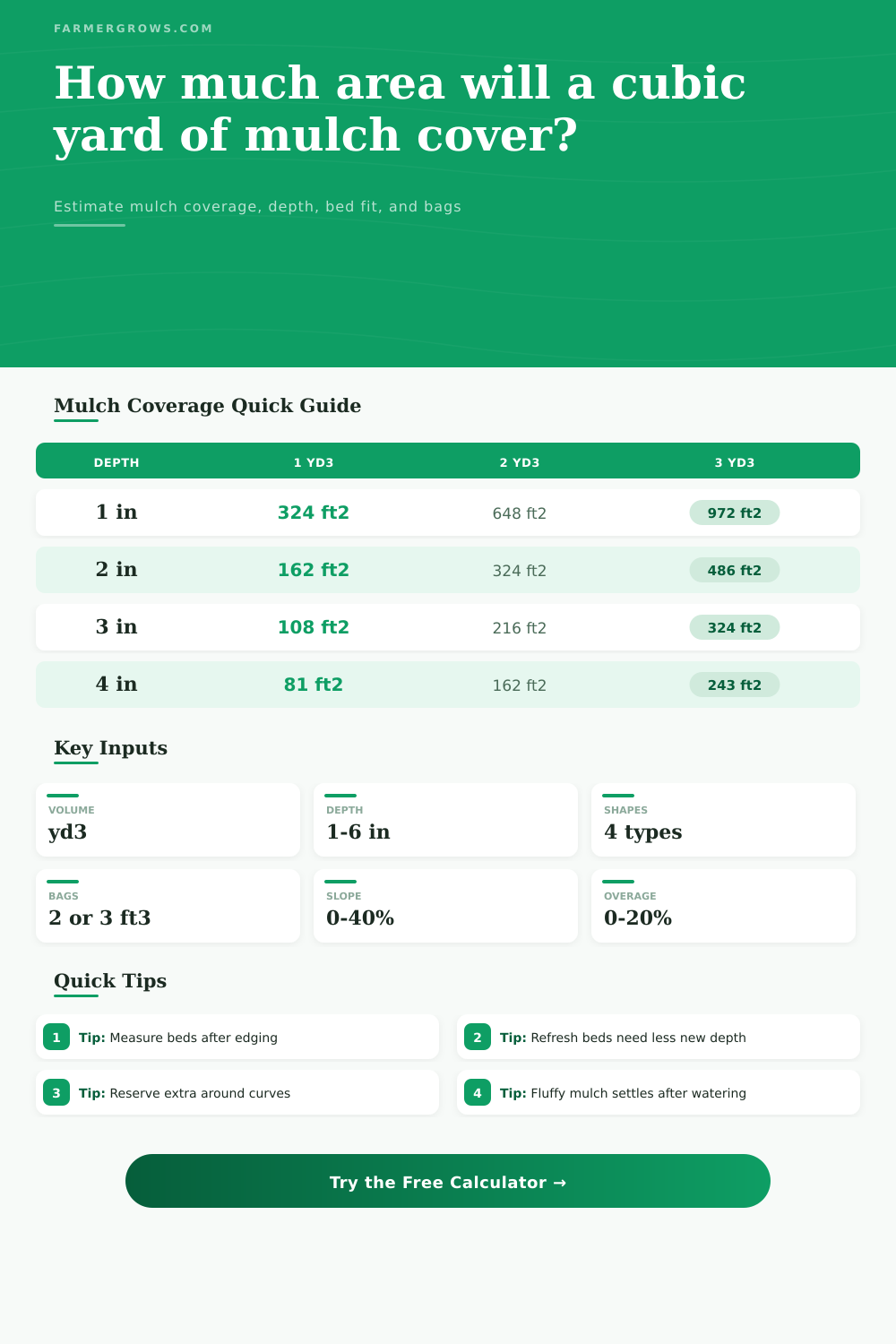
Cubic Yard of Mulch Coverage Calculator
Estimate how much bed area your cubic yards of mulch can cover after depth, shape, slope, settlement, overage, edge loss, and existing mulch credit are included.
Choose a common yard project, then adjust the cubic yards, target depth, mulch type, existing layer, and shape dimensions for your beds.
Mulch Coverage Results
Enter your cubic yards and bed details to estimate coverage.
These cards show clean, level coverage before overage, edge loss, slope, settlement, or existing mulch credit. One cubic yard equals 27 cubic feet.
| Finished depth | Coverage per yd³ | Metric coverage | Best use |
|---|---|---|---|
| 1 inch | 324 sq ft | 30.1 m² | Light refresh where old mulch is still present. |
| 2 inches | 162 sq ft | 15.1 m² | Annual refresh for neat ornamental beds. |
| 3 inches | 108 sq ft | 10.0 m² | Common depth for weed suppression and moisture moderation. |
| 4 inches | 81 sq ft | 7.5 m² | New shrub beds, paths, and spots that dry quickly. |
| 6 inches | 54 sq ft | 5.0 m² | Playground surfaces or deep walking paths. |
| Mulch amount | Volume | Bags per cubic yard | Coverage at 3 in |
|---|---|---|---|
| One 2 ft³ bag | 0.074 yd³ | 13.5 bags | 8 sq ft before losses. |
| One 3 ft³ bag | 0.111 yd³ | 9 bags | 12 sq ft before losses. |
| One cubic yard | 27 ft³ | 13.5 two-ft bags | 108 sq ft before losses. |
| Three cubic yards | 81 ft³ | 40.5 two-ft bags | 324 sq ft before losses. |
| Project | Area | Cubic yards at 3 in | 2 ft³ bags |
|---|---|---|---|
| Tree ring, 6 ft diameter | 28 sq ft | 0.26 yd³ | 4 bags before buffer. |
| Small bed, 10 by 20 ft | 200 sq ft | 1.85 yd³ | 25 bags before buffer. |
| Playground, 15 by 15 ft | 225 sq ft | 2.08 yd³ | 29 bags before buffer. |
| Large yard zone, 50 by 50 ft | 2500 sq ft | 23.15 yd³ | 313 bags before buffer. |
| Adjustment | Typical range | Calculator effect | Planning note |
|---|---|---|---|
| Settlement | 5% to 20% | Reduces finished coverage from fluffy delivered volume. | Coarse bark settles less than shredded or compost-rich mulch. |
| Overage buffer | 5% to 15% | Reserves extra material instead of counting every cubic foot. | Useful when bed edges are irregular or depths vary by hand. |
| Edge loss | 3% to 10% | Accounts for feathered edges, plant collars, and thin spots. | Increase for island beds, tree rings, and curved borders. |
| Slope grade | 0% to 40% | Increases true surface area over a flat map area. | Steep beds also lose mulch faster after rain or irrigation. |
Use finished depth, not fluffy depth. Mulch often looks deeper right after spreading, so include settlement when you want the bed to hold its target depth after watering.
Credit only useful existing mulch. Pull back matted, soil-filled, or washed-out mulch before measuring the remaining layer, because poor material will not perform like fresh coverage.
The truck arrives loaded up with a giant pile in your driveway, you ordered three cubic yards of mulch. Now there’s the pile, and then there are your flower beds. You stare at it all and wonder if you underestimated amount of space. That’s the problem with area versus volume. Mulch isn’t measured in square feet, it’s measured by depth. It’s one thing to figure out how big a cubic yard pile will be; now you need to turn that three-dimensional mass into two-dimensional layer. This is where people goes wrong: they estimate, taking a tape measure to their beds and guessing the balance. Often, what they get is either way too thin for root growth or way too thick.
The calculator above handle the complex conversions so you don’t have to memorize that one cubic yard equals 27 cubic feet. One cubic foot is 1/27th of a cubic yard. So you should of not remember this or anything like it. It adjusts your raw volume for your landscape. Landscapes aren’t rectangular boxes on level ground; they’re curved and sloped and those curvatures wastes some material around the edge, while slopes add more surface area. There may already be something in place that can still be used. The tool takes all of this into account. You put in the percentage of slope and how much each layer settles. Why? Because wood chips settle after rain. Plan for the settled depth or within a week the beds just look skimpy. Planning for settled depth give you a pro job. The settled depth is typically ten to twelve percent less different than initial volume.
How to Use the Mulch Calculator
Depth: Homeowners get carried away here. No, you don’t have to smother weeds with four inches of mulch. How deep? The industry standard are three inches. Enough to block out the light and keep weed seeds from getting the sunlight they crave. It must be deep enough to let air down into ground but not so deep as to form a water-repelling barrier. A barrier like this lets water bead up and run off rather than soaking in. That’s as true with pine straw or shredded hardwood mulches. If applied too thick, theyll mat and prevent water penetration.
At three inches (which will cover 108 square feet with one cubic yard), it’s a helpful figure to know when comparing bags versus bulk delivery. Bags are easy if there is just small areas to patch; beyond that, the time spent hoisting them may negate any price break. This is true except when there’s a change in slope. The more inclined your bed is, the more surface it have. That means you will need more mulch for a given bed size. Without accounting for that slope, the mulch will be gone after next storm. So will the plants. Mulch runoff stains your driveway. But all you need to do now is enter a percentage for slope into the calculator.
It also includes a buffer for overage to protect against any mistakes you might make when measuring. No one can measure the length around a curving border exactly right. By adding an additional 10-15 percent to their order, they don’t run short of mulch and leave an unsightly swatch of naked ground.
Another factor is weight. Is it heavy, such as stone gravel, or light, like pine straw? One cubic yard of stone mulch will weigh about two and a half thousand pounds. That’s not something you want to drag across your lawn by hand. On the other end of the spectrum are the lighter-weight organic mulches (such as hardwood or cedar). Those, too, must be planned for. The weight figures will tells you whether a truckload or wheelbarrow is in order. It is best to find this out beforehand, rather than when the load shows up on your driveway.
Edge your beds, then measure them. Use that tool to figure out how much stuff you need. Why waste your time, or money? It’s less stressful to have everything planned out in advance. Then when that truck pulls up with your load, you can see what goes where and why it fits. No more guesswork. No more driving back and forth. Even better: a nice even layer of something to keep your garden looking good for months.