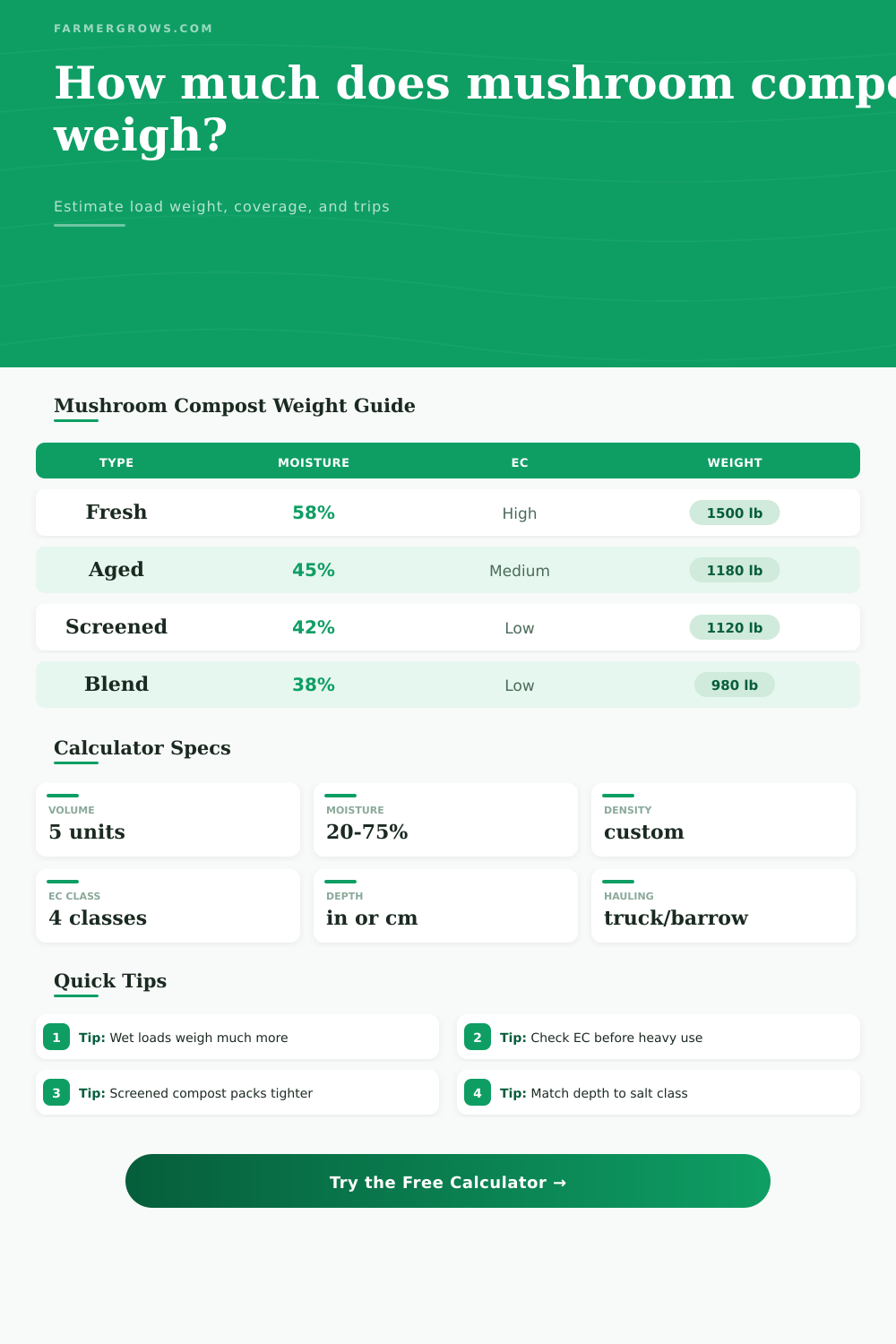
Mushroom Compost Weight Calculator
Estimate spent mushroom compost weight from volume, unit, moisture, maturity, screening, bulk density, salt or EC class, amendment depth, area, and truck or wheelbarrow capacity.
Choose a realistic mushroom compost starting point, then tune moisture, density, area, amendment depth, and hauling capacity to match the load you are actually moving.
Mushroom Compost Weight Results
Adjust the inputs to estimate a realistic delivered weight and hauling plan.
Usually wet, fibrous, and higher in soluble salts. Best blended or weathered before heavy planting use.
More stable and easier to spread. Weight sits near the middle unless rainfall has soaked the pile.
Fewer large straw pieces means less air space, smoother spreading, and slightly higher packed density.
Mixed with bark, leaf mold, or topsoil substitutes, it may cover more area per pound and lower EC risk.
| Preset type | Typical moisture | Reference density | Best use |
|---|---|---|---|
| Fresh house cleanout | 55% to 65% | 1,350 to 1,650 lb/yd³ | Blend, weather, or apply shallowly where EC is acceptable. |
| Aged windrow compost | 42% to 55% | 1,100 to 1,350 lb/yd³ | Garden beds, established perennials, and general soil building. |
| Fine screened grade | 35% to 48% | 1,000 to 1,250 lb/yd³ | Topdressing, raised beds, lawns, and even thin spreading. |
| Dry blended compost | 25% to 38% | 800 to 1,050 lb/yd³ | Bagged mixes, light trailer loads, and hand spreading. |
| Amendment depth | Coverage per yd³ | Metric depth | Coverage per m³ |
|---|---|---|---|
| 0.5 in | 648 sq ft | 1.3 cm | 79.8 m² |
| 1 in | 324 sq ft | 2.5 cm | 39.9 m² |
| 2 in | 162 sq ft | 5.1 cm | 20.0 m² |
| 3 in | 108 sq ft | 7.6 cm | 13.3 m² |
| 4 in | 81 sq ft | 10.2 cm | 10.0 m² |
| Hauling container | Typical volume | Weight limit check | Notes |
|---|---|---|---|
| Pickup bed | 1.5 to 3 yd³ | Payload rating | Wet mushroom compost often reaches weight limit before the bed is full. |
| Utility trailer | 2 to 6 yd³ | GVWR minus trailer | Spread the load evenly and include tongue weight in planning. |
| Wheelbarrow | 4 to 6 ft³ | 150 to 300 lb | Moist screened compost may need smaller practical barrow loads. |
| Loader bucket | 0.3 to 1 yd³ | Rated operating load | Use the bucket struck capacity for repeatable trip estimates. |
| EC class | Estimated EC | Depth guidance | Planting caution |
|---|---|---|---|
| Low | Under 2 mmhos/cm | 1 to 3 in | Usually suitable for broader garden use after normal mixing. |
| Medium | 2 to 4 mmhos/cm | 0.5 to 2 in | Mix into soil and avoid direct seed contact when possible. |
| High | 4 to 8 mmhos/cm | 0.25 to 1 in | Use shallowly, blend well, and irrigate before sensitive crops. |
| Very high | Over 8 mmhos/cm | Blend only | Weather, leach, or dilute before using near seedlings. |
Moisture check: If a handful drips water or clumps heavily, expect the hauled weight to be closer to the wet end of the calculator range.
EC check: Mushroom compost can carry soluble salts, so use a thinner topdress or blend with soil when the EC class is high.
Mushroom compost is the stuff you buy that seems so light and fluffy, the way forest soil would be, but it’s heavy. It feels lighter in your hands then topsoil does; your back aches as you lift a bag, push a full wheelbarrow. When wet, mushroom compost will gets real dense. What seems fluff becomes a boulder.
Weight estimates is more important than volume estimates. Volume only tells how much space something takes up, but weight tell whether your truck can haul it. With those three pieces of information (density, moisture and volume), the calculator above does the rest.
Why Mushroom Compost Is Heavy
Remember: Heavy compost mean wet compost. Damp, fibrous fresh cleanout from a growing house may well be closer to sixteen hundred pounds per cubic yard; aged, screened garden grade compost is dry, so that much compost will only weigh about nine hundred pounds. To compensate for that, tool allows you to adjust both its maturity and moisture level. Those adjustments comes into play when you’re figuring out how many hauling trips to take.
A key thing about soil amendments is that they tend to retain moisture (water weighs something!) and compost in particular has the ability of a sponge. Entering a moisture percentage tells the tool how wet the compost will be on the pile. New fresh mushroom compost can has more than half its weight as moisture; old compost may only have less than 40% moisture. This adjusts total weight, which is what the calculator figures into the answer.
If you are loading up on a wet day after a storm, add to the moisture figure. If you have bought dry, bagged blend, subtract from the moisture figure. You don’t want to assume a load’s dry and end up with more than you can carry on your utility trailer! That greatly change how many trips you take.
The other point of note about mushroom compost: It tends to have lots of soluble salts (electrical conductivity, or EC) which doesn’t weigh anything but changes its nature as far as use goes. Rather than change that reality, the tool flags such compost with an EC class selector so you know there’s some risk involved. Too-thick a layer of high-EC compost might burn your seedlings. Low EC lets you apply deeper; very high EC require a shallow layer (the reference table on the page explains). This is a safety check built into the planning stage, and it is better to know the salt content beforehand than after committing to a three-inch topdress.
Density has another aspect: Screening. Coarse, unscreened compost will not pack as tightly as fine, screened material. This makes a difference when it comes to weight (air pockets matter). Expect a bag of screen compost sold at garden center to be heavier than an equal volume of the fluffy, fibrous product made from a windrow. A screening multiplier accounts for that on the calculator. It’s a slight variable but avoids underestimating the weight of the load.
The last reality check: All vehicles has two limits: a volume limit and a weight limit. Each one is checked by the tool, and whichever binds first determines the trip count. For example, with wet compost, the weight usually bounds well before the volume. So you will be carrying only half a bed’s worth of material before hitting your vehicle’s payload rating. That’s where folks make their mistake: assuming an empty bed is an empty load. The calculator returns to you the number of trips that meets both constraints.
It’s heavy; IT’S WET; it’s got to be moved. That’s not the compost, but the water in it. Think of weight; be sure to check the moisture level first, and watch out for the salt content. Treat that rich, dark stuff gently, and thank yourself (and your back) later.