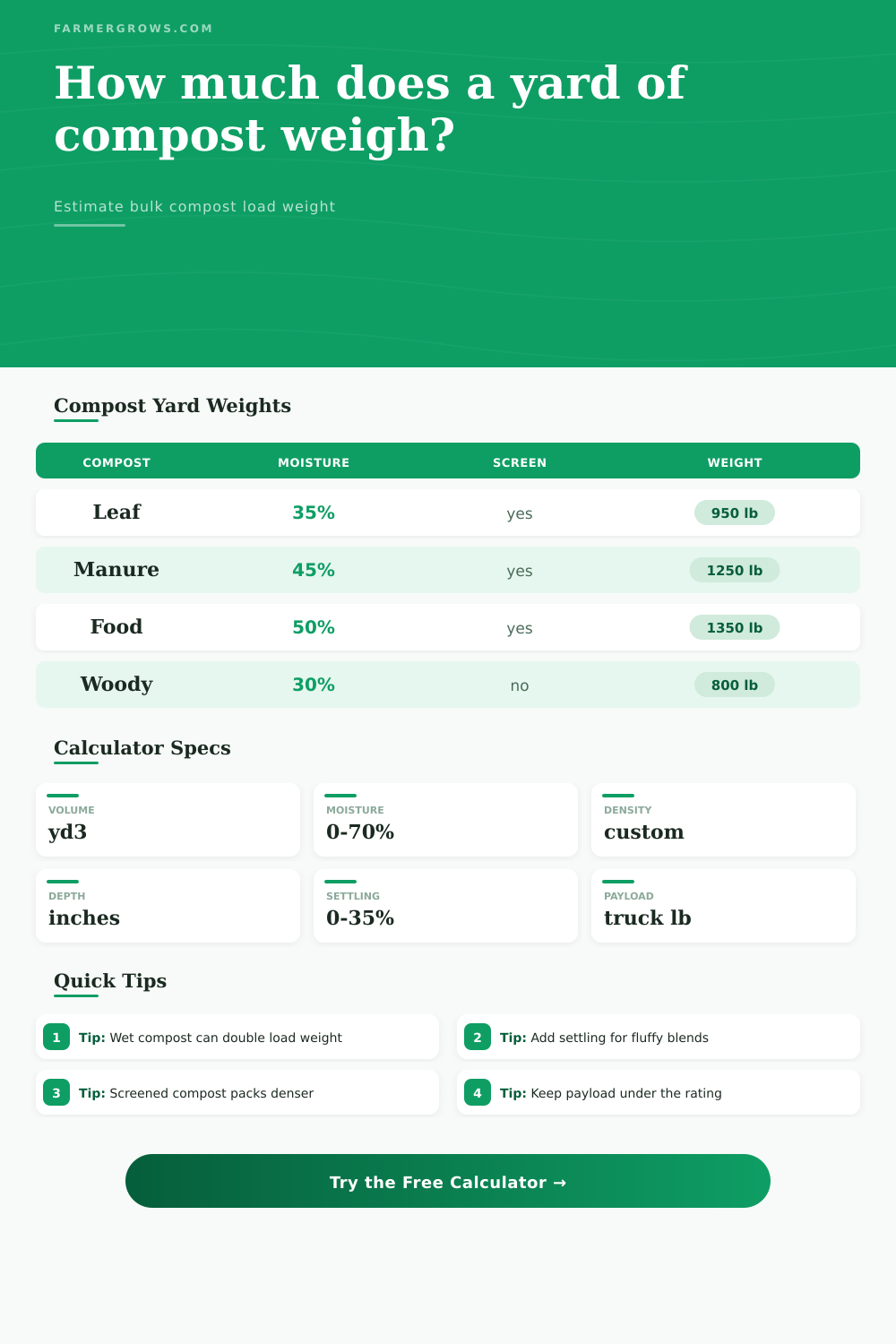
Yard of Compost Weight Calculator
Estimate how many pounds are in a yard of compost from cubic yards, compost type, moisture, maturity, screening, bulk density, amendment depth, bed area, settling, and truck payload.
Choose a named compost-yard starting point, then adjust the cubic yards, moisture reading, screening, bed area, amendment depth, settling allowance, or truck payload.
Compost Yard Weight Results
Estimate ready.
Usually lighter, mellow, and good for topdressing beds. It can vary a lot if leaves are dry or only partly broken down.
Often heavier because manure fines, bedding, and moisture create a denser bulk pile than leaf-based compost.
Fine texture and high moisture can push load weight up. Confirm moisture before filling a small pickup.
Chunkier particles create more air space, so unscreened loads are bulky but often lighter per cubic yard.
| Moisture reading | Relative load weight | One 1,000 lb reference yard | Field note |
|---|---|---|---|
| 20% moisture | About 25% lighter than 40% | 750 lb/yd³ | Dry, fluffy, and dusty unless recently watered. |
| 35% moisture | Near light screened compost | 923 lb/yd³ | Common for leaf compost and cured yard waste. |
| 40% moisture | Calculator reference point | 1,000 lb/yd³ | A useful middle planning value for bulk deliveries. |
| 50% moisture | About 20% heavier than 40% | 1,200 lb/yd³ | Wet piles and fine compost can land here. |
| 60% moisture | About 50% heavier than 40% | 1,500 lb/yd³ | Very wet compost may overload small vehicles. |
| Amendment depth | Coverage from 1 yd³ | Coverage from 3 yd³ | Metric equivalent |
|---|---|---|---|
| 0.5 inch topdress | 648 sq ft | 1,944 sq ft | 60.2 m² per yd³ |
| 1 inch amendment | 324 sq ft | 972 sq ft | 30.1 m² per yd³ |
| 2 inch amendment | 162 sq ft | 486 sq ft | 15.1 m² per yd³ |
| 3 inch raised bed blend | 108 sq ft | 324 sq ft | 10.0 m² per yd³ |
| 6 inch heavy incorporation | 54 sq ft | 162 sq ft | 5.0 m² per yd³ |
| Payload rating | At 900 lb/yd³ | At 1,200 lb/yd³ | At 1,500 lb/yd³ |
|---|---|---|---|
| 1,500 lb compact pickup | 1.6 yd³ | 1.2 yd³ | 0.9 yd³ |
| 2,500 lb half-ton payload | 2.5 yd³ | 1.9 yd³ | 1.5 yd³ |
| 3,500 lb three-quarter-ton | 3.5 yd³ | 2.6 yd³ | 2.1 yd³ |
| 6,000 lb dump trailer | 6.0 yd³ | 4.5 yd³ | 3.6 yd³ |
| 12,000 lb landscape truck | 12.0 yd³ | 9.0 yd³ | 7.2 yd³ |
| Project | Area and depth | Cubic yards before settling | Estimated weight at 1,100 lb/yd³ |
|---|---|---|---|
| Four 4 ft × 8 ft beds | 128 sq ft at 2 in | 0.79 yd³ | 870 lb |
| Small garden refresh | 400 sq ft at 1 in | 1.23 yd³ | 1,360 lb |
| Lawn topdress strip | 1,000 sq ft at 0.5 in | 1.54 yd³ | 1,700 lb |
| Market garden block | 2,500 sq ft at 1.5 in | 11.57 yd³ | 12,730 lb |
| New raised bed zone | 600 sq ft at 3 in | 5.56 yd³ | 6,110 lb |
Ask for moisture and screening status. A supplier yard is a volume measure, but water and particle size decide whether that yard rides like a light garden amendment or a heavy wet load.
Size truck loads conservatively. Payload ratings include passengers, tools, bed liners, and the hitch load, so leave margin when compost is wet or freshly screened.
When you order a truckload of compost, you do so confidently, imagining transformation your garden will undergo when you get that load of rich dark earth. And then the dump truck comes…and the driver looks at your pickup bed in concern. By volume, that pile doesn’t look too bad, but by weight? A whole other story! Knowing what a cubic yard realy weighs. Not just how many square feet it covers; is as important to knowing its soil-enhancing potential, because it’s also a question of whether you have the vehicle to actualy haul all that material without breaking an axle or violating safety limits.
This is related to compost. Plugging in your own estimates for the amount of water (moisture) and the total volume to be composted is still required, as the calculator does that math above. But then there’s the question: Why do those entries move the needle? What makes a number a plan?
Why Compost Weight Matters for Your Truck
Moisture content is the primary variable that you have control over, and here’s where the “heavy” enters the picture: Water is heavy. Compost soaks up water like a sponge. A cubic yard of dry leaf mold may be almost nine hundred pounds; a moist food scrap mix can easily top thirteen hundred pounds per cubic yard. It isn’t nothing. In fact, when you’re loading a trailer rated at three thousand pounds, that weight will matter more then the number of cubic yards. The weight may be much different even if you load same number of cubic yards.
The screening process will alter density of what you’re working with in an unexpected way. Because there’s less mass and more volume in the void spaces and coarse wood, if someone provides you with a screen-sized material for instance, it’ll be a lot denser but also finer (and thus more uniformly sized). An unscreened windrow compost can feel light and fluffy, like you’d expect. But when you screen it, that same cubic yard compresses tightly into a smaller space and becomes much heavier. This means the density changes. You might need fewer trips than you first calculated, but each trip will be heavier. Keep this in mind if you plan to topdress.
One subtle but true component of the equation is the age or maturity of the compost. Active piles has a bulky, fragmented structure, which means their compost will be lighter. The weight per volume (or bulk density) goes up as the compost matures and breaks down more completely. An overwintered compost pile made with super-mature materials will be heavy and dense. Plan accordingly for that added weight if you’re humping around aged stuff for a raised bed project. That’s what the tool does, considers the maturity factor so your estimate isn’t some generic average but reflects the compost’s actual physical properties.
Another trip-up is settling. Over time, compost will settle, particularly when it’s a bit damp. Fresh, fluffy compost may settle ten or even twenty percent. So if you do the math and are estimating how many cubic yard you’ll need, remember that number may be overly optimistic (a yard of fresh compost settles down a bit after a few days in the pile). To make sure you’ve ordered enough to cover the space at the depth you want, include a settling factor into your calculation. Better to have some more than not quite enough (and end up covering only a half-inch deep).
The numbers realy come into play when planning payloads for trucks. What can that truck actualy haul? That’s its actual payload capacity. It includes the weight in the back, the weight of the bed liner, and any passengers or tools you may be carrying. (This is different than towing capacity, another number that too many folks mix up.) Even a bit of damp compost will exceed your weight limit if your payload capacity isn’t high. With the calculator, you can see at a glance what you can haul safely; and stay within the mechanical and legal limits of your rig.
You’ll find some benchmark numbers (for example: how heavy dense vermicompost versus light leaf mold will be) in the reference tables at the bottom of the page. That’s so you can compare your own guess against these ranges as one way of making sure you’re sane. For instance, if it looks like weight of a load of leaves would fall well above the top end of that range, you may have overestimated the volume and/or underestimated the moisture. This is a nice reality check before ordering.
The bottom line: Compost isn’t one thing. Not all composts are created equal (or come in equal weights!). That’s why it matters how you adjust for its age. You must also adjust for whether it’s screened and for its moisture content. This way you have a more accurate snapshot of what you’re hauling around. You don’t order too much or overload your truck bed. You appreciate the physical nature of the substance. You work with the compost rather than assume that it will behave in any particular way. Plan to know precisely what you’re weighing, before the truck pulls up.