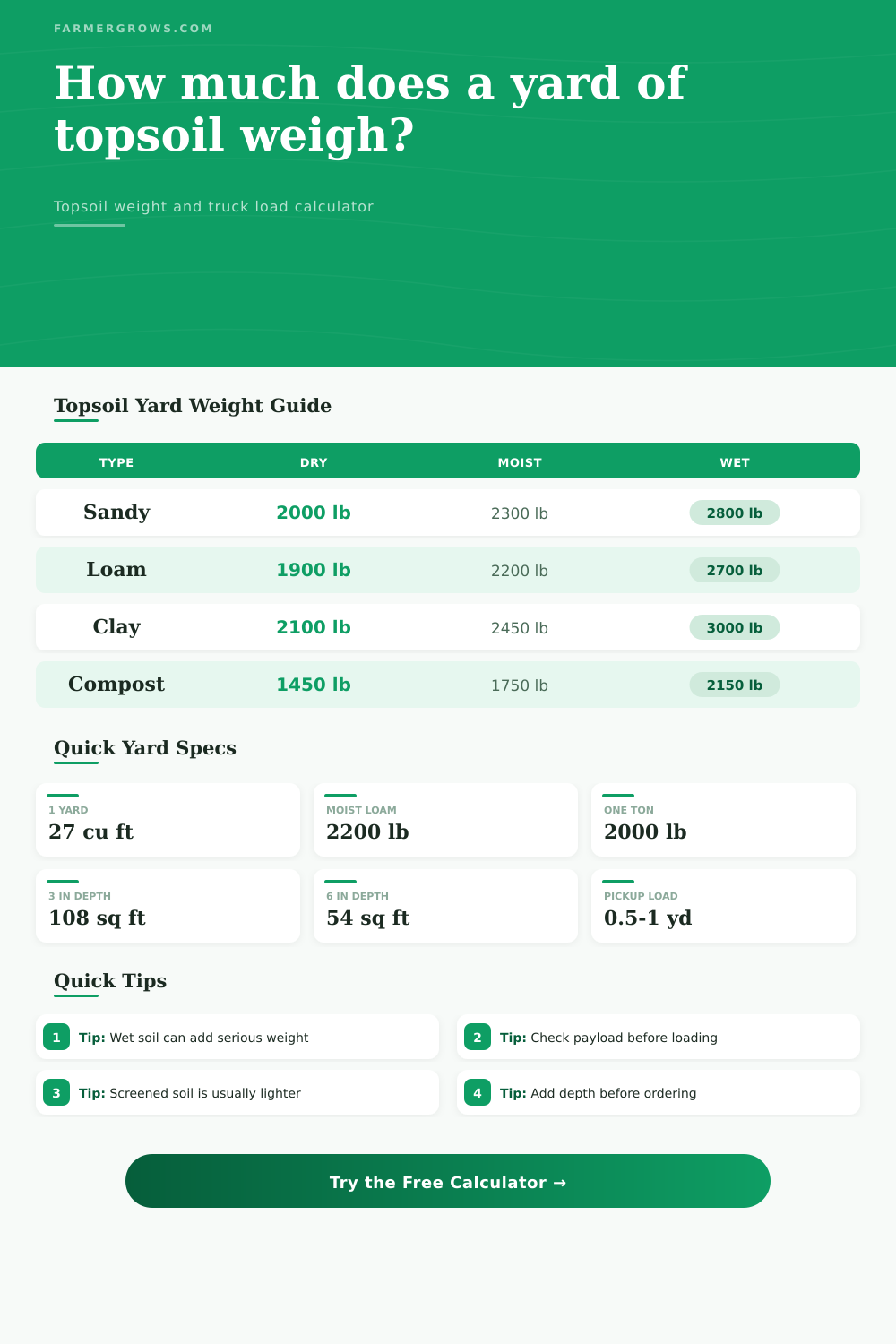
Yard of Topsoil Weight Calculator
Estimate topsoil pounds, tons, cubic yards, and truck loads from moisture, texture, debris, compaction, and depth.
Sandy topsoil
Drains quickly and is easier to shovel. It often weighs less when dry but can still run heavy when wet.
Loam topsoil
Balanced sand, silt, clay, and organic matter. This is the common reference for a yard of topsoil.
Silty loam
Fine particles hold more water, so weight rises quickly after irrigation or rain.
Clay loam
Dense and sticky. A wet yard can exceed a light pickup payload before the bed looks full.
Compost-rich mix
Higher organic matter lowers mineral density and improves handling, especially when screened.
Garden blend
Mixed topsoil, compost, and amendments. Weight depends on moisture and the mineral-to-organic ratio.
| Moisture level | Typical factor | 1 yd³ loam | Handling note |
|---|---|---|---|
| Dry / dusty | 0.90 | 1,980 lb | Lightest common condition |
| Slightly moist | 1.00 | 2,200 lb | Good delivery estimate |
| Field moist | 1.10 | 2,420 lb | Common after normal watering |
| Wet after rain | 1.28 | 2,816 lb | Payload risk rises fast |
| Saturated | 1.42 | 3,124 lb | Delay pickup if possible |
| Depth | Coverage per yd³ | Metric depth | Metric coverage |
|---|---|---|---|
| 1 in | 324 sq ft | 2.5 cm | 30.1 m² |
| 2 in | 162 sq ft | 5.1 cm | 15.1 m² |
| 3 in | 108 sq ft | 7.6 cm | 10.0 m² |
| 4 in | 81 sq ft | 10.2 cm | 7.5 m² |
| 6 in | 54 sq ft | 15.2 cm | 5.0 m² |
| Project | Area | At 3 in depth | Moist loam weight |
|---|---|---|---|
| Small raised bed | 32 sq ft | 0.30 yd³ | 660 lb |
| Tree ring | 28 sq ft | 0.26 yd³ | 570 lb |
| Front bed strip | 120 sq ft | 1.11 yd³ | 2,440 lb |
| Topdress lawn | 500 sq ft | 4.63 yd³ | 10,190 lb |
| Truck payload | Dry half yard | Moist half yard | Wet half yard |
|---|---|---|---|
| 1,000 lb | Too much | Too much | Too much |
| 1,500 lb | Usually ok | Near limit | Too much |
| 2,000 lb | Ok | Usually ok | Near limit |
| 3,000 lb | Ok | Ok | Usually ok |
There’s probably somebody out there telling people they can just grab a bag of dirt and throw it into their pickup for a yard of topsoil. Nope. Those people tend to be wrong.
And they’re probably dragging some junk-trailer around with cracked axles, They are also attempting to reverse uphill a driveway that wasn’t designed for that kind of weight.
Tips for Moving Soil Safely
Moving soil is all about physics, and some simple arithmetic: One cubic yard is equal to 27 cubic feet. It sounds easy enough, until you remember that “cubic” refers to volume, not weight. Wet clay will weigh more than dry sand even if piled together in the same tiny space. Your truck’s payload is already at it’s capacity, including your own weight and fuel in tank. That makes a difference.
When you input dimensions into this calculator (above), it do all the work for you. No more conversion guesswork, no more coefficients needed. The actual planning comes in understanding what goes into those numbers.
One thing that realy affects these projects is moisture level. You might think that dry soil isn’t so bad. But then it rains and/or your sprinklers run at night and the weight builds up quick. Water is heavy. It displaces air in spaces between soil particles. This packs in extra weight that you don’t see, but you will definitely notice when you try to get things moving. What used to be lightweight loam may now turn out to be an unsafe load when it’s wetter than usual due to a rainy week in springtime. That’s why the calculator prompts you with moisture levels, It’s a safety feature.
Finally, texture also matters. Even when wet, sandy soil remain relatively light and drains readily. By contrast, clay soils compact heavily; they retain moisture and are much heavier (per cubic yard) different than sandy types. If your mix is heavy on clay, be aware of its density. As the reference chart on this page shows, moisture increase the starting weight of each texture. A cubic yard of pure clay, for instance, will weigh up to three thousand pounds, well outside the safe limits of any standard half-ton pickup truck.
You don’t need an advanced degree in civil engineering, but you should of still do your homework before signing the delivery slip.
The other thing that nobody thinks about when screening matters: Topsoil can contain debris, roots, and rocks. All those extras weighs down the bag without contributing to the gardening value. A screen removes all that heavy stuff, leaving just fine material you want in your garden beds. Ask for screened soil if you’re ordering for a delicate area like a lawn topdressing or a raised bed. It’ll be a bit lighter, which means fewer trips or a safer load on your truck. It may even cost slightly more by the yard, but you’ll spare yourself a backache sifting it clean of rocks later on.
The other factor is compaction. A freshly delivered load of soil are light and fluffy, but it settles when it’s sitting there. And if you ordered by the cubic yard to cover a certain area, you have to remember that it’ll settle a bit. You can also enter your degree of compaction into the calculator. That way you’ll know just about exactly what you’re going to get in terms of spread.
Yes, I know, it’s not a big deal. But still. Nothing is worse then running out of soil partway through a job. Buying too much soil isn’t cheap. Understanding how your soil behaves once it is spread help you find that happy medium.
Know your truck’s limitations Every truck comes with a sticker in its door jamb specifying the maximum amount of weight it will carry. This is the total weight of the truck bed plus any cargo. Don’t forget to subtract weight of the truck bed. Many folks fail to remember this step. A truck bed rated for one-hundred and fifty pounds means they can haul one-hundred and fifty pounds of what? Dirt! No they can’t. The truck bed weighs something, too. It is on the scale. Minus it out first. Now check weight of your soil. Do the two amounts add up? Call a delivery truck if they don’t. Cheaper than new suspension.
Soil is not dirt: Soil is a complex combination of water and air and minerals and other living things known as organic matter. Mistakes happen when we treat soil as if it were a commodity. Save yourself some money (and time and possible mechanical damage) by thinking about its weight and moisture and by respecting the density of the stuff you’re moving around. Dig, dig dig…but only after you’ve checked the calculator and your truck.