4×5 Round Bale of Hay Weight Calculator
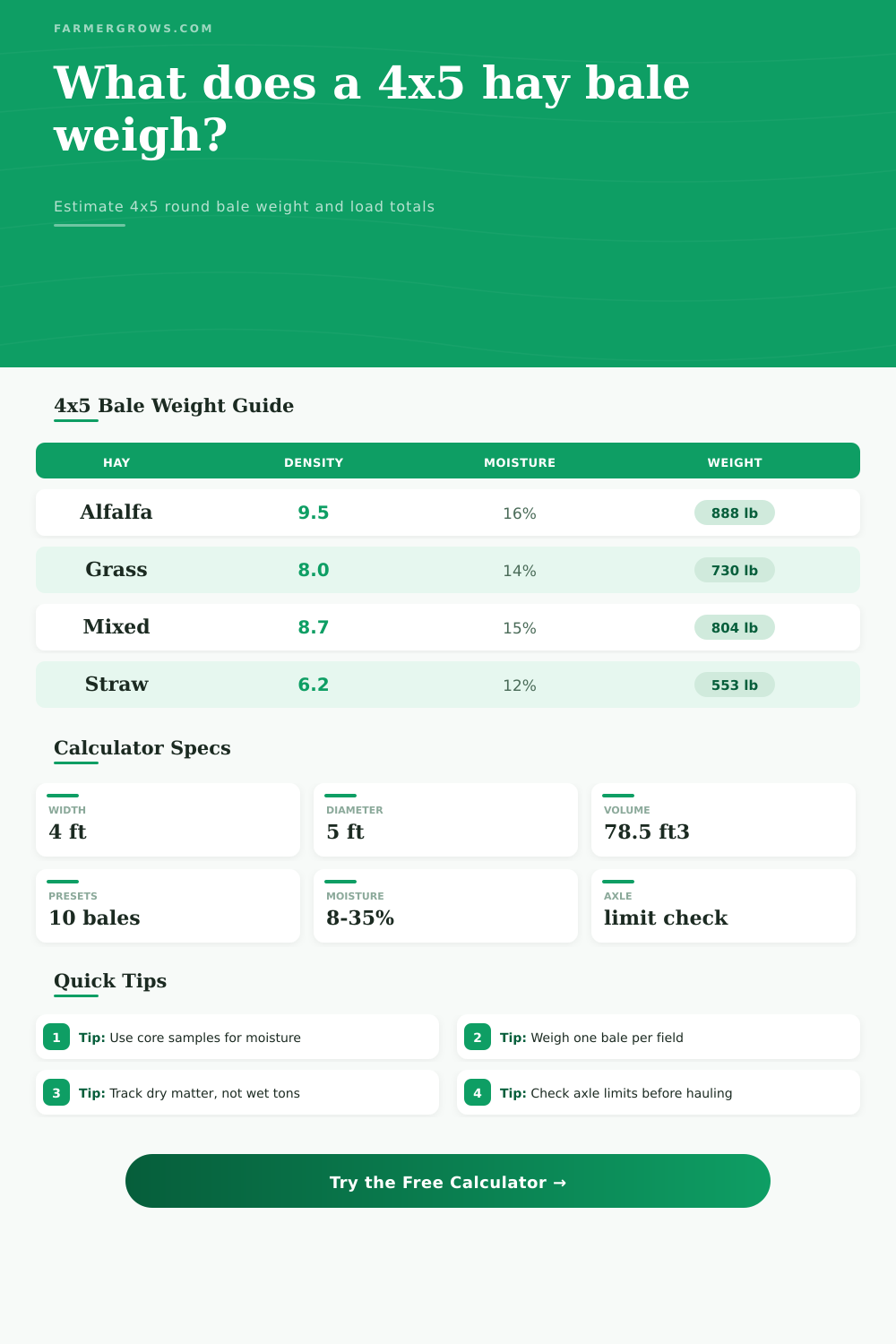
Estimate the weight of a fixed 4 ft wide by 5 ft diameter round bale using dry matter density, moisture, hay type, core firmness, bale count, storage loss, and axle limit checks.
Choose a named 4×5 bale condition, then adjust the density, moisture, count, and hauling settings for your hay lot.
4×5 Bale Weight Results
These values use a fixed 4 ft width, fixed 5 ft diameter, and a geometric bale volume of 78.5 cubic feet before density and condition adjustments.
About 64% of a 4×5 bale by volume, so it usually weighs much less at the same density.
The fixed bale size used here: common for mixed hay, grass hay, and smaller tractor handling.
About 125% of a 4×5 bale by volume when width increases to 5 ft.
About 180% of a 4×5 bale by volume, often requiring larger handling equipment.
| Hay type | Dry density, lb/cu ft | Typical moisture | 4×5 weight range |
|---|---|---|---|
| Alfalfa hay | 8.8 to 10.5 | 14% to 18% | 800 to 980 lb |
| Grass hay | 7.2 to 8.8 | 12% to 17% | 640 to 830 lb |
| Mixed grass alfalfa | 8.0 to 9.6 | 13% to 18% | 720 to 910 lb |
| Bermuda hay | 8.4 to 10.2 | 12% to 16% | 760 to 940 lb |
| Timothy hay | 7.0 to 8.5 | 12% to 16% | 620 to 800 lb |
| Straw or bedding | 5.4 to 6.8 | 8% to 14% | 460 to 620 lb |
| Dry matter weight | 12% moisture | 16% moisture | 22% moisture |
|---|---|---|---|
| 600 lb DM | 682 lb | 714 lb | 769 lb |
| 700 lb DM | 795 lb | 833 lb | 897 lb |
| 800 lb DM | 909 lb | 952 lb | 1,026 lb |
| 900 lb DM | 1,023 lb | 1,071 lb | 1,154 lb |
| Condition | Loss used | Best use | Calculator effect |
|---|---|---|---|
| Barn stored, dry floor | 0% | Inventory weights | Keeps full dry matter |
| Tarped or under roof edge | 3% | Short storage | Small usable DM reduction |
| Outside, well drained | 7% | Normal field stacks | Moderate feeding loss |
| Outside, weathered base | 12% | Older exposed lots | Larger usable DM loss |
| Long outdoor storage | 18% | Weathered carryover | Highest usable DM loss |
| Per-bale weight | 10,000 lb limit | 20,000 lb limit | 34,000 lb limit |
|---|---|---|---|
| 650 lb | 15 bales | 30 bales | 52 bales |
| 800 lb | 12 bales | 25 bales | 42 bales |
| 950 lb | 10 bales | 21 bales | 35 bales |
| 1,100 lb | 9 bales | 18 bales | 30 bales |
Moisture tip: A few points of moisture can move a 4×5 bale by dozens of pounds, so compare lots on dry matter when buying, feeding, or tracking inventory.
Hauling tip: Recheck axle limits with the heaviest bale class in the stack, especially when wet bales, tight cores, or wrapped haylage are mixed into the same load.
There comes a point in each day when you run hay equipment. It’s staring down a pile of bales and deciding whether they are to heavy for your tractor to lift or if you should of just walk away. Weight matter. Hitch strength, feed budgets, all matter on the farm.
That 4 by 5 round bale sits right there between massive and manageable. But how much does it weigh? Well that depends. It depends on what is inside the bale. How dense is it? Is there still moisture in the wrapped bale? Those variables comes into play along with size of the bale itself.
Why Knowing Bale Weight Is Important
After you estimate hay moisture and type, calculator does all of the math for you. It eliminates guesswork about conversions and coefficients. A lot of us think that every bale weigh X amount (i.e. 800 pounds) because we heard that somewhere in agricultural class. That’s where inventory trouble begins. A soft core hay bale isn’t going to weigh as much than a tight core. Grass won’t weighs as much as alfalfa. By inputting your own dry matter density, you’re letting the system know level of compaction within those fibers. Skipping this portion or selecting the wrong preset means your feed calculation will be off by default, along with the final weight. What’s on paper might be different than what’s really in the field.
The other big variable is moisture. A bale weighing 10 pounds at 12 percent moisture will weigh more or less then one that’s been cut at 18 percent moisture. That means more water, which weighs a lot. This translate into less dry matter fed to your animals and heavier hauls. When you’re paying per ton for hay, you’d like to be paying for the plant matter, not the rain that fell on it as it was drying in the field. The tool corrects for that; you can enter the moisture content and compare it to a desired dry matter percentage. It comes in handy if you are trying to stretch your winter feed budget across six months.
What you put into a bale is not necessarily what you get out of it; storage conditions matters. If bales are stored outdoors uncovered, bottom layers will be damaged by snow and rain. That’s why the calculator have a storage loss factor. This takes into account any waste due to crushing while retrieving, rotting, or other weathering. Not accounting for this makes your inventory look better on paper then it actualy is; perhaps it shows you’ll have plenty of feed through February, but when December comes around, you realize you’re a few bale short because half the outer bales rotted into mulch.
The math gets real on the hauling side. Quality hay doesn’t matter if you overload an axle. This tool will check that total load does not exceed the axle limit you establish. That’s not a convenient feature; it’s a safety feature. A lot of guys load bales ‘by-eye’; until they reach a soft road shoulder, or go up a steeper hillside. Set your equipment or legal weight limit and know exactly how many bales you can carry without going over. Avoid getting fined and avoid an accident. Two trips are better then busted.
To conclude. Weight estimation isn’t an exact science; it’s more a directional tool. You don’t have to know exactly how many ounces is in each bale. But if you can get close enough to the right answer to make a good profit and do it safely, all the better. A calculator takes the guesswork out of things. It gets you back in charge of what’s happening on your farm. It makes a ballpark estimate become a possible plan. And once you start measuring instead of guessing, managing hay will become a little easier to predict and not so stressful. The weight is just a number, but that number drive the rest of your season.