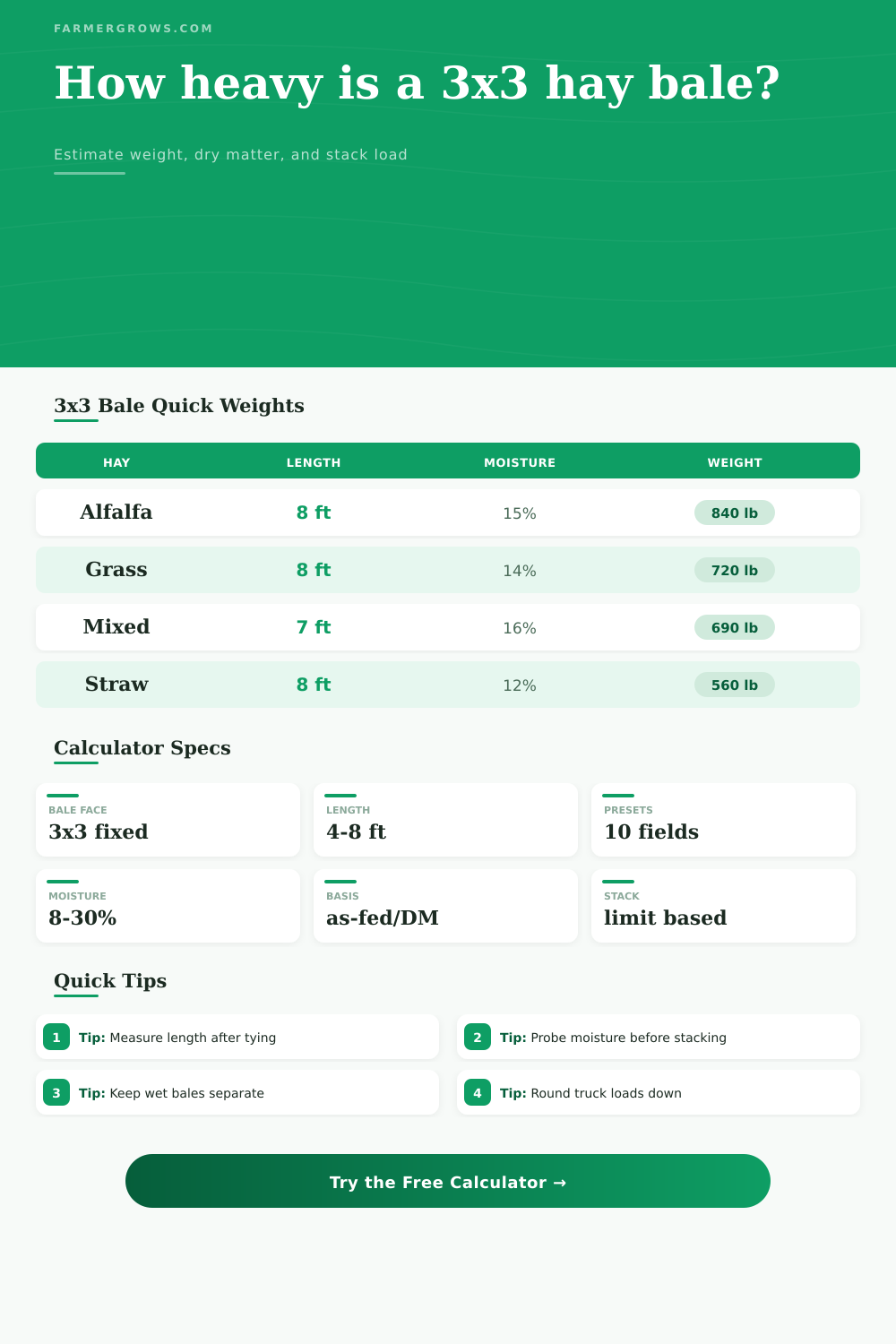
3x3 Bale of Hay Weight Calculator
Estimate large square 3 ft × 3 ft hay bale weight from length, hay density, moisture, compression, storage condition, bale count, stack limit, and dry matter basis.
Choose a realistic starting point for a 3x3 large square bale, then adjust length, moisture, compression, and bale count for your baler and hay lot.
3x3 Bale Weight Estimate
Results update from your bale length, density, moisture, compression, storage condition, and bale count.
Often easier to handle in mixed hay lots and shorter barn bays. At 10 lb/cu ft, it weighs about 540 lb before moisture adjustment.
A common compromise length for dairy hay, stacking, and highway loads where consistent bale count matters.
The standard large square size many buyers expect. Dense alfalfa can land near 800 to 900 lb per bale.
A larger face carries one-third more volume than a 3x3x8, so loaders, trailers, and stacks need higher capacity.
| Bale size | Volume | Grass hay, 10 lb/cu ft | Alfalfa, 11.6 lb/cu ft |
|---|---|---|---|
| 3 ft × 3 ft × 5 ft | 45 cu ft | 450 lb | 522 lb |
| 3 ft × 3 ft × 6 ft | 54 cu ft | 540 lb | 626 lb |
| 3 ft × 3 ft × 7 ft | 63 cu ft | 630 lb | 731 lb |
| 3 ft × 3 ft × 8 ft | 72 cu ft | 720 lb | 835 lb |
| 3 ft × 3 ft × 8.5 ft | 76.5 cu ft | 765 lb | 887 lb |
| Moisture reading | Dry matter share | Effect on as-fed weight | Stacking note |
|---|---|---|---|
| 10% moisture | 90% DM | Lighter than normal | Usually very dry |
| 14% moisture | 86% DM | Near cured hay target | Good storage zone |
| 18% moisture | 82% DM | Heavier from water | Watch heat closely |
| 22% moisture | 78% DM | Much heavier | Separate and monitor |
| Setting or condition | Factor used | Best use | Weight impact |
|---|---|---|---|
| Loose field setting | 0.88 | Light grass or fragile leaves | About 12% lighter |
| Standard compression | 1.00 | General 3x3 hay estimates | Baseline weight |
| Dense pack | 1.12 | Transport and tight stacks | About 12% heavier |
| Damp edge storage | 1.04 | Tarpped outdoor stacks | Adds water weight |
| Per-bale weight | 24,000 lb limit | 42,000 lb limit | 52,000 lb limit |
|---|---|---|---|
| 600 lb bale | 40 bales | 70 bales | 86 bales |
| 750 lb bale | 32 bales | 56 bales | 69 bales |
| 900 lb bale | 26 bales | 46 bales | 57 bales |
| 1,050 lb bale | 22 bales | 40 bales | 49 bales |
Probe and weigh one bale: density tables are planning numbers. The fastest calibration is weighing one representative 3x3 bale, then using the calculator to scale that lot.
Use dry matter for feed inventory: two bales with the same scale weight can carry different feed value when moisture changes. Compare lots on dry matter basis.
That means you’re standing in a barn bay gazing upon a stack of big square bales. Maybe you realize you have no idea if this pile is a structural risk or is it a manageable inventory? A 3×3 bale appears like every other bale.
Depending on how tight the baler was set, and what kind of crop grew in the field, weight within can vary wildly. Volume is not all that matters, density does. Most assume that a grass bale weighs the same as an alfalfa bale (8 feet long). They don’t. If you weigh them against each other, one weighs near 850, and the other are closer to 700. That’s only a 150-pound difference, but when you’re trying to calculate how many bales your truck can haul without breaking law, it suddenly sounds big. And then there is the question of whether your barn floor can even handle another layer.
Why Hay Weight Matters
Enter your hay type and bale length into this calculator above and it does the rest of the math for you. No need to do conversions or try to remember coefficients. Knowing why these numbers make a difference matter. Moisture is the hidden variable that makes all estimates go wrong.
Harvesting hay too wet = you’re not buying feed, you’re buying water. So a bale with 18% moisture will be heavy compared than one with 14% moisture. And it have less nutritional content. Want to know how much a bale weighs either as-fed or as dry matter? Toggle back and forth on the tool. Want to compare two different hay lots apples-to-apples? Dry matter is critical then.
You may find yourself thinking you have a better deal with the heavier bale. But if it’s wet, you’re shelling out money for water that evaporates. That’s where people screw up. The other is something that seems obvious but is overlooked, compression. Your barn holds both a tight bale and a loose bale the same size. One weighs much more then the other.
You’re storing air if you ran your baler light to minimize belt wear. And conversely, if you put bales into a dense export style pack, you’ve got the weight pushed up. That may be over axle limit of your trailer or even lift capacity of your loader. These settings is accounted for by the calculator. They show you how a 12% change in compression impacts final tonnage. Small thing, but it makes a difference when planning a load.
Physics kicks in when it comes to stacking limits. For instance, you might have all the hay in the world, but if you stack it too high, you risk damaging your barn floor or tipping a trailer. The stack limit check on tool lets you enter your maximum weight limit and see how many bales will be safe for a stack. This isn’t just for convenience; it prevents accidents and saves money.
A 900-pound bale won’t be twice as difficult to manage as a 450-pound bale. It calls for greater precaution and equipment. You’ve got to know where the cutoff is before you put up first bale, especially if you’re trying to do it by hand or with a smaller skid steer.
Finally, storage conditions factor into the final numbers. One bale that was cured in a dry shed will weigh less then one that was stored under a tarp in a damp field. Why? Moisture absorption. This lead to heat buildup and can cause mold issues as well. The storage factors in the calculator will help you account for this drift. They will also give you some idea of how much more (or less) your inventory weigh, so you know if it is getting heavy from sweat or light from losing leaves.
In the end, weighing your hay doesn’t matter because we’re doing math homework. It matters because it helps keep you safe. If you store feed for winter, or buy by the ton, guesswork gets costly and you should of checked first.
Here’s the deal with common bale sizes. Here’s what you get as a starting point. It is a place to start and then look deeper. You don’t have to remember the density for each type of grass. But you should know where those other variables lie: length, moisture, compression.
The next time you look at one of those stacks of bales, they aren’t all just squares anymore. They’re variables and if measured well, an odd thing becomes something manageable. It goes from hoping your truck holds to knowing it will.