Small Square Bale Weight Calculator
Estimate small square bale weight from bale dimensions, flake count, measured flake weight or hay density, hay type, moisture, compression, bale count, and a handling or loading limit.
Start with a common small-square bale setup, then fine tune your own bale size, flakes, hay type, moisture, density, compression, bale count, and safe loading limit.
Small Square Bale Weight Estimate
Adjust the inputs to compare flake weight, density, moisture, stack load, and handling capacity.
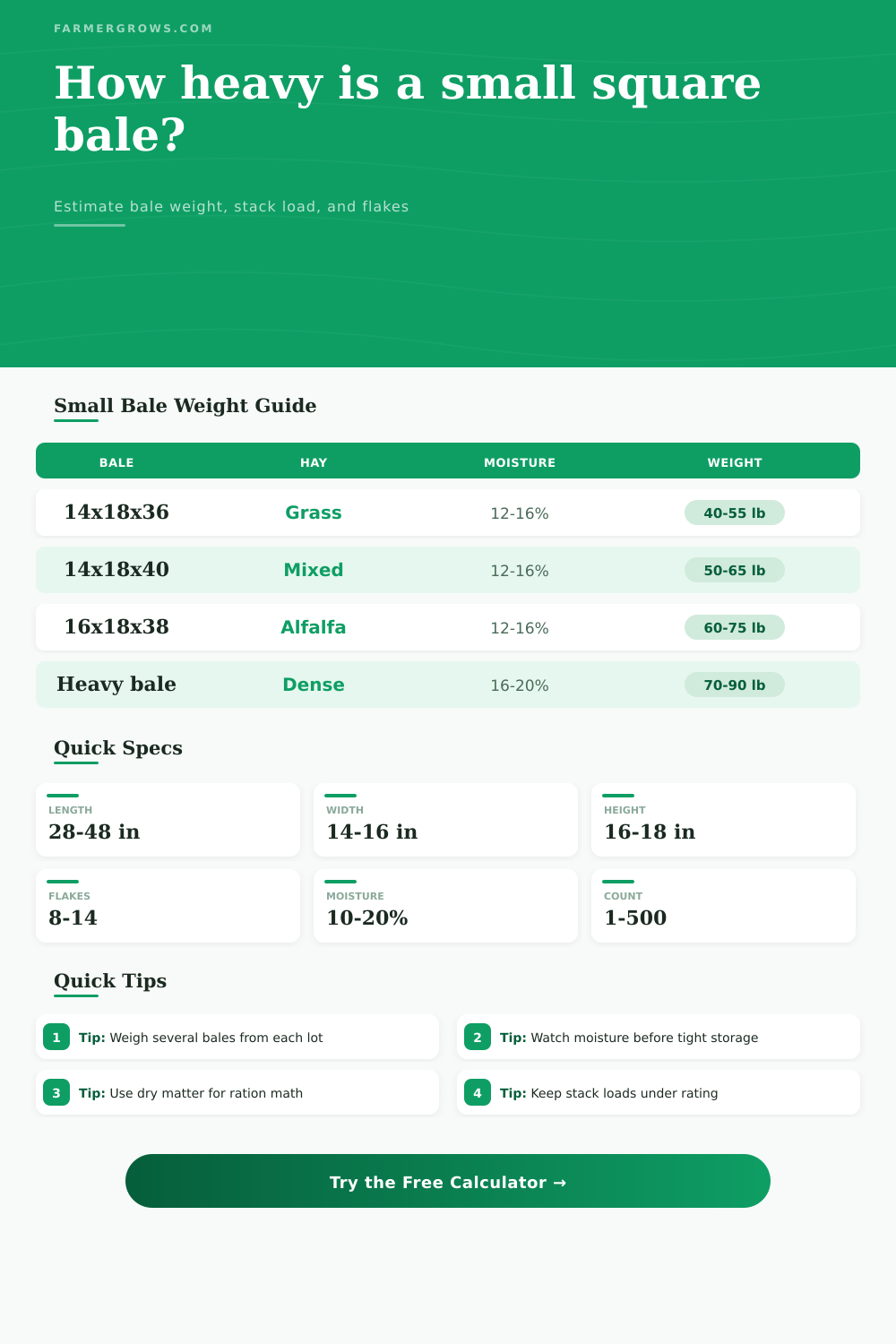
Use these common small-square bale profiles to sanity-check your calculated weight before loading wagons, lofts, trailers, or feeding plans.
Often lands near 40 to 55 lb when cured dry and baled at moderate tension.
Extra length can push mixed hay into the 50 to 65 lb range without feeling unusually tight.
Larger cross-section plus leafy legume density can create 60 to 75 lb bales.
Wheat straw is usually bulkier and lighter, often near 30 to 45 lb per bale.
| Small square bale size | Volume per bale | Common hay use | Typical weight range |
|---|---|---|---|
| 14 in x 18 in x 32 in | 4.7 cu ft | Short horse hay or hand-loaded lofts | 35 to 50 lb |
| 14 in x 18 in x 36 in | 5.3 cu ft | Standard two-tie grass or mixed hay | 40 to 60 lb |
| 14 in x 18 in x 40 in | 5.8 cu ft | Longer small squares and wagon stacks | 48 to 68 lb |
| 16 in x 18 in x 38 in | 6.3 cu ft | Dense alfalfa, clover, or commercial hay | 58 to 80 lb |
| Hay type | Starting density | 12% moisture bale | 16% moisture bale |
|---|---|---|---|
| Timothy horse hay | 8.0 lb/cu ft | 42 lb on 14x18x36 | 44 lb on 14x18x36 |
| Mixed grass hay | 8.4 lb/cu ft | 44 lb on 14x18x36 | 46 lb on 14x18x36 |
| Alfalfa hay | 10.2 lb/cu ft | 54 lb on 14x18x36 | 56 lb on 14x18x36 |
| Wheat straw | 5.8 lb/cu ft | 30 lb on 14x18x36 | 32 lb on 14x18x36 |
| Moisture reading | Dry matter percent | Storage note | Weight effect |
|---|---|---|---|
| 10% to 12% | 88% to 90% | Very dry hay; watch leaf shatter | Lower scale weight |
| 13% to 16% | 84% to 87% | Common small-square storage target | Normal scale weight |
| 17% to 20% | 80% to 83% | Use extra caution before tight stacking | Noticeably heavier |
| Over 20% | Under 80% | Risk rises without preservative or airflow | Heavy for its size |
| Handling limit | 40 lb bales | 55 lb bales | 70 lb bales |
|---|---|---|---|
| One person preference, 50 lb | 1 bale | 0 bales without help | 0 bales without help |
| Small garden cart, 300 lb | 7 bales | 5 bales | 4 bales |
| Light utility trailer, 1200 lb | 30 bales | 21 bales | 17 bales |
| Hay wagon section, 3000 lb | 75 bales | 54 bales | 42 bales |
Weigh across the lot. Small square bales from the same field can vary by chamber tension, windrow size, moisture, and leaf loss, so average several bales before committing a full trailer or loft load.
Separate weight from dry matter. A wetter bale may look like a better value by the scale, but feed planning is cleaner when you compare pounds of dry matter per bale.
Hay can be heavy in the fall. Not just physically, but also because it presents a challenge. You’re in the field, standing there watching the baler go. “Sure, I can handle that,” you think. You head back to the truck with a bale in hand and now it’s too much; you underestimated how heavy it would be.
All small square bale differ in weight depending on the type of crop, how wet or dry it was during baling, and what machine setting was used. Most people make their guesses based off appearance (volume). But that’s not accurate. For example, a loose straw bale may look the same size as a dense alfalfa one, but former will weigh less. Using the calculator allows you to plug in your numbers and recieve a definitive answer. No guessing. It turns the emphasis from size to density.
How to Calculate Hay Bale Weight
First of all, get out the tape. Usually, small square bales is around 14 to 16 inches wide, 18 inches tall, and 30 to 40 inches long. Measure them when they relax. They’ll expand a bit once they comes out of the baler and sit for a while. If you measure right away, you might assume they’re more dense than they actualy are. Measure one off your stockpile instead; or better yet, wait a few hours. The size tell you how much there is to work with.
What kind of hay? Lighter or denser. For example, alfalfa/clover mixes will pack in more pounds per square foot then timothy/orchardgrass (lighter). The other side effect: lighter types are airier and therefore easier to lift but occupy more space per ton. Your choice of forage also determines the default density for the tool. And it’s not a label; it’s a representation of how tightly the plant material pack together.
Moisture adds extra weight. Twelve percent moisture is a fairly dry bale of hay. Twenty percent moisture equals a bale of hay that has increased its weight significantly because it have more water in it. Water weighs a lot. If you are purchasing hay by the bale and it’s wet, you could of being paying for water instead of dry matter and nutrients. And if your horse has access to fresh water, he doesn’t need additional water; he needs nutrients!
Dry matter vs. Total weight: This distinction is important when developing feed plans, and the calculator breaks out both weights so you have them separately.
Weight is also affected by compression. Bales is heavier when tightly compressed in the baler. They’re easier to store, but harder for a person to move around. To test out different levels of tight packing, try moving the compression factor in the tool. How does that change the pack?
Know how much weight you have and how much you can safely stack. Maybe one bale is no problem, but a hundred will top your trailer or floor weight. The limit check feature keeps you inside safe bounds.
Take multiple measures. Don’t assume that one is good enough. Averaging three to five measures from each lot will help make sure you get an accurrate flake weight. The hay field isn’t perfect, and the windrow may be thick at some places and thin in others. Your baler tension changes, too. The flake weight provides a better idea of what you’ve got. That way you don’t get surprised when you pick up the load.
Respecting the physics of the material makes all the difference. Guessing won’t do it. Measure, that’s how you protect both your budget and your back.