🐔 Feed Per Layer Chicken Per Day Calculator
Estimate feed per hen per day from flock size, layer stage, egg production, bird size, feed protein and calcium class, oyster shell, forage, stress, waste, and feeding days.
Start with a flock that resembles your hens, then adjust the fields for your house, feeder style, forage access, and weather.
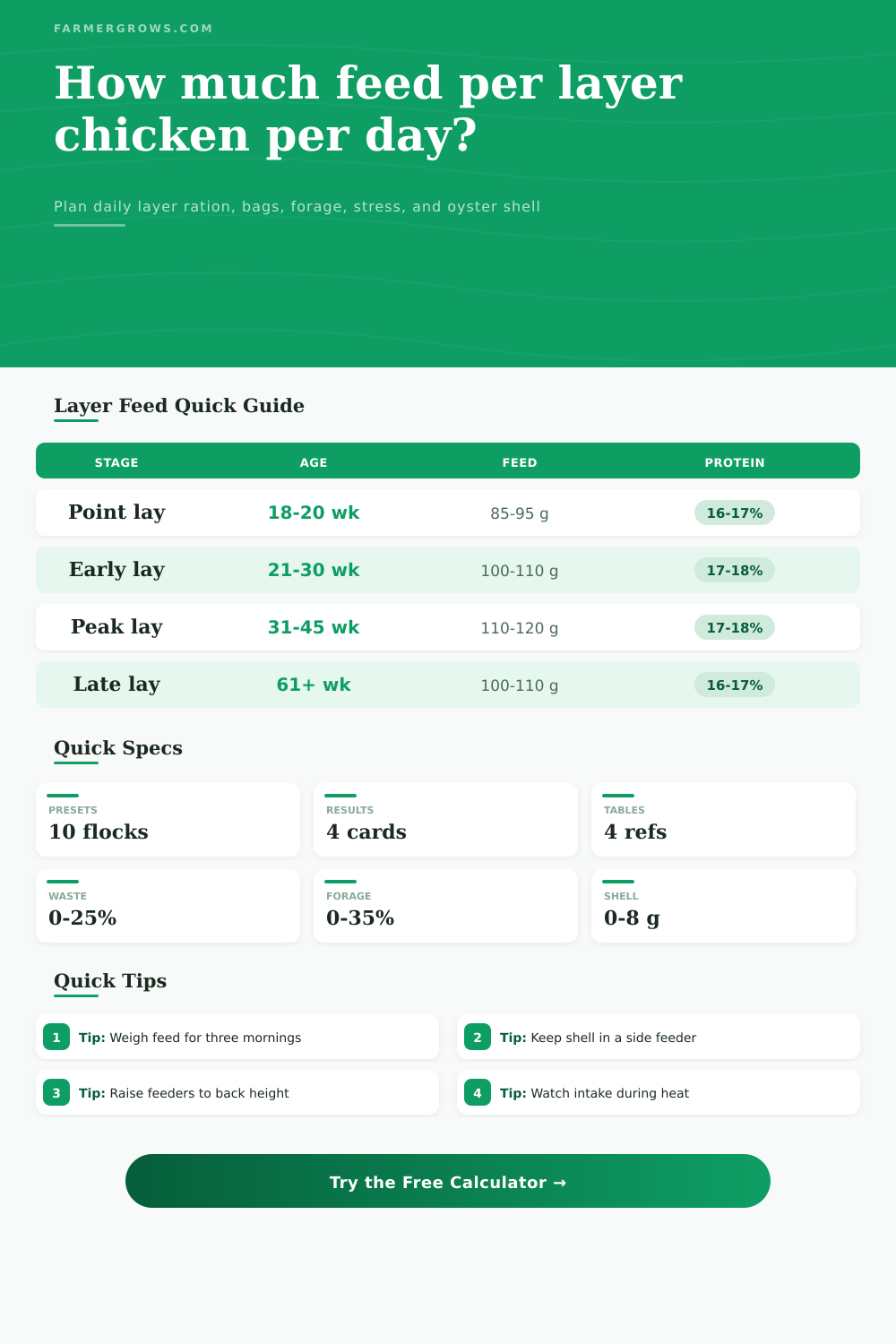
| Layer stage | Typical age | Feed range | Use this cue |
|---|---|---|---|
| Point of lay | 18-20 weeks | 85-95 g/hen/day | Transition gently while body weight catches up. |
| Early lay | 21-30 weeks | 100-110 g/hen/day | Egg size and production are both climbing. |
| Peak lay | 31-45 weeks | 110-120 g/hen/day | Keep feed, calcium, and water consistently available. |
| Mid lay | 46-60 weeks | 105-115 g/hen/day | Hold production without overfeeding heavy birds. |
| Late lay | 61+ weeks | 100-110 g/hen/day | Shell quality often matters more than extra feed. |
| Molt recovery | After molt | 90-105 g/hen/day | Increase gradually as birds return to lay. |
| Feed class | Protein | Calcium | Best fit |
|---|---|---|---|
| Economy layer | 15% | 3.2% | Low to moderate production flocks. |
| Standard layer | 16% | 3.8% | Most backyard and small farm layer pens. |
| Premium layer | 17% | 4.0% | Strong production and larger egg size. |
| High-output layer | 18% | 4.2% | Peak lay or high-performing hybrid hens. |
| All-flock feed | 20% | 1.1% | Needs separate oyster shell for laying hens. |
| Condition | Calculator effect | Practical range | Watch point |
|---|---|---|---|
| No forage | 0% feed reduction | Full ration | Use when hens are confined. |
| Light pasture | 5-10% reduction | Small feed offset | Layer nutrients still come from ration. |
| Good forage | 10-20% reduction | Moderate offset | Do not cut feed if egg size drops. |
| Cold stress | 8-15% intake lift | Higher maintenance | Check evening crops and body weight. |
| Heat stress | 8-16% intake dip | Lower feed intake | Protect water, shade, and shell quality. |
| Flock size | Daily feed at 115 g | 30-day feed | 50 lb bags |
|---|---|---|---|
| 6 hens | 1.5 lb/day | 45.6 lb | 1 bag |
| 12 hens | 3.0 lb/day | 91.3 lb | 2 bags |
| 24 hens | 6.1 lb/day | 182.5 lb | 4 bags |
| 100 hens | 25.4 lb/day | 760.6 lb | 16 bags |
| 500 hens | 126.8 lb/day | 3803 lb | 77 bags |
If the calculator says less feed but egg size, shell strength, or body condition drops, reduce the forage credit and use the higher stage intake.
A side feeder lets high-producing hens take more calcium without forcing extra calcium on birds that do not need as much that day.
The feed bin is opened in early spring and you find that it’s only half full, but the hens is staring at you with expectant, hungry eyes. Feeding layers is never an exact science; they don’t consume uniform quantities each day. Changes to external factor like surrounding temperatures, the light cycle, and even a bird’s reproductive body processes all affect how much she eats.
This calculator fills-in-the-gaps by making up for what you cannot see (or estimate), and accounts for your flock’s real biological needs. The calculator handles the complex algebra of protein, calcium, and waste so you can focus on birds. Just concentrate on the birds.
How to Feed Your Chickens Correctly
Lay stage, or the point in the bird’s life cycle, is the base from which all rations are calculated. Point-of-lay birds require far fewer grams of food per day than those in peak production. The gram weight is adjusted according to age bracket, and that’s accounted for in tool. Next, you input flock size and the calculator multiplies it with a factor for production pressure and average bird size. Why? Because lightweight layers has less body weight to maintain than heavy dual-purpose breeds. Feed them the same and you’ll be starving the big girls or overfeeding the little guys. Understanding how/why the inputs differ allows you to trust the output. The calculator runs the numbers for you.
Most simple feeding charts don’t take into account one thing: weather. When it’s hot out, birds won’t eat much (they’re too hot); if it’s freezing, they’ll gobble (it takes energy to keep warm). You can input the level of stress here; it will change the base-line intake value, then run through the rest of the equation for final tally. That way, instead of figuring on stocking enough food for a balmy springtime day, you can order for a bitter winter snap. Keeping alive gets really expensive in cold weather. To produce body heat, birds consume more. If you don’t make up for that, you may notice they’re still nibbling at the feeder well beyond there quota.
The other tough variable, what about forage? Lots of keepers think that “free range” = free feed, meaning layers can eat whatever is available in addition to what’s provided. While eating bugs and greens offers some entertainment value and vitamins, it isn’t nearly as high in calories as formulated layer feed. The calculator assumes there is at least some forage, and reduces intake by only a little bit. Why so conservative? Because laying hens need a lot of calories to maintain body condition while producing eggs! Cutting back their grain ration too much out of a mistaken assumption that they’re getting lots of calories from grazing will result in thinner shell and smaller eggs. The birds will not sacrifice their own health to produce heavier eggs, so it is better to feed them more then to risk lower production.
Let’s also consider calcium management. Each day, laying hens lay down a huge amount of calcium in each eggshell. To keep calcium separate from the primary feeding calculations, this tool includes a place for oyster shell. You’ll be able to feed it separately. High producing hens will take what they want; lower producers won’t overdo calcium (which can damage their kidneys). A simple habit is to always keep the shells in another feeder, which means fewer cracked eggs on the coop floor and stronger eggshells.
It’s the unsexy side of raising chickens: Any coop creates waste. Feed gets spilled and drops on the ground. It also accumulates dust as it sorts through. The waste allowance slider in the calculator reflects this. For most regular coops without young birds still learning how to eat, seven to ten percent is typical. Bump it up if you’re using open troughs or if you have young birds learning to eat. That way, your bag count estimate will be realistic. Don’t skimp on the spill factor…don’t end up with no feed because you forgot about it.
You can plug in your day-to-day feeding days, whether you’re getting your feed once a month (bulk order) or once a week, and it will show you just what bags of food to order and how many grams each hen gets per day. It takes biology into the grocery store aisle. It’s a translation: Need to know? Here’s How Much. And now you can change the number of days you feed according to your own supply chain needs. Is it easier for you to get groceries delivered every week? Want to do a bulk order once a month? Just plug those numbers in, and off you go.
There are some quick-reference tables on the page to double-check things. Perfection isn’t necessary. Consistency is. And birds love routine. Knowing exactly how much they need also helps you eliminate the guesswork and reduce stress for everyone. With layers, there’s no hard-and-fast rule to follow, just consistent monitoring. The model is the framework; you are the eyes for verification. Even if the model shows otherwise, when shell thickness begins to decrease or egg size decreases, you adjust accordingly. Consider the calculator the starting point and go from there.
One little thing is that a happy bird is a good egg-laying bird. And a well fed bird is a happy bird. You stop panicking over empty feed bin. It becomes just one more thing on the calendar.