Feed Per Chicken Per Day Calculator
Estimate complete feed per bird and total flock feed from bird class, breed size, production goal, free-range forage credit, feed form, weather stress, feeding days, waste, and bag weight.
Choose a starting flock, then adjust the bird count, age class, breed size, goal, forage credit, feed form, weather, waste, days, and bag weight for your coop.
Young chicks eat less by weight, but they need a high-protein starter ration and should not rely on forage credit.
Pullets need steady growth without excess calcium. Their daily feed rises as frame size and age increase.
Most standard layers eat about a quarter pound daily, with more needed for large breeds, cold weather, or high lay.
Meat birds ramp up quickly, so finisher batches usually need the highest complete-feed allowance per bird.
Chicken Feed Estimate
Results show complete feed to provide after forage credit, then add feeder waste and round to whole bags.
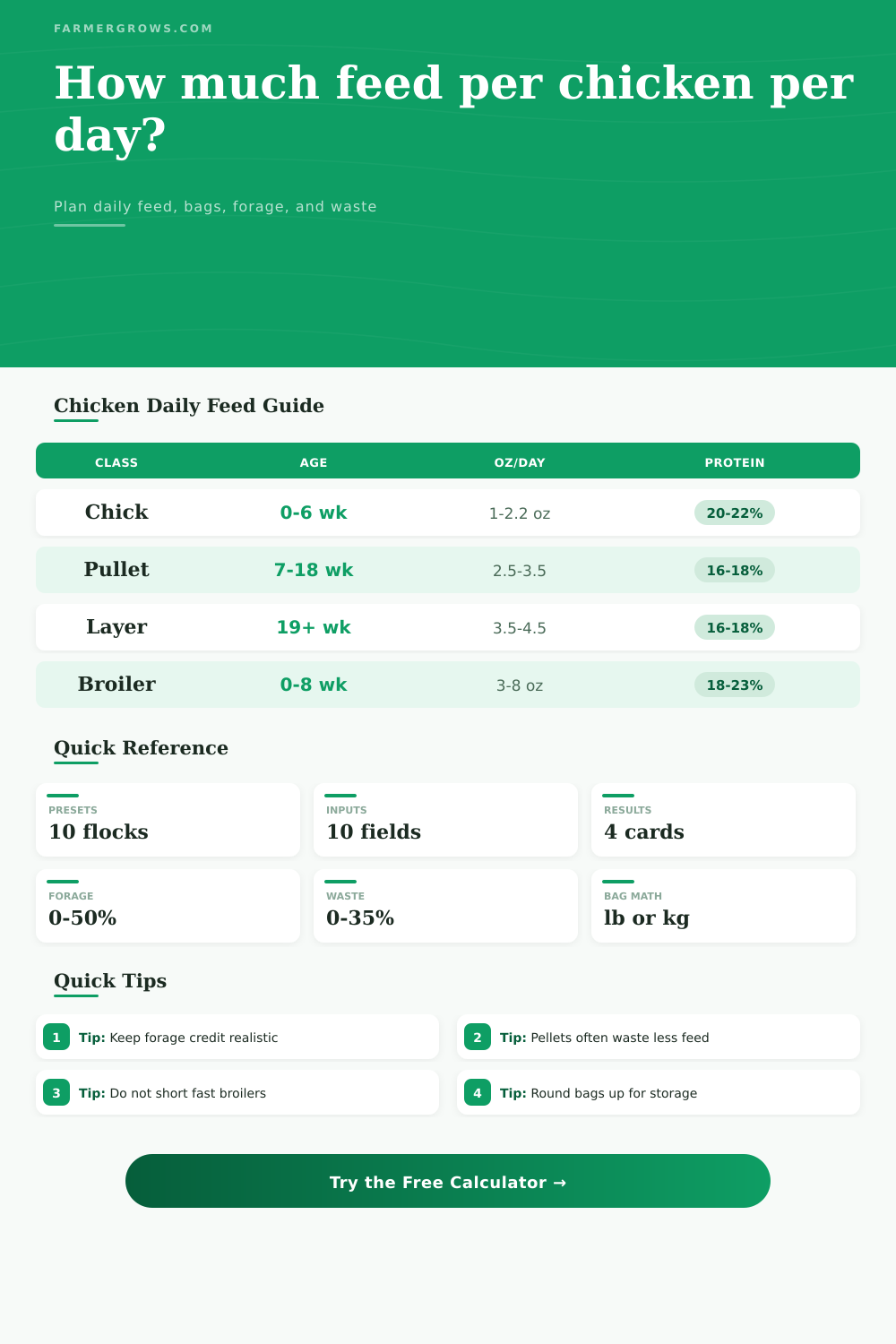
| Chicken class | Typical age or use | Daily complete feed | Protein guide |
|---|---|---|---|
| Starter chicks | 0 to 6 weeks | 1.0 to 2.2 oz per bird | 20% to 22% starter feed |
| Grower pullets | 7 to 18 weeks | 2.5 to 3.5 oz per bird | 16% to 18% grower feed |
| Laying hens | 19 weeks and older | 3.5 to 4.5 oz per bird | 16% to 18% layer feed |
| Broiler starter | Early meat bird phase | 2.5 to 4.0 oz per bird | 21% to 23% meat bird feed |
| Broiler finisher | Late meat bird phase | 6.0 to 8.0 oz per bird | 18% to 20% finisher feed |
| Adult roosters | Maintenance birds | 3.5 to 5.0 oz per bird | 14% to 16% maintenance feed |
| Adjustment | Factor used | Best fit | Planning note |
|---|---|---|---|
| Bantam size | 0.55x | Silkies, Sebrights, small bantams | Small birds eat much less than standard laying hens. |
| Light breed | 0.90x | Leghorn-type layers | Efficient layers often need a slightly smaller ration. |
| Large breed | 1.12x | Orpington, Wyandotte, dual-purpose hens | Large frames raise maintenance feed demand. |
| High egg production | 1.08x | Heavy laying period | Do not cut complete feed too hard during peak lay. |
| Fast broiler growth | 1.18x | Meat bird growout | Broiler feed restriction should follow the breed program. |
| Condition | Calculator effect | Use when | Watch point |
|---|---|---|---|
| No forage credit | 0% removed | Run, coop, winter, or bare yard | Complete feed supplies the full planned ration. |
| Light forage | 5% to 15% removed | Grass yard with some bugs and greens | Still provide complete feed free choice for layers. |
| Strong range | 20% to 35% removed | Rotated pasture during active growth | Use only if birds hold weight and production. |
| Hard cold | 12% added | Cold, damp, snow, or wind exposure | Energy demand can rise even when forage disappears. |
| Heat stress | 6% removed | Hot weather appetite drop | Watch water, shade, shells, and body condition. |
| Feed form or bag | Typical effect | Good use | Planning note |
|---|---|---|---|
| Pellet feed | 0% form change | Adult layers and mixed pens | Usually the easiest form for low waste. |
| Crumble feed | 2% extra | Chicks, pullets, small birds | Fines can increase waste if feeders are too deep. |
| Dry mash | 5% extra | Farm mixed rations | Watch sorting and dusty leftovers. |
| Fermented feed | 5% less dry feed | Managed wet feeding | Use dry-weight bag math, not wet bucket weight. |
| 50 lb bag | 200 layer-days | Standard hens at 4 oz | Round up so the flock does not run short. |
Check the forage credit against the birds. If body weight, egg production, or feather condition slips, lower the forage credit so complete feed carries more of the ration.
Separate waste from appetite. Spilled pellets, dusty fines, rain-soaked feed, and low feeder height should be fixed before assuming the flock truly needs more feed.
So let’s say you start out wanting to keep chickens. You envision a straightforward process. Turns out it means feeding your birds, monitoring their intake. You must make sure you has enough food to last until next time but not more then necessary.
This makes the biology measurable: it allows you to translate that need into an order for food. And it calculates it for you (rather than expecting you to do the work) so you can concentrate on your flock’s well-being.
How to Calculate Your Chicken Feed
The first variable to keep in mind is age. What does a baby chick eat? It’s different than what an adult hen eats. Each stage require certain things. Young birds need higher protein; therefore starter feed is denser. Don’t feed your day old chicks adult mash, you will see issues quickly. They will also have an increased appetite as they grow.
On average, a laying hen consumes around four ounces of food per day. While that might not seem like much for just one bird, multiply this by however many hens you may have and it start to add up!
The calculator takes into account these age class automatically. In order to recieve an accurate result, make sure you choose the right category. Combining different age groups into one calculation throw off the data. If the birds are eating different things, keep the numbers separated.
An Orpington is much bigger than a Leghorn. All other things being equal, larger breeds requires more calories to support their bodies. It’s physics (thermodynamics) not preference. They use up more energy. This is reflected in the reference tables where the heavier breed eat more.
If you’re feeding your birds without regard for size, then you’re either under-feeding your big guys or over-feeding your little guys. Both are bad for health and both will cost you money.
The other variable in the equation is forage. If your free ranging birds are eating weeds, grass, and bugs then some owners think they can halve their feed bill. Often that’s not true. Feed will never be completely eliminated by even good pasture. However, pastures don’t provide consistent nutrition.
You can enter a percentage of forage credit into the calculator to adjust downward how much feed you estimate you need to give. Make sure you keep it reasonable. Ten percent forage credit if you have a small yard is reasonable. Fifty percent means you’re on a managed grazing system that only a very few keeper have. Underestimating forage will result in tired birds and weak egg shells.
The weather is part of the feeding equation. Birds burns more calories to stay warm in cold weather. Digesting food also increases their body temperature, so they eats less when it is hot. This weather adjustment in the tool includes that stress.
So if you live somewhere with harsh winters, there might be times where you’re providing additional energy sources. And in the heat of summer, they might just not have much appetite. Don’t assume a hot bird is necessarily a full bird!
Make sure your inputs reflect what time of year it actualy is (not just the calendar date).
The last variable is waste. The birds don’t eat what falls off the ground. Pellets tend to have less waste than mash because birds can’t pick out only what they like best. Raise that number if your feeder’s up high and your birds is a little clumsy. More waste equals more bags overall.
You won’t have to worry about being out of food before the final bag runs dry. That’s planning for how messy real life really is.
Accurate numbers leads to a stable budget and full feeders.