Hay per Beef Cow per Day Calculator
Estimate daily hay for beef cows from class, body weight, body condition, pregnancy or lactation stage, hay dry matter, forage quality, pasture intake, feeding waste, cold stress, and bale size.
Choose a herd situation, then fine tune cow weight, production stage, hay dry matter, forage quality, pasture contribution, waste, weather, herd size, and bale weight.
Daily Beef Hay Estimate
Results update from cow class, body weight, stage, hay dry matter, forage quality, pasture contribution, waste, cold stress, herd size, and bale size.
Lowest daily need when body condition is adequate and weather is mild. Best fit for mid-gestation winter groups.
Needs more feed as fetal growth rises. Keep hay quality steady before calving to protect condition.
Milk production raises intake quickly. First 90 days after calving usually drives the highest cow hay demand.
Still growing while nursing a calf, so heifers often need better hay than mature dry cows.
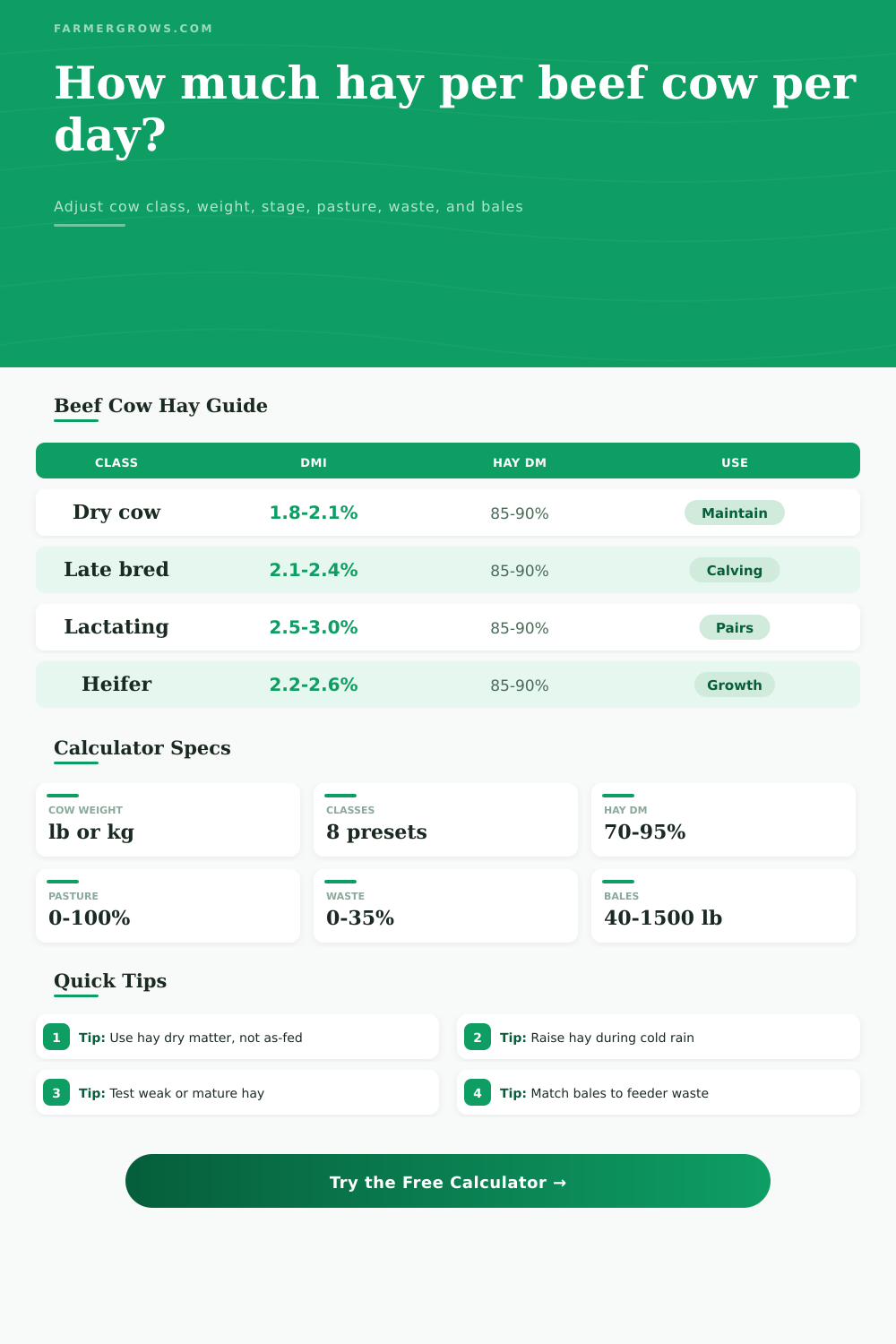
| Beef group | Typical DMI target | Best forage fit | Calculator use |
|---|---|---|---|
| Mature dry cows in mid pregnancy | 1.8 to 2.1% of body weight | Good grass hay when condition is moderate. | Maintenance baseline for winter cow herds. |
| Last 60 days pregnant | 2.1 to 2.4% of body weight | Good hay with enough protein and energy. | Late-gestation stage factor raises intake. |
| Early lactation beef pairs | 2.5 to 3.0% of body weight | Better grass-legume hay or supplement support. | Lactation stage produces the largest hay demand. |
| Growing replacements or stockers | 2.2 to 2.8% of body weight | Higher quality hay for gain and frame growth. | Growth class keeps intake high even at lighter weights. |
| Hay type or condition | Typical dry matter | Quality factor | Feeding note |
|---|---|---|---|
| Dry grass hay, stored inside | 88 to 90% | Good baseline | Use the scale weight as-fed and adjust by dry matter. |
| Mixed grass-legume hay | 85 to 90% | Often higher intake | Useful for late bred cows, thin cows, and pairs. |
| Mature weathered hay | 82 to 88% | Lower intake value | Calculator flags poor quality because pounds alone may not meet needs. |
| Baleage or high moisture hay | 45 to 70% | Use tested DM | As-fed pounds rise sharply when dry matter percentage falls. |
| Situation | Hay adjustment | Watch point | Practical response |
|---|---|---|---|
| Cool but dry weather | About 5% extra intake | Wind exposure can change this quickly. | Keep hay available and check bunk cleanup. |
| Below lower critical temperature | About 10% extra intake | Thin cows and wet hair coats need more help. | Feed better hay or add energy support. |
| Cold rain, mud, or wet coat | About 18% extra intake | Mud increases maintenance needs and waste. | Move feeders and protect feeding areas. |
| Severe wind chill or storm | About 25% extra intake | Short-term demand can exceed normal plans. | Stage bales before storms and reduce waste. |
| Bale type | Common as-fed weight | Best calculator entry | Planning note |
|---|---|---|---|
| Small square bale | 40 to 70 lb | Use actual stack average. | Useful for limit feeding or small groups. |
| 4x5 round bale | 700 to 950 lb | Weigh several bales if density varies. | Days per bale changes quickly with cow count. |
| 5x5 round bale | 950 to 1300 lb | Enter the delivered scale estimate. | Common planning size for cow-calf herds. |
| Large square bale | 900 to 1500 lb | Use dry matter and waste carefully. | Dense bales can feed longer than the same visual size suggests. |
Separate intake from delivery. The cow needs dry matter first; hay dry matter converts that need to as-fed pounds, then pasture and waste adjust what you actually put out.
Group cows by demand. Thin cows, first-calf heifers, and fresh pairs usually deserve better hay or separate feeding before mature dry cows pull the ration average down.
Most ranch margins dissapears during winter feeding season. Half of the year, you have a good deal: Buy some cows for not-too-much money, put ’em on inexpensive pasture, and go home.
But once the grass stops growing, it’s time to pay the piper. If you don’t know exactly how much hay your cows will eat before you start stacking the bales, chances are you’re either going to run out by January… Or overbuy.
How to Plan Your Cow Feed for Winter
This tool (above) calculates their daily dry matter requirements based off their size and production status. It spares you the mental arithmetic in the middle of the night and digging around in extension charts.
The first thing most operators do is guess at their flat-rate-per-head charge (e.g., “fifteen pounds a day“). This will get you through with an average, dry, cow on a nice day but it doesn’t take long before things unravel. In deep snow, a lactating cow that’s nursing a calf is eating almost twice as much then.
It all boils down to dry matter intake, the nutrients the animal ingests, minus water weight. Even hay that appears to be bone-dry in the stack isn’t a hundred percent dry matter. How wet it gets depends on its crop type and how it was stored; you need to convert your as-fed weight into amount that the animal actually digests. If you don’t make this adjustment, you could believe you’re feeding the animals adequately while they’re literally starving for energy.
The poundage isn’t all that counts; it’s the animal’s body condition, too. A cow that’s leaner (body condition score 3) have a higher requirement than one who’s more plump (say a seven), as she must eat more to recover reserves. That’s where the tool comes into play: It lets you set the herd’s physical state as an input, which changes starting point for intake percent.
Then, because the last sixty days of gestation is when fetal growth spikes and the cow’s nutritional demand peaks right before calving, it takes those stages of pregnancy into account. Get it wrong and not only do you have weaker calves, but they’ll be late getting bred again next year, which would of cost a lot more than some additional hay to close that gap.
The silent killer of hay feeding programs is waste. Even if you calculate the perfect ration, you can easily lose twenty to thirty percent of your hay to spoilage and trampling if you’re feeding out of open ring feeders in the mud. The calculator allows you to account for both ground conditions and feeder type by adding that loss back into the total required. It’s a frustrating reality, but accurate. You don’t just pay for what ends up in the rumen, you pay for the whole bale.
Often the cheapest way to reduce your per-head cost is to protect that resource with better feeders or move them around regularily.
The other element that never gets accounted for on paper is weather. The colder it is the more energy those cattle will use maintaining themselves and cold wet cattle are much worse because a wet coat acts like a radiator, draining body heat rapidly. They may only need to bump up their feed a little bit on a cold dry day. But if they have a wet coat, it acts like a radiator and their body heat drain quickly. The tool has built-in allowances for weather so you can be ready for stormy days ahead rather than scrambling trying to find bales as the blizzard arrives. It is better to have too much hay during a blizzard than to scramble around watching the animals get weak in the herd.
The other factor that will change things is the contribution of pasture. Cows may have access to aftermath grazing and/or dormant forage during the winter. If so, subtract that contribution from your total need to avoid over-feeding hay (wasting money) as well as potential digestive problems with a too-abrupt change. Be honest: How much actual dormant or green grass do they really have? You might be tempted to over-estimate remaining pasture in the field.
Not only does planning save money, it will also save your sanity. Knowing that you’ll have enough bales for a certain time of year means you can plan when to purchase (buy now vs. You can plan when to purchase, whether to buy now or wait for lower prices during harvest, or even how to spread those purchases out to avoid unloading three trucks at the same time during a snowstorm.
You can use the reference tables provided with the tool to split common bale size classes, providing a quick sanity check on what you enter as inputs. This way you can see if your estimates match the standard industry ranges or not. If they don’t, then trust the actual calculation for your individual herd situation.
At its core, feeding beef cattle is both a game of brute force and precision. It’s an exercise in balancing energy with environmental damage. When you get the numbers down, you stop worrying about the supply chain and start focusing on the animal itself. The calculator above will do the math for you. But it’s knowing why those numbers vary that keeps your operation profitable. Feed the cow you have today, not the one you planned for last fall.