Hay Per Cow Per Year Calculator
Estimate annual hay for beef cows, dairy cows, growing cattle, and replacement heifers from cow count, cow class, body weight, intake rate, dry matter, hay waste, grazing days, feeding days, cold stress, and bale weight.
Load a named annual cattle plan, then fine tune the head count, cow class, average body weight, intake percent, hay dry matter, waste, grazing calendar, cold stress factor, and bale weight.
Annual Cattle Hay Estimate
Results use dry matter intake first, then convert to as-fed hay and bales after dry matter, waste, cold stress, and feeding days.
Often works with moderate-quality grass hay when body condition is good and weather stress is limited.
Mixed grass-legume hay helps cover extra milk demand while keeping dry matter intake realistic.
Dairy rations usually pair forage tests with ration balancing; this calculator estimates hay inventory only.
Heifers need enough hay for frame growth without pushing excessive condition before breeding.
Baleage can be palatable, but lower dry matter means more as-fed pounds and more bale handling.
Mature bulls may have maintenance intake rates, yet body weight can make their annual hay use large.
| Cattle class | Typical body weight | DM intake target | Planning note |
|---|---|---|---|
| Dry beef cow | 1050 to 1350 lb | 1.8% to 2.2% of BW | Use the lower end for good-condition cows in mild weather. |
| Lactating beef cow | 1100 to 1450 lb | 2.3% to 2.8% of BW | Milk production, calf age, and hay quality drive the upper end. |
| First-calf heifer | 900 to 1150 lb | 2.2% to 2.6% of BW | Plan for maintenance, milk, and continued growth. |
| Growing stocker | 500 to 900 lb | 2.2% to 2.8% of BW | Target gain and supplement strategy matter more than class name alone. |
| Dry dairy cow | 1250 to 1650 lb | 1.9% to 2.3% of BW | Use ration guidance for close-up dry cow groups. |
| Milking dairy cow | 1250 to 1700 lb | 2.7% to 3.8% of BW | This calculator estimates hay inventory, not a complete lactation ration. |
| Hay or forage type | Typical dry matter | As-fed impact | Inventory note |
|---|---|---|---|
| Dry grass hay | 86% to 90% DM | Moderate as-fed weight | Common planning default for beef cow winter hay. |
| Mixed grass-legume hay | 84% to 89% DM | Similar to dry grass hay | Quality can vary widely by cutting and leaf retention. |
| Alfalfa hay | 85% to 90% DM | Often dense and nutrient rich | Test protein, fiber, and relative feed value when ration balancing. |
| Wrapped baleage | 45% to 65% DM | Much heavier as-fed | Enter measured dry matter or bale counts can be far too low. |
| Straw supplement | 88% to 92% DM | Dry but low nutrient density | Use only as part of a balanced plan for cattle needs. |
| Feeding method | Common waste range | Best fit | Planning caution |
|---|---|---|---|
| Ring feeder on firm pad | 5% to 12% | Round bales and winter lots | Move feeders or manage mud to avoid hidden loss. |
| Cone or cradle feeder | 4% to 10% | High-value hay | Works best with enough bunk space for the group. |
| Unrolled bale on pasture | 12% to 25% | Manure distribution and rotation | Weather and stocking density can push waste higher. |
| Ground-fed loose hay | 20% to 45% | Emergency or short-term feeding | Trampling, bedding, and refusal add up quickly. |
| Covered storage, fed daily | 6% to 15% | Small squares or chopped hay | Include storage shrink before daily feeding loss. |
| Scenario | Daily as-fed hay | Feeding days | Annual hay per cow |
|---|---|---|---|
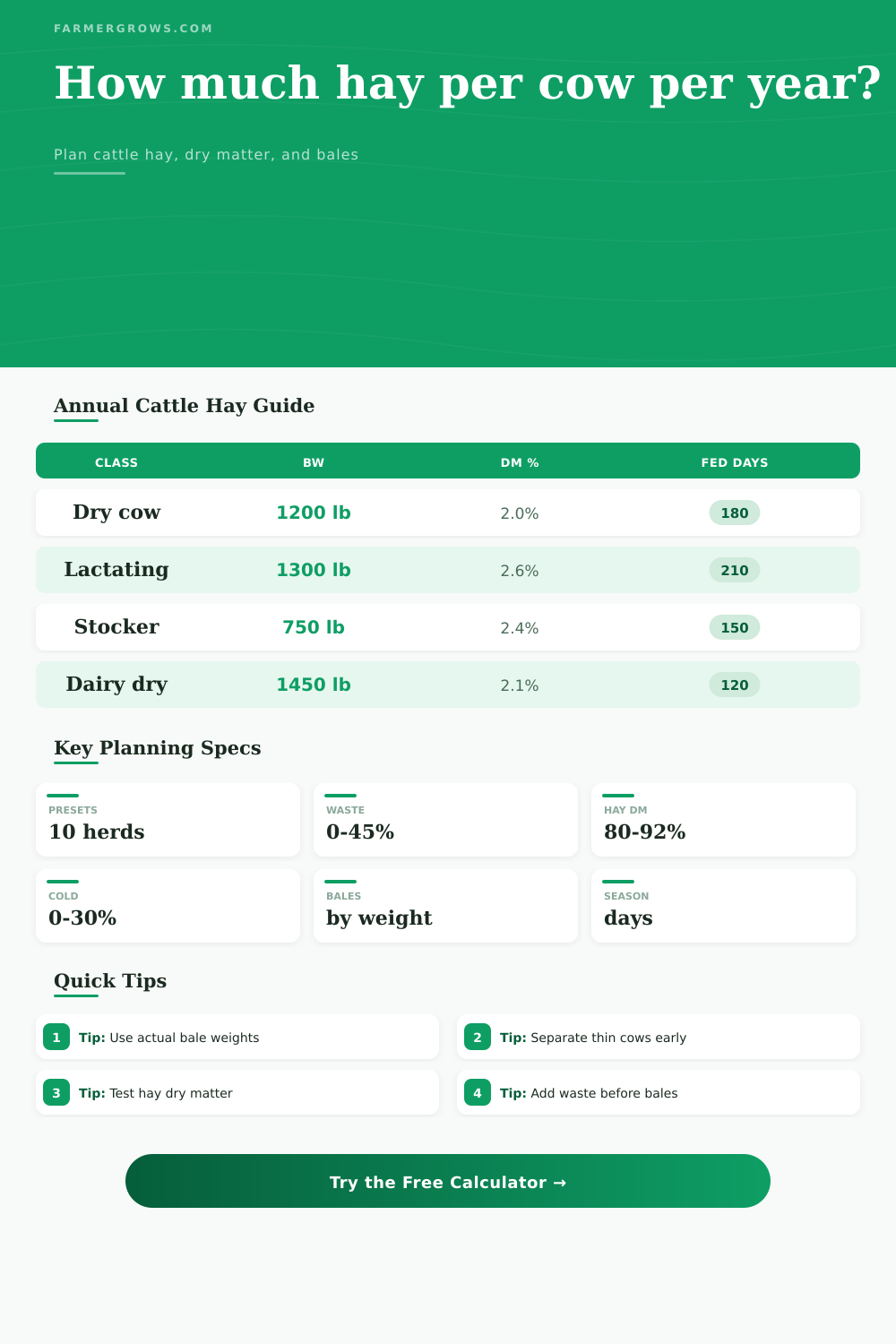
| 1200 lb dry beef cow, 88% DM, 10% waste | 30.3 lb | 180 days | 5450 lb, about 2.7 tons |
| 1300 lb lactating beef cow, 88% DM, 12% waste | 43.6 lb | 210 days | 9150 lb, about 4.6 tons |
| 900 lb replacement heifer, 87% DM, 10% waste | 26.0 lb | 160 days | 4160 lb, about 2.1 tons |
| 1450 lb dry dairy cow, 88% DM, 8% waste | 37.6 lb | 120 days | 4510 lb, about 2.3 tons |
| 750 lb stocker, 86% DM, 15% waste | 24.6 lb | 150 days | 3690 lb, about 1.8 tons |
| Bale description | Common weight | Bales per 20 tons | Inventory use |
|---|---|---|---|
| Small square bale | 40 to 70 lb | 570 to 1000 bales | Good for hand feeding and small pens. |
| Large small-square bale | 80 to 120 lb | 335 to 500 bales | Useful when labor and storage are planned. |
| 4 x 5 round bale | 700 to 1100 lb | 37 to 58 bales | Weight depends on baler, crop, moisture, and density. |
| 5 x 6 round bale | 1200 to 1800 lb | 23 to 34 bales | Heavy bales reduce count but need suitable handling equipment. |
| Wrapped baleage bale | 1000 to 1800 lb | 23 to 40 bales | Lower dry matter means more as-fed pounds per cow. |
Thin cows, young cows, and late-gestation or lactating cattle often need a separate hay plan. Sorting them can lower total waste while protecting body condition.
Bale counts are only useful after you know average bale weight and dry matter. A few weighed bales can prevent a large annual planning error.
Farm profit and herd health depend on winter feed. Managing pasture well will reduce risk, but even with good grazing management, when your hay supply deplete in March, it’s too late. You’re selling marginal cows in spring or feeding them expensive grain. Know what you need for hay before the snow flies.
Don’t just stack bales; align logistics with biology.
How to Plan Your Winter Hay Supply
Feed stores will tell you what they think. So will other producers, guessing at last year’s events (or the one before that). That’s bad science. Every winter is different and each individual cow is different. A nursing cow in a blustery cold winter require more than a dry cow in a mild climate.
The calculator does math for you: how many days are you feeding? How much weight do your animals have? It moves you away from fixed figures and into thinking about intake relative to their body weight. A 1000 pound cow isn’t the same thing as a 1200 pound cow; the bigger one has more tissue to sustain it.
Hay planning is also about waste. On ground, cows don’t consume everything in a bale. Some stems are left behind and some get stepped on or kicked. Then weather turns hay into mud, and some is lost in storage before feeding starts. Assuming there will be no waste lead to shortages. The tool allows you to change assumed percentage of waste. A ring feeder on concrete will result in less waste than dropping bales onto muddy lots. Be truthful about your infrastructure. Set the waste factor high if you feed on the ground. Better to have more hay then none when there’s a blizzard.
Another confusing term is dry matter. Moisture in hay isn’t all edible fiber! A thousand-pound bale might only have eight hundred pounds of actual nutrients in it. So, when you look at hay values or test your own, be sure to look for the dry matter percentage. Then the calculator will divide out what you need by that number, which shows you how much as-fed hay you require. This is important because things like baleage and grass hay have different water contents than alfalfa, so you will need a larger amount of weight to get same amount of nutrition. If you don’t account for it, you’ll end up with hungry cows and empty stalls.
Feeding plans becomes even more complicated with cold stress. Strong winds and wetting of the coat cause cattle to require additional energy to maintain body heat. For this reason, there’s a stress factor included in the tool. It’s a buffer for reality. Weather is uncontrollable; however, expecting it allow you to plan accordingly, meaning you increase intake needs during most difficult months. Making this slight adjustment will prevent catastrophic loss down the road.
That’s where the bales come in. Tons are good for accounting. But they’re what you load into trucks. And how many bales do you have? How will you get all those big rounds onto your tractor? Is there room at home for all of them?
Plan on a 10 percent reserve to act as a safety net against weather mishaps, such as an extra-early frost or a late spring thaw. If you plan, then your animals stays in shape. You should of known how many bales?
Stop worrying. Start managing.