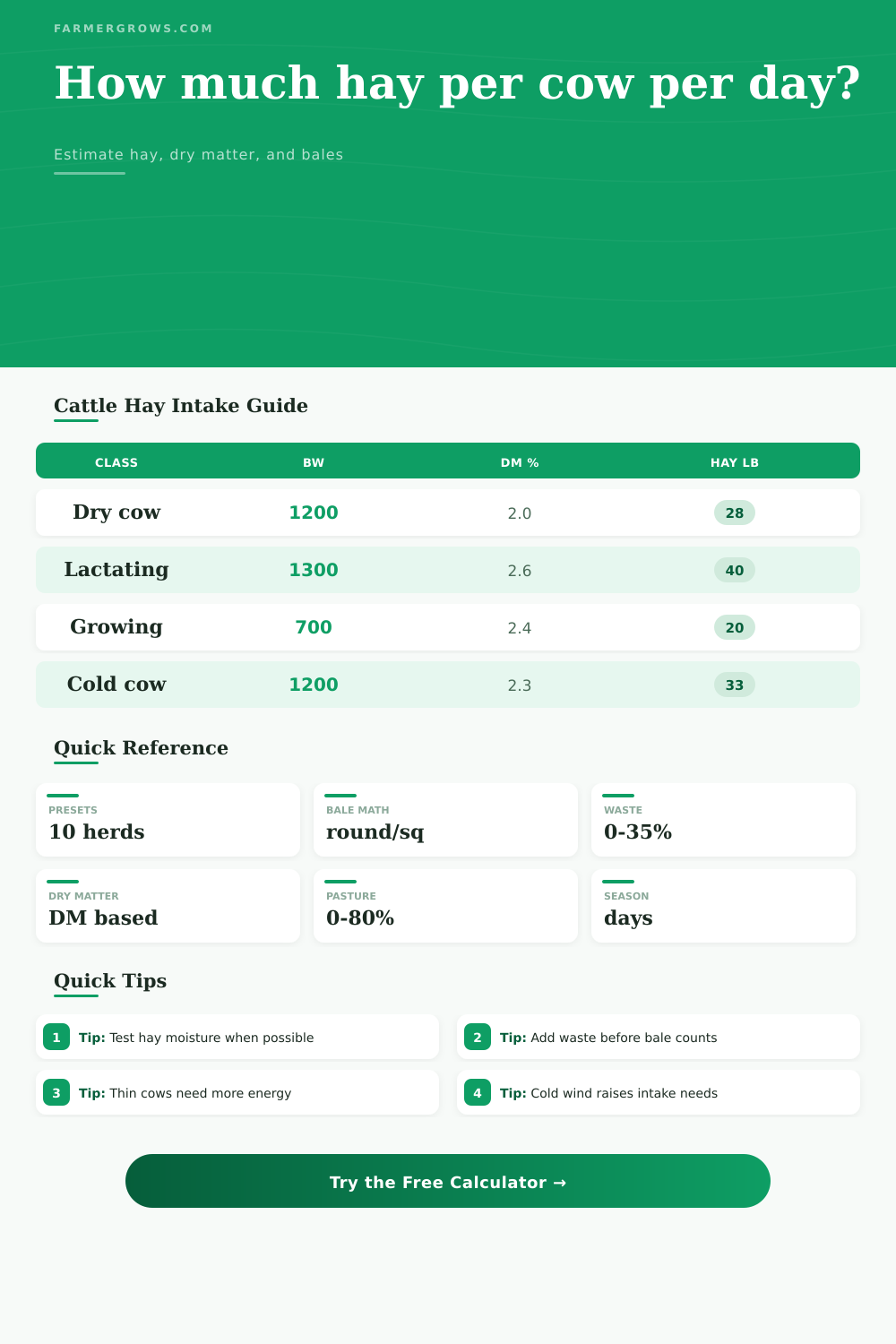
Hay Per Cow Per Day Calculator
Estimate hay for beef cows, dairy cows, growing cattle, and winter feeding groups from body weight, forage dry matter, waste, pasture contribution, body condition, and cold stress.
Choose a herd situation, then adjust the head count, weight, hay dry matter, waste, pasture credit, bale size, condition, and weather pressure for your ration plan.
Maintenance cows usually have the lowest hay demand, but thin condition or cold weather can quickly raise the daily allowance.
Milk production lifts intake needs, so lactating cows often require noticeably more hay or higher quality forage each day.
Stockers and replacement heifers need enough forage for frame growth, with changes based on target gain and forage quality.
Hay Feeding Estimate
Results are shown as-fed for the hay you enter, after pasture credit and feeding waste are applied.
| Cattle situation | Body weight | Intake target | Hay at 88% DM, 15% waste |
|---|---|---|---|
| Dry beef cow, moderate condition | 1,100 lb | 22.0 lb DM/day | 29.4 lb as-fed/day |
| Dry beef cow, larger frame | 1,300 lb | 26.0 lb DM/day | 34.8 lb as-fed/day |
| Lactating beef cow | 1,250 lb | 32.5 lb DM/day | 43.4 lb as-fed/day |
| Growing replacement heifer | 750 lb | 18.0 lb DM/day | 24.1 lb as-fed/day |
| Cold-stressed dry cow | 1,200 lb | 26.9 lb DM/day | 36.0 lb as-fed/day |
| Forage type | Dry matter | As-fed hay for 24 lb DM | Planning note |
|---|---|---|---|
| Very dry grass hay | 90% | 26.7 lb before waste | Less water weight, lower as-fed pounds. |
| Average cured hay | 88% | 27.3 lb before waste | Good default when no forage test is available. |
| Weathered hay | 82% | 29.3 lb before waste | More as-fed pounds are needed for the same dry matter. |
| Baleage or high moisture hay | 55% | 43.6 lb before waste | Use a forage test because water weight changes the ration. |
| Feeding setup | Typical waste | Use in calculator | Why it matters |
|---|---|---|---|
| Cone or ring feeder on firm pad | 5% to 10% | Enter 8% | Less trampling and better bale access. |
| Standard ring feeder | 10% to 18% | Enter 15% | Common all-around planning value. |
| Unrolled daily hay | 12% to 25% | Enter 18% | Can work well if fed to match daily appetite. |
| Bales fed on mud or snow | 20% to 35% | Enter 28% | Ground loss can drive total hay needs sharply higher. |
| Bale type | Typical weight | 50 cows at 30 lb/day | 120-day season |
|---|---|---|---|
| Small square bale | 50 lb | 30 bales/day | 3,600 bales |
| Large square bale | 800 lb | 1.9 bales/day | 225 bales |
| Medium round bale | 1,000 lb | 1.5 bales/day | 180 bales |
| Large round bale | 1,200 lb | 1.3 bales/day | 150 bales |
Use dry matter first. Hay pounds can look high or low simply because moisture changed, so base the plan on dry matter and then convert to as-fed hay.
Separate the hard keepers. Thin, young, lactating, or cold-stressed cattle may need a different group allowance than mature cows in moderate condition.
With higher gas prices, thinner margins and fewer pennies to spend, you have to plan forage as a business. That one wrong guess at how much to feed each bale of hay could spell the difference in purchasing costly supplements in February versus having some bales left over. Planning isn’t about surviving anymore. It’s about using resources wisely while controlling costs.
The first question most producers ask is “How many bales do I need?” Wrong answer. Start with dry matter intake. Hay contains both water and nutrients, and that moisture percentage affects the value of the foodstuff. A 1,000-pound bale that is 90% dry matter is much more nutrient-dense than a 1,000-pound bale that is only, say, 82%. The calculator does all the conversion math for you so you don’t have to guess what percentage of each bale is actualy water. People make that mistake. They think they’re buying by the ton, but they end up feeding by a pound of actual dry matter.
How to Plan Your Hay Feeding
The starting point for the appetite meter, however, is cattle class. The average dry beef cow in moderate condition will maintain on roughly two percent of her body weight per day as dry matter intake. That figure increase toward two and a half percent when she is lactating, and sometimes even reaches two and six tenths percent. Stocker calves require slightly more to fatten them up. And these aren’t random numbers. They’re the metabolic truths. You can’t keep starving factory and expect it to produce. A lactating animal is running a biological factory.
The weather gets in on the act, too. Wet hair coats and/or wind chill will increase cow energy consumption as they work hard to keep warm. Cold stress adjustments can help with that. They may not shiver but their rumen is working overtime creating heat for them. If you don’t account for this when facing a polar vortex, it’s a quick ticket to lower conception rates and weight loss come spring time.
Waste is the other silent budget killer. Whether you feed hay out of a round bale or from a bag, how do you deliver it? The way you do so can make a big difference between what gets to the rumen and what is blown away by wind or stomped into the mud. If you have a good ring feeder positioned on a solid pad, waste may be closer to ten percent. If you drop a round bale onto soft ground, that loss could of been over thirty percent. It is the same bale but a different delivery, leaving a third of your investment to rot in the soil.
If you have stockpiled forage, that gives you a little pasture credit. This means that as long as your cows graze leftover grass, don’t feed them a full bellyful of hay. Deduct that from your daily tally and it’s quite a load off your hay burden. Be realistic, however regarding how much real green grass they’re eating. Hope doesn’t fill anybody’s belly.
Adjustments can be based off body condition score as well. The heavier keepers don’t need as much and the thinner cows will require more time to recuperate. Adjust these inputs to ensure you are not under-feeding the cow who struggle to maintain weight or over-feeding the heavier keepers.
The hay plan is a balancing act. It’s a balancing act. You must consider weight, moisture, and behavior. It’s not as simple as ‘stacking bales’. You’re balancing energy needs against energy input and environmental loss. Get the dry matter right. Account for waste. Wake up in January with full feed bunk and a clear head. That’s how you win the winter.