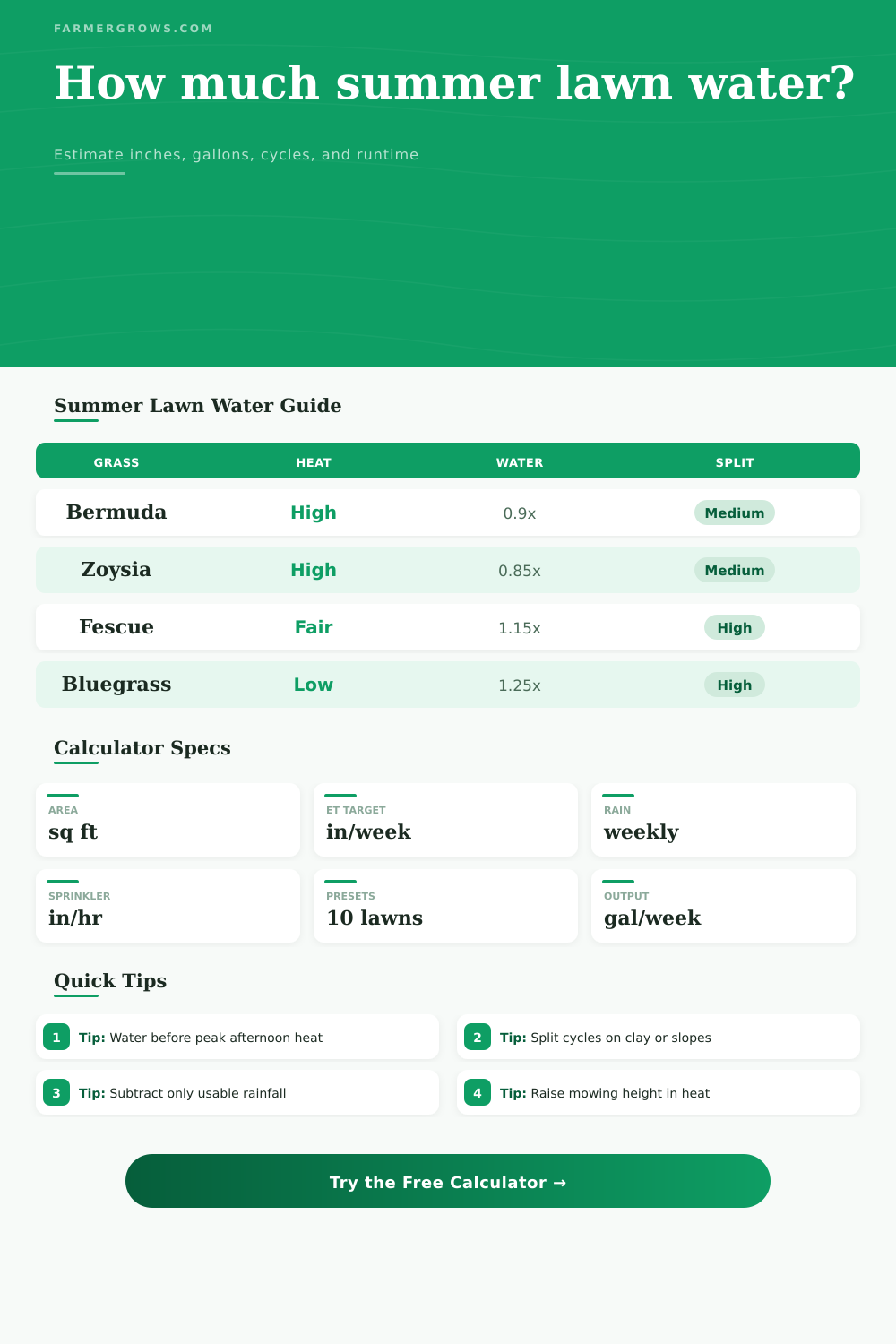
Lawn Watering in Summer Calculator
Estimate how many inches, gallons, sprinkler minutes, and weekly cycles your lawn needs during hot weather using grass type, ET target, temperature, soil, shade, rain, restrictions, and visible drought stress.
Choose a common hot-weather lawn situation, then fine-tune sprinkler rate, rainfall, shade, or watering limits to match your yard.
Summer Watering Plan
Results update from your lawn size, grass, heat, rainfall, soil, restrictions, and sprinkler rate.
Strong summer recovery; lower water factor when mowed high enough.
Dense turf with good drought response, but slow recovery from deep stress.
Good survival under low water; appearance may thin during dry spells.
Low-water turf where summer irrigation can stay conservative.
Handles heat but wilts quickly when roots are shallow or soil is sandy.
Moderate summer demand; avoid frequent shallow watering.
Cool-season turf often needs more irrigation during hot weeks.
Can go summer dormant; green color takes more water in heat.
| Grass type | Summer water factor | Typical weekly range | Heat note |
|---|---|---|---|
| Bermuda | 0.90x ET | 0.75 to 1.25 in | Best with deep, less frequent irrigation. |
| Zoysia | 0.85x ET | 0.70 to 1.20 in | Good drought tolerance, slow fill after dormancy. |
| St. Augustine | 1.05x ET | 1.00 to 1.50 in | Watch sandy lawns for midday wilt. |
| Bahia | 0.75x ET | 0.50 to 1.00 in | Survives dry periods but may look stemmy. |
| Buffalo | 0.65x ET | 0.35 to 0.85 in | Low-water turf for hot dry climates. |
| Tall fescue | 1.15x ET | 1.25 to 2.00 in | Needs careful summer support in heat. |
| Soil texture | Calculator factor | Suggested max per cycle | Summer watering behavior |
|---|---|---|---|
| Sandy soil | 1.12x | 0.35 in | Low holding capacity; use shorter cycles. |
| Sandy loam | 1.05x | 0.45 in | Moderate holding; watch dry edges. |
| Loam | 1.00x | 0.55 in | Balanced soak and holding capacity. |
| Silt loam | 0.98x | 0.48 in | Can seal on top if watered too fast. |
| Clay soil | 0.94x | 0.40 in | Holds water, but runoff starts quickly. |
| Compacted or sloped | 1.08x | 0.30 in | Needs cycle-and-soak to limit waste. |
| Sprinkler rate | Minutes for 0.25 in | Minutes for 0.50 in | Best use |
|---|---|---|---|
| 0.25 in/hr | 60 min | 120 min | Slow rotors or weak coverage. |
| 0.50 in/hr | 30 min | 60 min | Common rotor baseline. |
| 0.75 in/hr | 20 min | 40 min | Mixed rotor or spray zones. |
| 1.00 in/hr | 15 min | 30 min | Many fixed spray heads. |
| 1.50 in/hr | 10 min | 20 min | High-output sprays; split cycles. |
| Restriction setting | Allowed days used | Planning approach | Runoff caution |
|---|---|---|---|
| No weekly limit | Up to 7 | Spread cycles over the week. | Still avoid shallow daily watering. |
| Odd/even addresses | Up to 3 | Use every other legal morning. | Split if each cycle exceeds soil limit. |
| Three assigned days | 3 | Good fit for most summer lawns. | Cycle clay and slopes. |
| Two assigned days | 2 | Use deeper cycles with soak breaks. | Check runoff at sidewalks. |
| One assigned day | 1 | May need multiple short cycles that day. | Severe stress may persist. |
| Hand watering only | 1 | Prioritize hot spots and new sod edges. | Measure output if using hose sprinklers. |
Cycle-and-soak: If calculated runtime is longer than your soil can absorb, split it into two or three starts with 30 to 60 minutes between starts.
Stress check: Footprints, folded blades, and bluish color mean the lawn is short on water; puddles or mushrooms mean the schedule is too wet.
By 10 a.m., it’s likely ninety outside, and the grass look like it could use some rain. But how much, exactly? How long should you turns on the sprinkler each evening (or whenever)? The conventional wisdom (run it an hour), every night, is good advice except when we’re in a heat wave, or in a drought, which make it seem as if the hose is spraying money up into the air. You need a happy medium: getting enough moisture into soil without wasting precious drops. I’ve found one; so has this company, which makes the tool above to help you get it just right.
Homeowners tend to guess at watering based off their lawn’s color: If it looks yellowish, I’m thirsty! This is frequently not true; your lawn will show symptoms of dryness late in the game, sometimes well past the point of no return when the root system has also become parched. To avoid that, plan to replace what was lost to water loss (ET). Evapotranspiration refers to water loss via plant transpiration plus evaporation from the soil.
How to Water Your Lawn Correctly
The calculator starts with ET and then modifies it based on grass variety. Cool-season lawns such as fescue tend to require slightly more water each week then do warm-season ones like Zoysia or Bermuda. Why? Because warm-season varieties is adapted to heat; they love it, and therefore loses less water during the summer months. In contrast, cool-season turf lose more moisture in the summer; deep but regular watering are essential to maintain its strength in the face of the sun’s heat.
On the ground, water will either soak in or run off, depending on the soil type. I know that sounds obvious, but did you know that the texture of your soil also affects it capacity to retain water? Sandy soils drain fast, meaning they don’t hold enough water for the roots to reach. Clay soils is like sponges; they absorbs water slowly but hold it tightly. Watering a clay lawn for an entire hour in one session can result in half the water running down the street. To compensate, the calculator recommends watering on a cycle-and-soak schedule. Run the sprinkler for fifteen minutes, wait an hour, and run it again. It is tedious, but it is effective for getting water into the clay soil without causing runoff.
Add this twist: What about rain? A gentle summer shower doesn’t necessarily excuse you from watering duty. In fact, the tool accounts for the rain… But accurately. Because heavy downpours tend to bounce off crusty lawns and evaporate before penetrating deep into the ground, the credit for rain gets subtracted…with a caveat. It subtracts only what actualy makes it through.
No, that’s not a reason to go easy on the lawn by assuming that a little bit of sprinkling is enough. Watering too little (thinking, “I’ll skip today”) risks leaving the lawn chronically dry instead of just temporarily thirsty. Shade operates similarily. Trees will cause lower evaporation rates in those areas beneath them, requiring less run time than their sun-baked neighbors. Run your shaded sections at the same length as your sunny slopes and you risk rotten root systems, not saved lawns.
There are other reasons you might be watering differently: municipal watering restrictions make you do so. You can’t simply water less when you’re only allowed to water twice a week; instead you must water smarter.” This means watering deeper and more intensely during the days you are allowed to water. And here we come around again to the limitations of soil. How will clay soil fare if you’re only allowed one day? It won’t do well, so you’ll should of have to water in multiple short cycles across several hours to prevent runoff. This becomes another logistical matter, but it keeps the lawn from turning patchy and brown which indicates severe drought stress.
So what does it give me? It shows gallons used. Minutes per zone. It shows inches per week. It is a prescription for my lawn. And that is not just any number. That’s a number based on my unique circumstances. Follow it and you won’t waste water; your lawn will be green. Ignore it and you’re back at square one: making guesses. The calculator gives its best guess and tells you to start there. Let your grass tell you if it likes it or not, and tweak accordingly. No one wants a perfect lawn anyway. We want a sustainable one. Water it and keep the root zone wet; let the math take care of the rest.