Water for Lawn Calculator
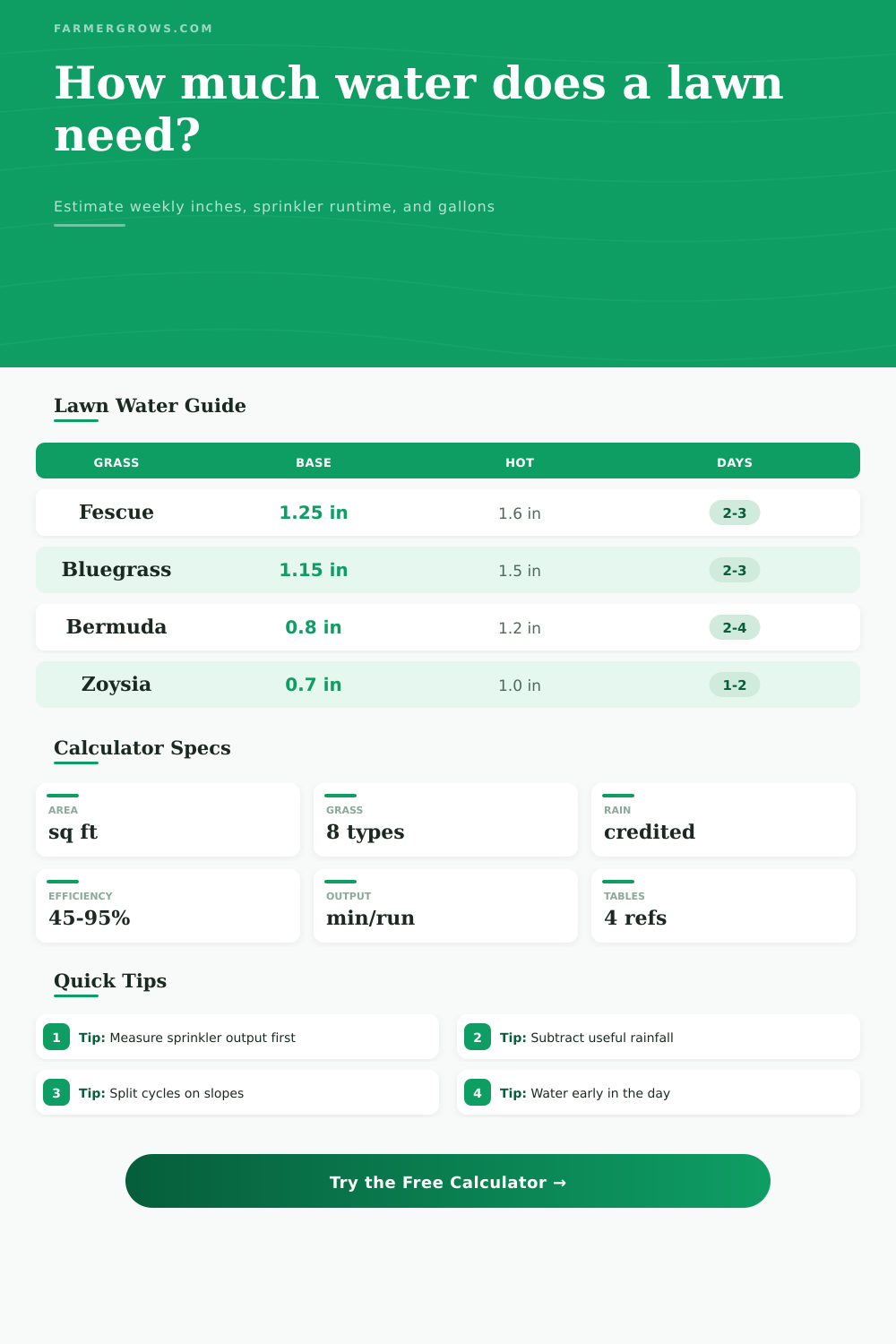
Estimate weekly lawn watering from square footage, grass type, soil texture, season, temperature, rain, sprinkler precipitation rate, irrigation efficiency, slope, shade, and a custom target inches per week.
Choose a named lawn scenario, then fine-tune the weekly rain, sprinkler output, shade, slope, and target watering depth for the actual zone.
Often needs 1.0 to 1.5 inches weekly in warm weather. Deep roots help if watering is less frequent but thorough.
Recovers well from stress but usually needs steady moisture during summer heat to avoid dormancy.
Handles heat and lower water better than many cool-season lawns, especially in full sun and sandy soils.
Slow-growing and drought-tolerant, often needing less weekly water once it is mature and rooted.
Lawn Watering Results
Use these values as a starting schedule, then verify soil moisture with a screwdriver, probe, or small core from the root zone.
| Grass type | Typical target | Heat adjustment | Best watering pattern |
|---|---|---|---|
| Tall fescue | 1.0 to 1.5 in/week | Add 10% to 25% in hot dry weeks | 2 to 3 deep waterings |
| Kentucky bluegrass | 1.0 to 1.4 in/week | Add water during active summer growth | 2 to 3 waterings or allow dormancy |
| Fine fescue | 0.75 to 1.1 in/week | Lower need in shade, higher in sun | 1 to 2 deep waterings |
| Perennial ryegrass | 1.0 to 1.5 in/week | Needs steady water in heat | 2 to 3 waterings |
| Bermuda grass | 0.6 to 1.2 in/week | Performs well under heat if rooted | 2 to 4 lighter warm-season waterings |
| Zoysia grass | 0.5 to 1.0 in/week | Often tolerates lower summer water | 1 to 2 deep waterings |
| Buffalograss | 0.35 to 0.75 in/week | Use less in drought-tolerant sites | Occasional deep watering |
| Mixed cool-season turf | 0.9 to 1.3 in/week | Follow the thirstiest visible grass | 2 to 3 waterings |
Targets are planning ranges for established lawns. New sod, new seed, disease pressure, or local restrictions can require a different schedule.
| Sprinkler type | Typical in/hr | Minutes for 0.5 in | Notes |
|---|---|---|---|
| Fixed spray heads | 1.3 to 2.0 | 15 to 23 | Fast application; watch runoff on clay. |
| Rotary nozzles | 0.4 to 0.8 | 38 to 75 | Slower, often more even on slopes. |
| Gear rotors | 0.25 to 0.75 | 40 to 120 | Good for larger zones but needs longer runtime. |
| Impact sprinklers | 0.2 to 0.6 | 50 to 150 | Highly dependent on pressure and spacing. |
| Traveling sprinkler | 0.2 to 0.5 | 60 to 150 | Use catch cans because speed changes depth. |
| Oscillating hose sprinkler | 0.3 to 0.9 | 33 to 100 | Output varies across the rectangular pattern. |
| Site condition | Water holding | Max minutes before soak | Cycle advice |
|---|---|---|---|
| Sandy level lawn | Low | 25 to 35 | More frequent, smaller amounts. |
| Loam level lawn | Medium | 35 to 50 | Usually handles 2 deep weekly runs. |
| Silt loam | Medium-high | 30 to 45 | Check surface sealing after heavy rain. |
| Clay level lawn | High but slow intake | 18 to 30 | Split runtime with a soak gap. |
| Moderate slope | Runoff prone | 12 to 22 | Use 2 to 4 cycles per watering. |
| Compacted soil | Restricted | 10 to 20 | Aeration may improve infiltration. |
| Condition | Factor | When to use it | Example impact |
|---|---|---|---|
| Spring growth | 0.75 to 0.90 | Cool soil, active growth, milder sun | 1.2 in target becomes about 1.0 in |
| Early summer | 0.95 to 1.05 | Warm days but not extreme heat | Target stays near normal |
| Peak summer | 1.10 to 1.25 | Hot sunny weeks with drying wind | 1.2 in target may become 1.5 in |
| Fall recovery | 0.75 to 0.95 | Cool nights and lower evaporation | Reduce runtime gradually |
| Dormant or low growth | 0.35 to 0.60 | Intentional dormancy or winter protection | Water only enough to protect crowns |
Check depth after watering. Push a screwdriver or soil probe into the lawn. If the watered layer is shallow, increase runtime or split into cycles instead of guessing from minutes alone.
Use rain as a credit, not a promise. A short storm may wet leaves but miss the root zone. Count only rain that soaks in and adjust again after checking soil moisture.
When you water your lawn, do you turn on tap until “it feels right”? That’s how we fill up sinks, but not how grass feel about our feelings.
Grass cares about depth. Just misting the top inch of soil with a shallow sprayer keeps its roots shallow, baking them all summer long. To force roots downward, where they’ll become drought-resistant, you need to soak deeply and slow (pushing water down into the soil).
How to Water Your Lawn
The trick is knowing what that means for your lawn. Enter the calculator, it’ll do the math. You just has to learn to translate.
Here’s where the first variable catches folks: What kind of grass? That may sound obvious, but a Tall Fescue lawn is not the same than a Bermuda lawn. Biologically speaking, they’re two different machine.
A cool season grass such as Fescue or Kentucky Bluegrass has shallow roots, making it dry out quicker. These types of lawns requires regular watering to remain green. By contrast, a warm season grass such as Bermuda or Zoysia is tougher; it can absorbs a dry period better and will go dormant during hot weather. Mistaking a needy Bluegrass lawn for a resilient Bermuda one results in money wasted and mud made. Some types of grass honestly do requires less water than others.
And then there’s the matter of the soil. Homeowners don’t usually check this. Is your soil heavy clay? Water pools on surface and then rolls off before it can penetrate. Or is it sandy? So much water rushes through too quickly for the roots to grab hold.
This is where the tool has its say: it factors in both the soak time and the cycle time. On clay or a slope, you’re not going to set a timer for an hour and go out back and leave. The water will puddle up and run downhill so the upper part of hill will be dry while everything at bottom end is soaked. You’ll need to divide that hour into three sessions of 20 minutes each, pausing between them. It is more work, but it is the only way to get anything in the root zone rather than down the street gutter.
There’s also the matter of inefficiency, which is the other invisible expense. Most home sprinkler systems aren’t perfect. Old nozzles is inefficient. Wind catches the water and blows it onto the sidewalk. There is also overspray on the house.
To adjust for this inefficiency, the calculator look for an efficiency percentage. If your sprinkler system is just seventy five percent efficient (meaning that you need to operate it longer in order to put down the same amount of water that a perfect system would), then you’re always under watering, even if the timer tells you otherwise. And yes, it’s a little thing. But it still matters. If you ignore it, then you’re ignoring inefficiency (and thus always under watering).
You can also fudge the rain credit easy. Raining doesn’t equal hydrated lawn. Rain on the leaves is no good. It may be a quarter inch or maybe more, but it won’t soak into the topsoil. The rain must soak in to reach the root zone. By subtracting the actual rainfall recorded in your tool, you can avoid overwatering when we get heavy storms, which is just as bad than underwatering. Oversaturated soils kills roots; cutting them off oxygen.
This will tell you how many gallons of water to put on, and also the run time in minutes. Don’t take this as gospel; take it for a guideline. You should of used more math.
After watering, stick a screwdriver into the soil. Does it go right in? That means it’s down six inches or so. Is it stuck? You don’t have enough depth; get out there and dig deeper. Was it like wet cement? Less is more.
It’s all about watching the ground and watering based off what you see. The math is the beginning. Then use your eyes.