Space for Corn Calculator
Plan a corn block from plot length, plot width, corn type, row spacing, in-row spacing, target population, germination, block rows for pollination, equipment aisles, fertility level, and planting method.
Choose a named layout, then adjust the spacing, germination, aisle, fertility, and planting method to match your actual field or garden block.
Short, repeated rows improve pollen shed across silks and are usually better for sweet corn gardens.
Useful along fences or beds, but needs several parallel rows or hand shaking for stronger pollination.
Can raise population in field, silage, or baby corn layouts where fertility and moisture support it.
Keeps sprayer, picker, or cart lanes out of the plant count so seed orders match usable row space.
Corn Spacing Results
Your corn spacing plan will appear here.
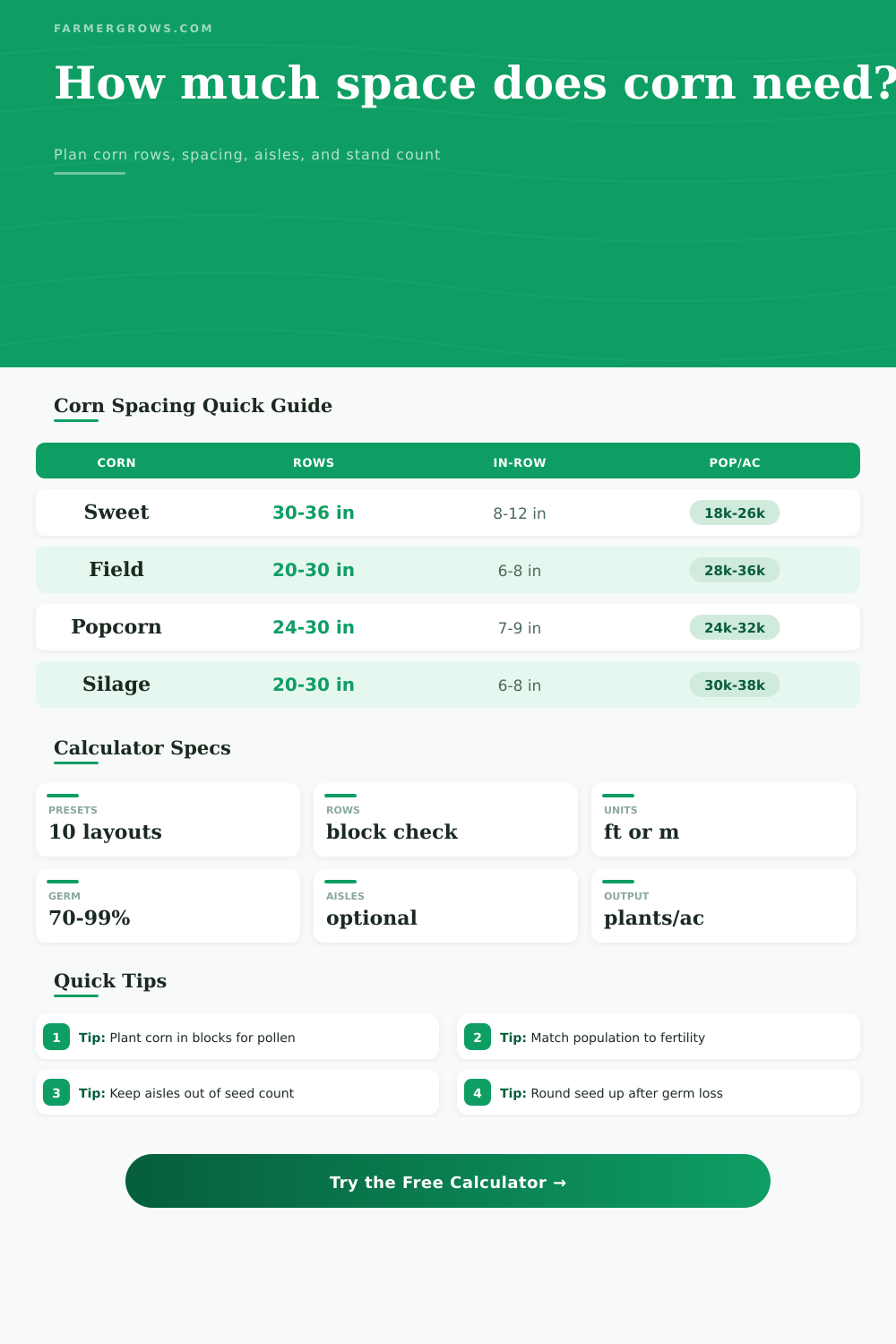
| Corn type | Typical row spacing | Typical in-row spacing | Usual stand target |
|---|---|---|---|
| Sweet corn garden block | 30 to 36 inches | 8 to 12 inches | 18,000 to 26,000 plants/ac |
| Field grain corn | 20 to 30 inches | 5.5 to 8 inches | 28,000 to 36,000 plants/ac |
| Silage corn | 20 to 30 inches | 5.5 to 8 inches | 30,000 to 38,000 plants/ac |
| Popcorn | 24 to 30 inches | 7 to 9 inches | 24,000 to 32,000 plants/ac |
| Flint or flour corn | 30 to 42 inches | 10 to 15 inches | 16,000 to 26,000 plants/ac |
| Baby corn | 18 to 24 inches | 3 to 5 inches | 50,000 to 80,000 plants/ac |
| Fertility level | Best fit | Population guidance | Spacing note |
|---|---|---|---|
| Low fertility or dryland | Food plots, dry gardens | Use the low end of the type range | Wider in-row spacing protects ears and water. |
| Medium fertility | Most home and market blocks | Use the middle of the type range | Good starting point for sweet corn and popcorn. |
| High fertility and irrigation | Field, silage, intensive sweet corn | Use the upper half of the type range | Closer rows or plants can work with steady moisture. |
| Organic high-compost block | Garden blocks with rich soil | Moderate to moderately high | Dense canopies still need airflow and weed control. |
| Planting method | Seed count adjustment | Use this when | Layout caution |
|---|---|---|---|
| Hand seeded rows | 1.05x | Garden rows or small plots | Thin doubles so final spacing stays even. |
| Plate planter | 1.03x | Push or small tractor planter | Check plate skip and double rate in the row. |
| Precision planter | 1.00x | Calibrated field planter | Seed meter spacing should match the target. |
| No-till planter | 1.08x | Residue, cover crop, or firmer soil | Emergence often needs a little extra allowance. |
| Hill planting | 1.12x | Traditional gardens or Three Sisters | Use hill spacing as a cluster count, not single plants. |
| Transplanted starts | 1.00x | Early sweet corn starts | Population depends on surviving transplants. |
| Layout choice | Pollination strength | Access | Calculator effect |
|---|---|---|---|
| 2 rows | Weak to moderate | Very easy | Shows a warning for most sweet corn blocks. |
| 4 rows | Good garden minimum | Easy with side paths | Useful default for small sweet corn plots. |
| 6 to 8 rows | Strong | Needs planned paths | Aisles can be deducted after each row block. |
| 12+ rows | Field-like | Equipment friendly | Population target becomes the main density check. |
Keep the pollen block honest: A short block of four or more rows usually fills ears better than one long row because pollen lands across neighboring silks.
Adjust density to the weakest limit: If fertility, water, or weed control is uncertain, widen the in-row spacing before the crop sets ears under stress.
When it comes to corn spacing, most of us think it’s just a matter of throwing some seed along a row and hoping for the best. Corn are actualy pollinated by windblown pollen from nearby plants and needs fullness in all kernels. An ear can look like this if you don’t provide enough chances for a pollen cloud to cross-pollinate them. (Planting a long row means that the innermost plant will have little chance of being blown pollen from either side.) To overcome this, plan on planting in blocks, four or more rows close together, where the pollen clouds intersects well.
It sounds easy but there is many factors to balance when working out the math for your own bit of ground. After you input the size of your plot and what kind of corn you want, the calculator do all the work. It calculates how many seeds to sow. It also takes into account factors like soil fertility, loss from germination rates, and the size of aisles between equipment rows. This produce a more realistic estimate of plant counts then most gardeners realize.
How to Space Your Corn Plants
Remember: Seed packets are not a guarantee of 100 percent emergence. If you have less-than-perfect conditions in the field, some seeds will fail to emerge even with a high germination rate. You’re going to have to plan on planting more seeds than the final number you’d like to see pop up in your row. The calculator would of increase the seed count according to those variables so that you do get to your target population.
For example: compare field corn to sweet corn. The former is a commodity crop that’s planted close together to maximize yield (density=abundance); the latter is eaten fresh off the cob, so you care less about total plant matter and more about quality. Generally, this means wider spacing, say, ten inches between plants and thirty between rows, to give every ear room to reach maturity without battling its neighbors for nutrients and sunlight. But within those two categories is infinite variations (which is why you can adjust the settings). The calculator has presets for both, but feel free to mess around with them if you’re halfway between.
The spacing of the rows is also important; it’s key to balancing plant density based off your fertility levels. Because healthy roots mean access to needed nutrients (specifically high amounts of nitrogen), plants on fertile soil will competes for space more successfully. Conversely, on a dry site or if you’re struggling with poor soil, wider in-row spacing allow each plant a bigger area for its roots to search for minerals and water. You’ll note that the tool has an option for selecting fertility level, which just slightly alters the recommended population targets. It is a little feature but it avoids the common mistake of overplanting weak soil, which result in poor pollination and stunted plants.
Access is another consideration: Will you be wheeling in a wheelbarrow or driving back and forth with a small tractor? Subtract the aisle space from what will really get planted. In the calculator, you can specify how wide the aisles are and where they occur, and remove that space from the seed total so you don’t buy more than necessary to fill an area you won’t actualy plant. This is a smart way to save both money and resources.
The planting technique also makes a difference. With hand-planting, there’s usually some kind of space around each to account for thinning; with a precision planter, the seeds all goes down precisely where you want them (at the distance apart you specify). The tool has settings that determine how many is planted using different techniques. It’s more than math; it’s what happens when you actualy place the seed in the ground.
So really: how many corn plants should you grow? It’s all about figuring out what resources are available to them; how much space. And how to best get that pollen moving between them. Don’t plant too few so that there isn’t a thick cloud of pollen, and don’t plant too many because then they will starve one another. How do you get that balance just right? That’s where the calculator comes in, turning your real-life plot into a planting plan. Input the size of your block, tweak for your soil, and let the rest be the computers problem. Your reward will be full ears, and a garden that finally starts to make sense.