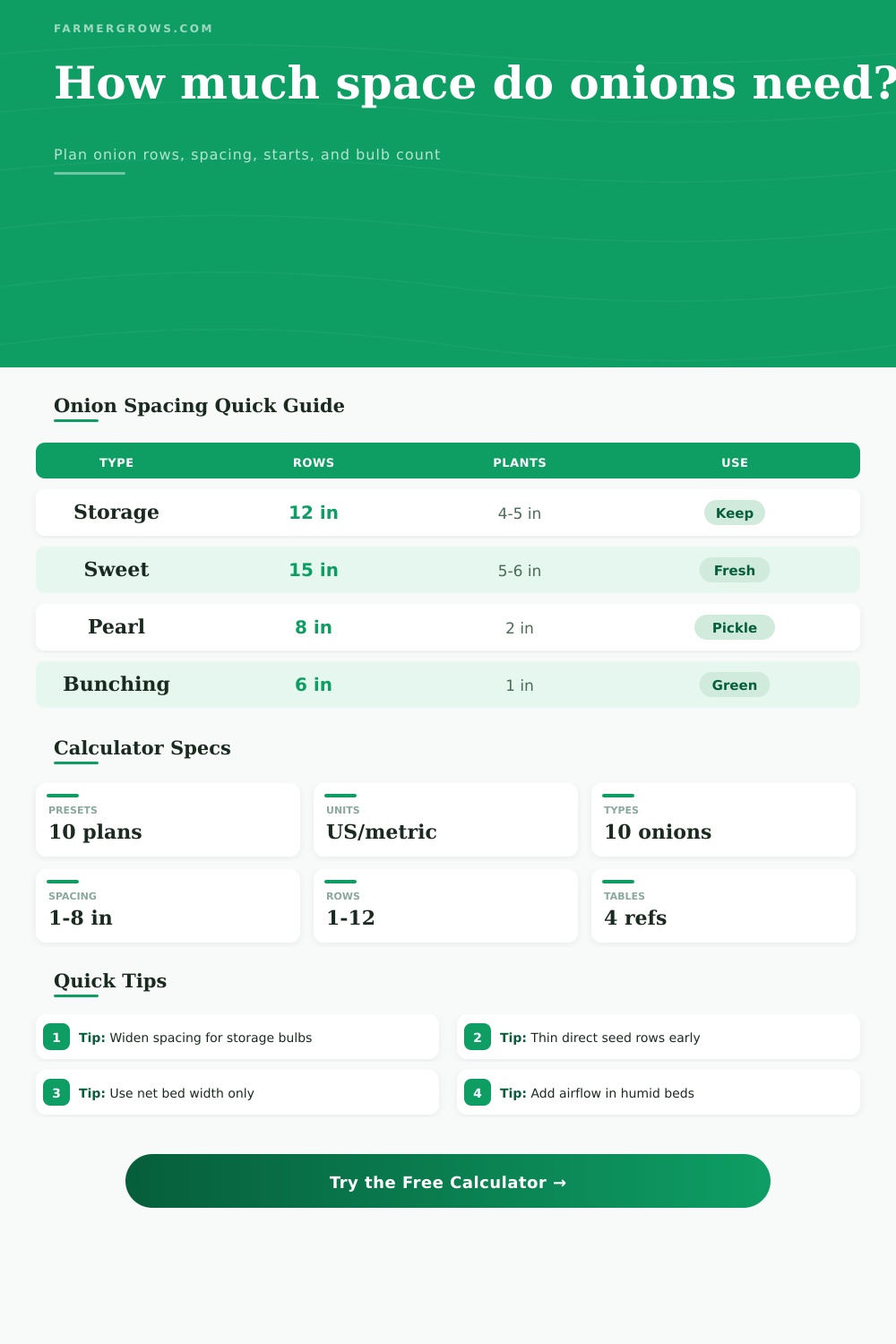
Space For Onions Calculator
Plan onion bed spacing from onion type, bulb size goal, bed count, row spacing, in-row spacing, planting method, thinning rate, harvest goal, and airflow pressure.
Use planted bed dimensions only. Exclude paths, drip headers, wheel tracks, trellis posts, and unplanted corners before calculating onion stations.
Use moderate spacing, strong airflow, and full maturity for curing and winter keeping.
Give extra in-row space because mild sweet types are often grown for larger fresh bulbs.
Medium spacing works for salads, market bunches, and short to medium storage windows.
These small flattened bulbs can sit tighter than jumbo storage onions in rich beds.
Close rows and close in-row spacing produce many small bulbs for pickling or garnish.
Plant very close for scallions because the goal is tender stems, not large dry bulbs.
Space by planted set or clump, then leave enough room for each clump to divide.
Use sturdy spacing and good airflow so plants can resume growth cleanly in spring.
Your Onion Spacing Plan
Results update from the calculator inputs.
| Bulb Goal | In-row Spacing | Row Spacing | Best Use |
|---|---|---|---|
| Green onions | 1 to 1.5 in | 6 to 8 in | Scallions, bunches, quick pulls |
| Pearl or pickling | 1.5 to 2.5 in | 6 to 10 in | Small bulbs, dense rows, pickling jars |
| Small bulbs | 3 in | 8 to 12 in | Fresh kitchen bulbs and tight raised beds |
| Medium bulbs | 4 in | 10 to 14 in | Standard home garden onions |
| Large bulbs | 5 in | 12 to 16 in | Fresh slicing onions and market display |
| Jumbo sweet bulbs | 6 to 8 in | 14 to 18 in | Big mild onions with open leaf growth |
| Onion Type | Typical In-row | Airflow Need | Spacing Note |
|---|---|---|---|
| Yellow storage onion | 4 to 5 in | High near harvest | Avoid crowding so necks dry evenly for curing. |
| Sweet onion | 5 to 6 in | Moderate | Wider spacing helps build large mild bulbs. |
| Red onion | 4 to 5 in | Moderate | Use medium spacing for fresh use or short storage. |
| White onion | 3 to 5 in | Moderate | Can be grown tight for fresh bulbs or wider for slicing. |
| Cipollini onion | 2.5 to 3.5 in | Moderate | Flat bulbs size up well without jumbo spacing. |
| Pearl onion | 1.5 to 2 in | Low to moderate | Dense spacing intentionally limits final bulb size. |
| Bunching onion | 1 to 2 in | Low | Harvest as green stems before bulb swelling matters. |
| Shallot clumps | 6 to 8 in | High | Each set divides, so count clump expansion space. |
| Mode | Calculator Use | Why It Matters | Practical Range |
|---|---|---|---|
| Direct seed | Start count rises with thinning | Extra seed covers germination gaps and later thinning. | 10 to 60 percent thinning |
| Transplants or plugs | Start count adds cull reserve | Count one healthy plant per final onion station. | 5 to 15 percent reserve |
| Onion sets | Set count adds backup reserve | Sets are planted directly at final spacing. | 5 to 12 percent reserve |
| Multi-sown cells | Cell count is lower than plant count | Several seedlings can be transplanted together for small onions. | 3 to 5 seedlings per cell |
| Example Bed | Layout | Approx Stations | Best Match |
|---|---|---|---|
| 4 ft by 8 ft raised bed | 4 rows, 4 in plants | 96 onions | Medium yellow or red bulbs |
| 4 ft by 12 ft raised bed | 5 rows, 3 in plants | 240 onions | Small fresh bulbs or cipollini |
| 30 ft garden row | 1 row, 5 in plants | 72 onions | Large storage or sweet onions |
| 100 ft market bed | 4 rows, 4 in plants | 1,200 onions | Maincrop storage harvest |
| 10 ft scallion strip | 6 rows, 1 in plants | 720 stems | Bunching onions |
Storage tip: When onions must cure and keep, use the wider end of the spacing range and avoid tight humid rows that trap leaf moisture late in the season.
Thinning tip: Direct-seeded onions can be sown thick, but the final stand should match the bulb goal; pull extras early as scallions instead of waiting until bulbs compete.
Home gardeners planting their onions too closely is disappointed in a particular way: When it comes time to dig them up (with high hopes), out come not one or two, but a clump of tiny, distorted bulb fighting over available nitrogen in the soil. What happened? Well, not that you didn’t care; it’s that you didn’t know the math.
Spacing among onion plants isn’t just about cramming lots of them into your raised bed. It’s about a balancing act between the bulb’s desire to grow and leaf’s need to breathe. Get it right, and you’ll have storage onions, or salad ingredients. Geometrys left to the calculator. It converts your bed size into how many planting stations there is. However, what you choose to enter is up to you and reflects harvest you want.
How to Space Your Onions
For example, do you want big, mild sweet onions like the Walla Wallas? The bulbs must be given enough space to expand, often six inches or more apart. Go smaller; go closer together; cry at cutting time. Want to grow storage yellow onions instead? A little tighter is fine…
But then you run into other variables: airflow. Foliage that packs in too thickly invite rot and mildew if you live in an area where humidity is high. Wide spacing isn’t just a growth strategy but a preventive one.
Planting style also matters. And how you do it alters everything. On the one hand, direct sowing‘s an economical move. Tempting! On the other, a lot of seeds gets weeded out (literally). You sow thickly, praying. With thinning reserve in tool, I figure in the probability that half my seedlings will be coming out. Better to mentally count them as bonus scallions, right?
The opposite approach, using transplants or sets… Is more exact. No guessing where each bulb go from the get-go. Less guesswork = less waste. The calculator tacks on a reasonable safety margin here, too, for starts that didn’t take, or culls. A safety margin like this matter: nothin’ derails a row of garden yield quicker then not having a set in every station ’cause one was bad.
How many onions? Density: People is always surprised by bed density. A standard-sized bed (four-by-eight feet)… Sounds like a big space. A standard bed with rows of well-spaced medium storage bulbs contains about a hundred onion plant. Hundred. Enough for a serious freezer stash. Want pearl onions (or pickling types)? Double that. Use the same size bed. But each one will be tiny when harvested. The tables on page spell it all out: How in-row spacing varies, eight inches apart for jumbo sweets and just an inch for bunching onions. Big difference, in terms of consuming soil resources.
Pure math doesn’t account for humidity. In high-humidity summers (or in shady gardens) adjust the spacing yourself to be wider then the calculator recommends. Go beyond its default optimum range. A well-spaced-out row allows free air circulation. Water from irrigation or rain will dry fast on the foliage. A tight row holds onto water instead, creating a microclimate helpful to disease. It is a small difference, but it can save the crop. To adjust: You can enter airflow pressure into the tool, which nudges its own recommendations.
In the end, what are you planning for your onion bed? Picture it: How will it look when it’s all done and you’re harvesting? Before you purchase a single seed packet, make a plan. Do you want to have a big, bulb-filled harvest for grilling? Maybe you want a tight row of scallions for garnish. Use the numbers, but also think about what those numbers mean within the context off your bed. Plug them in, and the number of stations per bed reveals a realistic goal. Suddenly that fuzzy idea of growing some onions becomes a real plan. It is not just any old plan, but one with a predicted yield. That’s how a murky area of ground gets turned into an actual kitchen garden. You can go confidently planting, knowing every bulb will have room to shine. It’ll cure well and hold through the winter.