Space Between Potato Plants Calculator
Plan potato seed piece spacing from variety type, pieces on hand, row length, row spacing, hill width, bed width, target tuber size, airflow risk, and harvest method.
Pick a named potato layout, then adjust seed pieces, row length, row spacing, hill width, target tuber size, airflow, and harvest style for your garden bed or field row.
Potato Spacing Result
Results update from potato type, seed pieces, row length, row spacing, in-row spacing, hilling width, bed width, tuber goal, airflow, and harvest method.
Fast crops for new potatoes. Close spacing favors more small tubers and quick bed turnover.
Good all-purpose spacing for Yukon-style potatoes with steady yields and medium tubers.
Need extra in-row room and wider rows to size long tubers without crowding the hill.
Can sit tighter because the market target is small, narrow tubers rather than big bakers.
Leave enough room for vines and hilling soil when growing a full-season storage crop.
Moderate spacing helps keep tuber size even while preserving airflow in leafy canopies.
Use medium spacing unless the variety is known for heavy set or very vigorous vines.
Wider spacing and stronger airflow help inspection, rogueing, and clean seed-piece production.
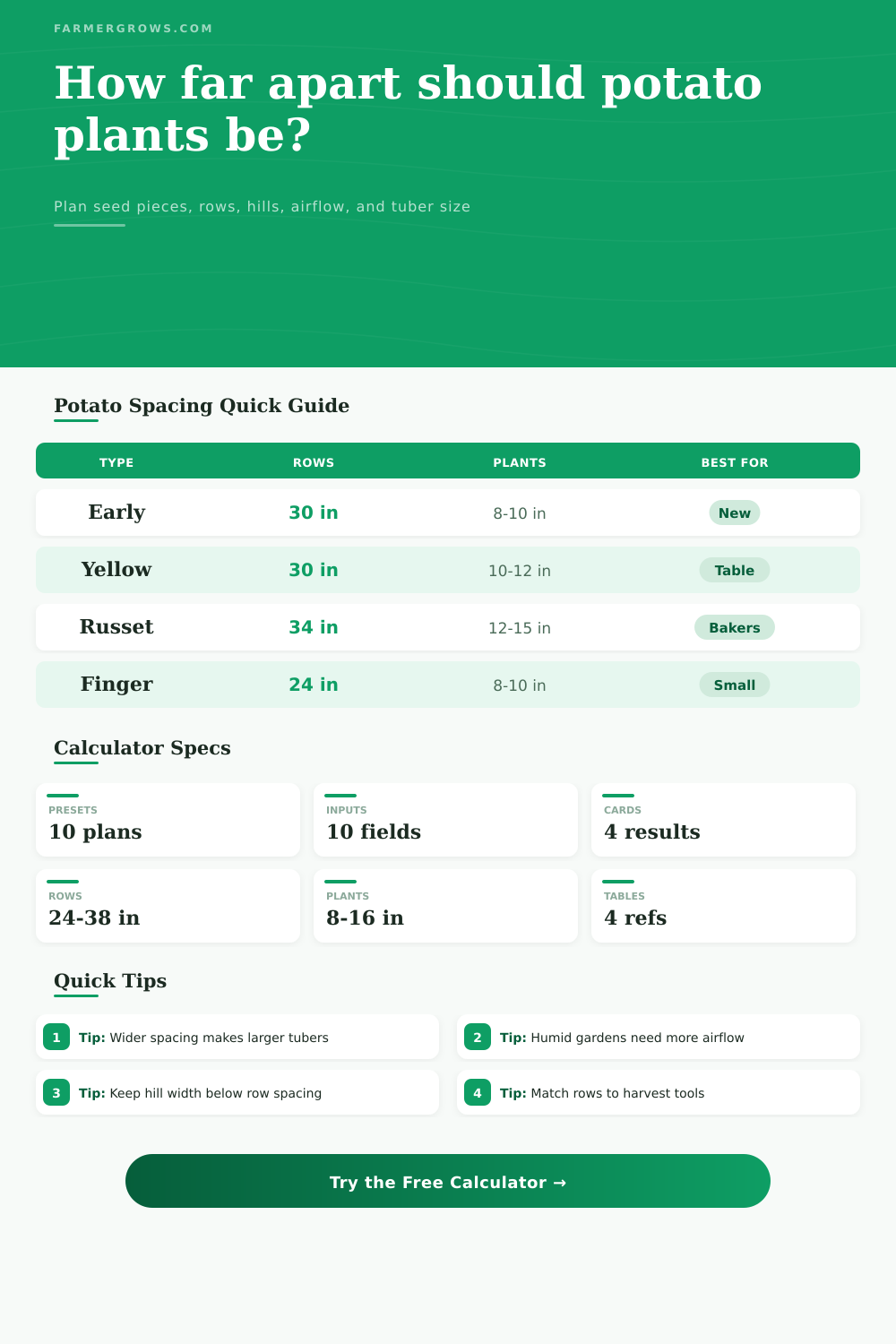
| Potato type | Typical in-row spacing | Typical row spacing | Spacing note |
|---|---|---|---|
| Early red or white | 8 to 10 in | 28 to 32 in | Close enough for new potatoes and fast harvests. |
| Yellow table potato | 10 to 12 in | 30 to 34 in | Balanced for home gardens and market bunches. |
| Russet baking potato | 12 to 15 in | 34 to 38 in | Wider spacing supports larger, longer tubers. |
| Fingerling potato | 8 to 10 in | 24 to 30 in | Tighter spacing fits small tuber targets. |
| White storage potato | 11 to 13 in | 32 to 36 in | Good for full-season growth and hilling room. |
| Processing or chip potato | 10 to 12 in | 34 to 36 in | Usually managed for uniform medium tubers. |
| Target tuber size | Spacing adjustment | Expected effect | Best harvest use |
|---|---|---|---|
| New potatoes | 2 in closer | More plants, more small tubers | Early digging and tender skins |
| Small salad potatoes | 1 in closer | Higher set with modest size | Boiling, roasting, markets |
| Medium table potatoes | No change | Balanced plant count and size | General garden harvest |
| Large storage potatoes | 2 in wider | Fewer plants, larger tubers | Curing and storage bins |
| Baker-size russets | 4 in wider | Maximum room for long tubers | Baking and premium sizing |
| Airflow setting | In-row adjustment | Row spacing target | Hilling reminder |
|---|---|---|---|
| Dry site, low pressure | No change | Use normal type row spacing | Keep hills covered but not oversized. |
| Average garden airflow | Add about 1 in | 30 to 34 in for most types | Leave visible walking or drying gaps. |
| Humid or blight-prone | Add about 3 in | 34 to 38 in when possible | Do not var hills merge into a wet ridge. |
| Seed crop airflow | Add about 4 in | 36 in or wider preferred | Space for inspection and rogueing. |
| Harvest method | Preferred row spacing | Hill clearance | Layout concern |
|---|---|---|---|
| Hand harvest or fork | 24 to 34 in | 2 to 4 in minimum | Comfortable digging access matters most. |
| Broadfork or walk-behind lifter | 30 to 36 in | 4 to 6 in preferred | Keep row centers consistent across the bed. |
| Mechanized digger | 34 to 38 in or wider | 6 in or more preferred | Match row centers to wheels, shovels, and webs. |
| Mixed hand and machine | 32 to 36 in | 4 to 6 in preferred | Choose the wider system if tools are shared. |
Tip: If seed pieces are limited, plant at the calculated recommended spacing first, then shorten the final row instead of tightening the whole bed too much.
Tip: If late blight, heavy dew, or overhead irrigation is common, use the wider side of the spacing range and keep hilled rows from touching.
Potatoes: Don’t plant them too closely; an inch or two makes all the diffrence between a big crop and a meh one.
Once you’ve entered the dimensions of your beds and number of seeds or seed pieces you have, this calculator will do the rest. You won’t have to guess how many rows to put down. Enter your desired tuber size and length of row, and it will recommends an appropriate spacing.
Why Spacing Matters
But here’s what makes it worth something: It doesn’t just give you numbers. Half the equation is knowing why they change. Want to know why the tool recommends wider spacing when you’re planting Russet Burbanks, as compared with Yukon Golds? Because Russets grows long tubers, heavy ones, and require elbowroom to stretch out without coming in contact with their neighbors. If you squeeze a baker into too small a place, it will curl itself up to get around the other one, and then both of its shape and its storage life are ruined. Most people don’t think about that.
Fingerlings and early varieties has their own set of rules: Get them in quickly, space them closely, and harvest them young. That’s why it recommends about eight to ten inches apart; that’s close enough to get all those tiny seeds or seedling-sized plants into ground. Each plant isn’t competing for giant swaths of soil, so you can cram more plants into a given amount of square feet. It’s a question of compromise between total number of plants versus the strength of each one. The calculator allow you to see where the balance point lies based off the limits of how much room there is in your rows.
Another important variable is airflow in a humid climate. Dense foliage creates a space where moisture gets trapped, so wet things tend to stay wet. Wet leaves are the ideal environment for late blight to develop. Opening up the spacing just a bit lets the canopy breathe, which means they will dry more quickly from dew or rain events. It is a tiny change, yet one that makes all the difference during years of high disease pressure. That’s why the calculator takes it into account and recommends a little wider when you choose a humid site. Essentially purchasing insurance against rot.
That’s where most gardeners trip over themselves: the hilling. You build that broad ridge by piling more soil on top of emerging tubers so they don’t green out. But if you’re too close together in your rows, all those hills turn into one big solid mass. At harvest time, it will be a muddy mess to walk across, and what will you do with your tools? The calculator compares the width of your hills to the width of your bed so there’s still some usable space between the rows. This layout would of made life complicated before you have even started planting.
And spacing depends on how you’ll be harvesting. Tighter rows work if you will use a hand fork; leave some space if you’re planning to use a broadfork (or a mechanized digger). This takes into account your harvesting tools, so plan accordingly, you don’t want to end up with tractor-sized ridges and no room for it to pass through on harvest day. Oh, the hours we’ve wasted because we forgot that…
Spacing comes down to letting every single plant stretch out and show itself off. Will you grow huge bakers to store through the winter, or little new potatoes for the first meal of spring? Every potato variety need a certain amount of space from its seed piece, and that determines everything.
Use the calculator up top to crunch those numbers for you, but knowing what you’re shooting for, big, medium, small, or baby; is the smart part. Decide on your desired size, measure your bed, and then let the calculator do the work. You’ll get a garden that grows, and even better, that has room to breathe. And produce just what you intended.