Space For Pepper Plants Calculator
Estimate pepper plant capacity, bed footprint, area per plant, airflow score, and harvest range from pepper class, row layout, bed or container mode, support style, humidity, target yield, and walkway width.
Load a common pepper layout, then fine tune row length, spacing, humidity, pruning, walkways, and target harvest.
Pepper Spacing Results
Your pepper layout estimate will appear here.
Large canopy, heavy fruit, benefits from sturdy stakes and moderate airflow.
Compact productive plants that tolerate closer spacing when kept picked.
Tall, spreading plants with larger fruit and better quality in wider rows.
Bushy plants with slower canopy drying, especially in warm humid climates.
Wide branching plants that need more air around leaves and fruit clusters.
Good bed pepper spacing for long fruit, steady harvest, and easy picking.
Moderate spacing suits smaller fruit and a dense but manageable canopy.
Closer plants can work when stems are pruned, clipped, and trained upward.
| Pepper class | Plant spacing | Row spacing | Typical yield per plant |
|---|---|---|---|
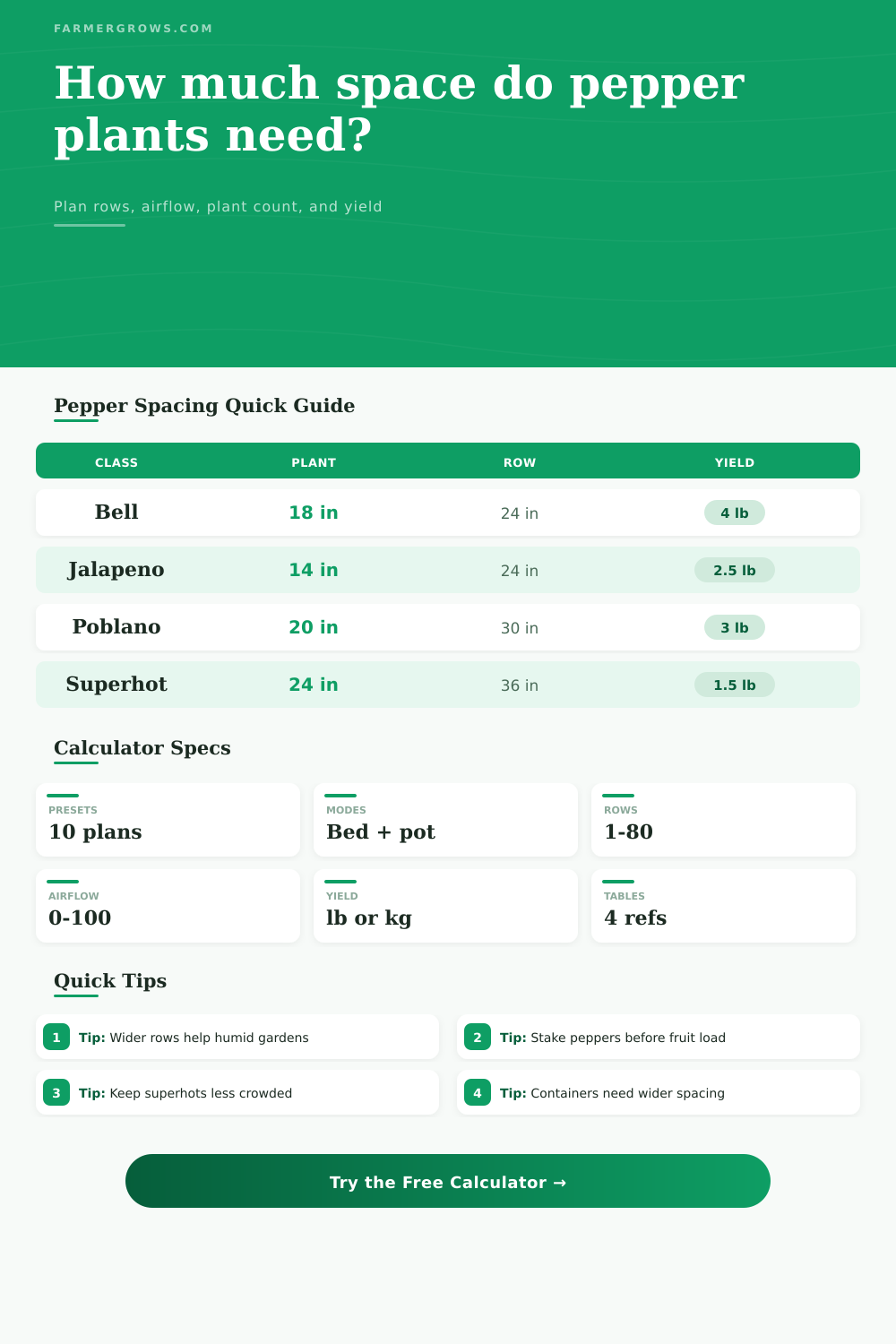
| Bell or sweet blocky | 18 in / 46 cm | 24 in / 61 cm | 3 to 5 lb / 1.4 to 2.3 kg |
| Jalapeno or serrano | 14 in / 36 cm | 24 in / 61 cm | 2 to 3 lb / 0.9 to 1.4 kg |
| Poblano or Anaheim | 20 in / 51 cm | 30 in / 76 cm | 2.5 to 4 lb / 1.1 to 1.8 kg |
| Banana or frying pepper | 18 in / 46 cm | 24 in / 61 cm | 2.5 to 4.5 lb / 1.1 to 2 kg |
| Habanero or Scotch bonnet | 22 in / 56 cm | 30 in / 76 cm | 1 to 2.5 lb / 0.5 to 1.1 kg |
| Superhot wide canopy | 24 in / 61 cm | 36 in / 91 cm | 0.8 to 2 lb / 0.4 to 0.9 kg |
| Paprika or drying pepper | 16 in / 41 cm | 24 in / 61 cm | 1.5 to 3 lb / 0.7 to 1.4 kg |
| Mini or ornamental pepper | 12 in / 30 cm | 18 in / 46 cm | 0.5 to 1.5 lb / 0.2 to 0.7 kg |
| Greenhouse pruned pepper | 14 in / 36 cm | 36 in / 91 cm | 3 to 7 lb / 1.4 to 3.2 kg |
| Condition | Spacing action | Airflow impact | Best use |
|---|---|---|---|
| Dry, breezy climate | Use class guide spacing | Low penalty | Open gardens with quick leaf drying |
| Humid summer | Add 2 to 6 in between plants or rows | Medium penalty | Dense foliage, cloudy weeks, or low wind |
| Very humid or still air | Favor wide rows and staking | High penalty | Leaf spot pressure and slow morning drying |
| No staking | Avoid crowding the class guide | Lower score | Small plants or low fruit load only |
| Cage or weave support | Class guide can work well | Higher score | Heavy bell, poblano, and banana peppers |
| Pruned trellis | Can handle closer in-row spacing | Higher score | Greenhouse or high tunnel peppers |
| Layout mode | Space rule | Capacity note | Airflow note |
|---|---|---|---|
| Single raised bed row | Use plant spacing along row | Best for narrow beds and easy harvest | Good airflow if sides stay open |
| Two-row raised bed | Keep row centers at least 24 in | Efficient for 3 to 4 ft wide beds | Stake early in humid climates |
| Field or market rows | Use 30 to 36 in row spacing | Lower density but easier access | Best drying and harvest movement |
| Container line | Use pot diameter plus canopy room | Capacity follows bench or patio length | Leave gaps between leafy plants |
| Greenhouse row | Prune stems and widen aisles | High yield per row length | Ventilation matters more than density |
| Example layout | Spacing | Plants in 12 ft row | Expected harvest range |
|---|---|---|---|
| Bell peppers, two raised bed rows | 18 x 24 in | 16 plants | 48 to 80 lb / 22 to 36 kg |
| Jalapenos, compact garden row | 14 x 24 in | 10 plants per row | 20 to 30 lb / 9 to 14 kg |
| Habaneros, wider humid layout | 22 x 30 in | 6 plants per row | 6 to 15 lb / 3 to 7 kg |
| Poblanos, market garden rows | 20 x 30 in | 7 plants per row | 18 to 28 lb / 8 to 13 kg |
| Superhots, high airflow row | 24 x 36 in | 6 plants per row | 5 to 12 lb / 2 to 5 kg |
| Greenhouse pruned row | 14 x 36 in | 10 plants per row | 30 to 70 lb / 14 to 32 kg |
Airflow tip: If mornings stay wet or leaves overlap by midsummer, widen the next planting by 2 to 6 inches or use stronger staking.
Yield tip: A tight pepper block can look efficient, but target yield often improves when each plant has enough light and picking access.
Pepper planting can pose its share of challenges, and sometimes enthusiasm meets up against real world. You begin with high hopes for a big harvest, then find yourself staring at an unruly mass of foliage where a few choice fruits has rotted unseen beneath. Spacing is the usual deciding factor, dull subject matter, till you attempt to pick a pepper obscured in jungle of foliage. Do it right beforehand and avoid wasting yield (and time spent clipping things back).
This tool does math for you; abstract measurements become a concrete plan for how to lay out your container or bed. The tool asks: What’s your humidity? That’s key, since peppers loves moisture. However, wet leaves can cause fungal disease. So why don’t most gardeners think about air when determining spacing? Because of airflow! It cools the leaves.
How to Space Pepper Plants
Bigger gaps between plant also mean more space for the roots. Climate humidity adjusts automaticly in the tool. Because what works in a dry area might not work well in a humid one. Remember: You’re engineering a microclimate here, not simply planting seeds. As much as the number of plants, the airflow score (shown below) in the results is significant, since higher airflow dries leaves quicker, removing the need for fungicide applications.
The shape depend on what kind of pepper it is. Bell peppers are bulkier; they get both tall and wide. If they’re too crowded, their heavy fruit may just snap right off weak stems. So give bell peppers about eighteen inches between plants and twenty-four inches between rows. That’s space for the canopy to open up, and also for the plant to stand up straight with its stems.
Hot peppers like jalapenos are more compact; you can have a little tighter spacing (as long as you pinch back regulary). Otherwise, they’ll still sprawl…if left unpruned. The chart below makes this clear enough; one size doesn’t fit all.
There’s one wrinkle: containers. For example, if you’re using them by packing some pots against others to maximize space, you reduce air flow and therefore limit root development. (Each plant needs at least 5 gallons of growing room; most are more productive with even larger container.) The calculator handles that: Just tell it how many containers you have per row, and it converts to equivalent numbers of bed rows.
You don’t want to overcrowd plants in any way; otherwise they’ll be fighting each other for food and moisture. It takes into account the width of your walkways, which doesn’t sound like much, but it does matter. Can you get a basket between plants? If you can’t, you will spend time picking fruit as it ripens. You will also watch fruit go bad because you couldn’t get back there to pick it. That is not good.
The spacing math changes when you stake. With caged or staked peppers, for instance, you don’t need to space them quite as far from each other; the vertical support keeps their leaves separated. Plants left unpruned will splay out on the ground and get in each others’ faces (and then they’ll also be inviting pests). But because the tool lets you select your support style for the plants, it also adjusts its recommendations to suit. It is a small detail. However, it matters because a clean plant is a productive plant, and a staked plant is a clean plant.
The planning gets practical at target yield: How many poblano plants do you intend to grow, for example, fifty pounds worth, for use in both salsa and dried? The calculator runs this scenario, then shows whether your layout will produce that much. It will tally up the number of plants you plan on planting versus average yields, and when it finds that your set-up comes up short, it recommends how to adjust. Maybe you’d better widen that bed, add another row? It’s all check-list stuff, no more guesswork.
You should of measure twice and plant once because we dig slower than we plan, so make your plans first. Get the math down, get the tool to sort out airflows and densities, and then go ahead and trust the plan. You will have less disease and cleaner fruit from your peppers, and you will feel rewarded at harvest time instead of being on a rescue mission.