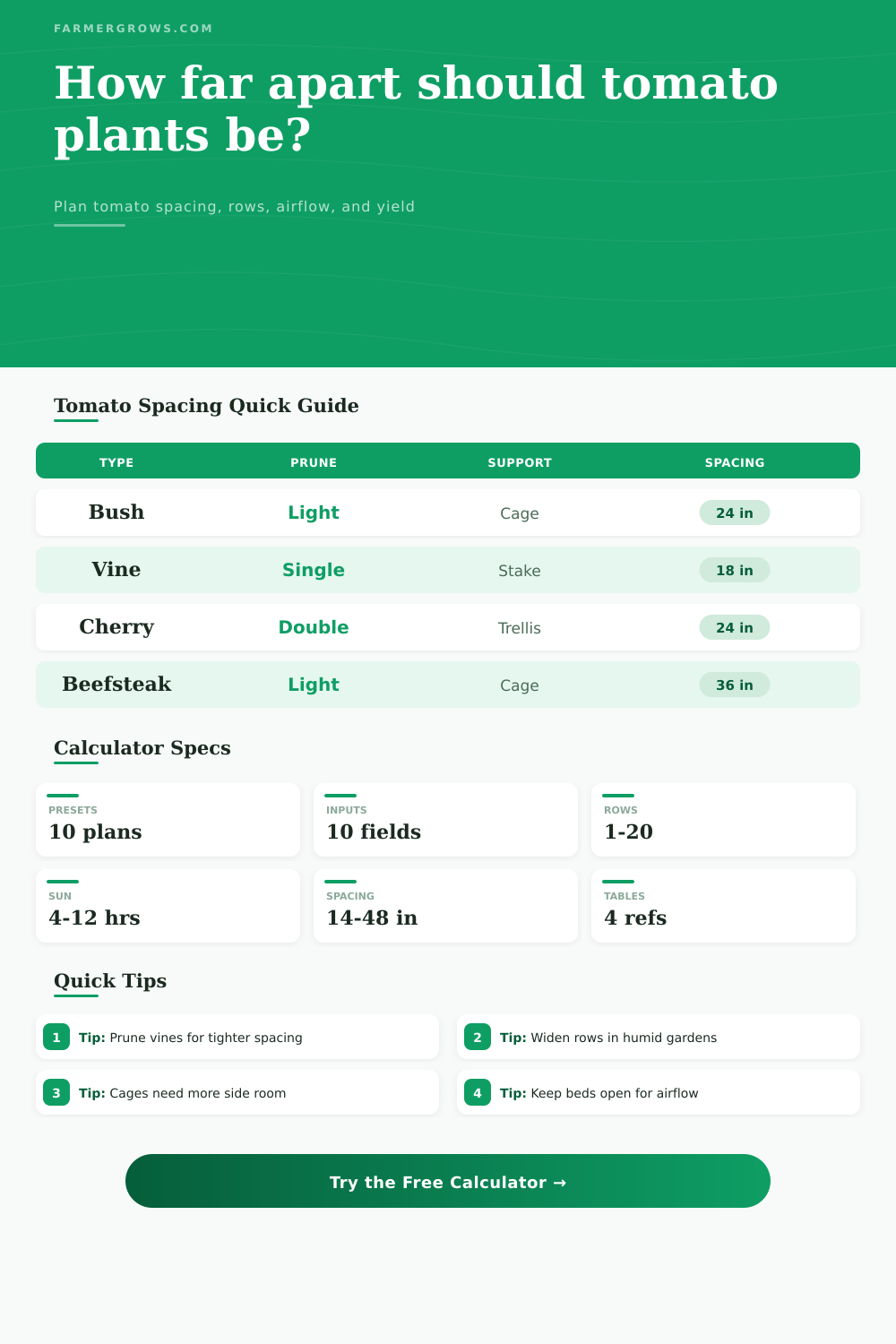
Space Between Tomato Plants Calculator
Estimate tomato plant spacing from variety type, pruning, supports, row length, row count, row spacing, disease pressure, target plant count, bed width, and sunlight.
Load a real planting style, then adjust the row length, rows, bed width, pruning intensity, and disease pressure for your garden.
Best around 24 to 30 inches in-row with cages or short stakes. Plants stop taller growth after a set fruiting flush.
Needs wider spacing when unpruned, but can tighten to 18 to 24 inches with single-stem pruning and strong support.
Small fruit does not mean small plants. Most cherry vines need the same or slightly more airflow than slicers.
Dwarf and patio types can fit closer, especially with individual stakes, containers, or narrow raised beds.
Tomato Spacing Results
Your row plan will appear here.
| Tomato type | Typical in-row spacing | Best support | Spacing note |
|---|---|---|---|
| Determinate bush | 24 to 30 in | Cage or short stake | Compact plants still need leaf drying room after fruit set. |
| Indeterminate slicer | 18 to 36 in | Stake, string, cage, or trellis | Spacing depends heavily on pruning and support strength. |
| Cherry or grape | 24 to 36 in | Tall cage, arch, or trellis | Vines often grow bigger than the fruit size suggests. |
| Dwarf or patio | 14 to 24 in | Stake, cage, or container cage | Use close spacing only where sun reaches the lower leaves. |
| Paste or Roma | 24 to 30 in | Cage, stake, or weave | Can be planted like determinate crops unless the variety is vining. |
| Large beefsteak | 30 to 42 in | Heavy cage or strong trellis | Large canopies and fruit loads need access and airflow. |
| Training style | Spacing effect | Airflow effect | Use when |
|---|---|---|---|
| Unpruned cage or sprawling | Add 6 to 10 in | Needs widest rows | You want low labor and have plenty of room. |
| Light pruning | Use baseline spacing | Moderate airflow | You remove lower leaves and keep some suckers. |
| Two-leader pruning | Reduce 3 to 6 in | Good airflow | You train two main stems on string or trellis. |
| Single-stem pruning | Reduce 6 to 10 in | Best airflow | You prune weekly and tie vines to stakes or strings. |
| Heavy tomato cage | Add 0 to 4 in | Depends on cage diameter | You need room to reach fruit around each cage. |
| Disease pressure | Spacing change | Row spacing target | Canopy goal |
|---|---|---|---|
| Low, dry climate | No added spacing | 3 to 4 ft | Leaves dry quickly after dew or irrigation. |
| Normal garden | Add about 2 in | 3.5 to 4.5 ft | Canopies touch late, not early, in the season. |
| Humid or disease-prone | Add about 6 in | 4 to 5 ft | Clear walking row remains visible between plants. |
| Very high pressure | Add about 10 in | 5 ft or more | Prune lower leaves and avoid wet foliage. |
| Plan | Rows and length | Spacing | Plants that fit |
|---|---|---|---|
| Small raised bed | 1 row x 8 ft | 24 in | 4 plants |
| Backyard double row | 2 rows x 16 ft | 30 in | 12 plants |
| String-trained line | 1 row x 20 ft | 18 in | 13 plants |
| Market-garden bed | 2 rows x 50 ft | 24 in | 50 plants |
| Wide beefsteak row | 1 row x 30 ft | 36 in | 10 plants |
Airflow tip: In humid gardens, treat 24 inches as a tight spacing for vigorous vines unless you prune consistently and keep lower foliage lifted from mulch.
Bed width tip: A narrow bed can fit the plant count on paper but still crowd cages. Leave side clearance for picking, tying, and leaf drying.
You purchase a solid row of tomato cages, determined to get really good spacing between rows of your heirlooms. More plant = more tomatoes, right? But then it’s July and your vines grows all tangled up with one another. Rain falls; lower foliage remains wet. Instead of eating from the garden at dinnertime, you’re battling blight.
This is where people go wrong on this step. Spacing isn’t about fitting the most plant into a space. It’s about giving each plant maximum health. To get your spacing plan, enter your local humidity level and your pruning practices (above) into the calculator, along with which kind of tomato you grow (see details on that). That way it does the math so you don’t have to imagine how wide the plant canopy will stretch.
Why Proper Spacing Is Important for Tomato Plants
Base your first answer: How did you begin? For most gardeners, it is about variety type, such as determinate versus indeterminate. The former stops growing once fruit is set and therefore can be more tightly spaced. The latter keeps on going, climbing and branching out until frost defeats it. An indeterminate left to its own devices would take over the whole bed. The calculator takes such things into account. It recommend less space between plants when they stay in place, like stems; it recommends more space when they spread out, like vines.
But here’s where pruning comes into play. If you’re committed to growing on a single stem, you can eliminate suckers by removing each one as it grows from leaf axil (where the leaf meets the twig). Just one main climbing stem remains attached to a string or stake. That makes spacing closer, which the calculator adjust to reflect. Why does it work? A single stem is narrow and doesn’t occupy much horizontal space. But that’s not low maintenance. With single-stem plant you must pinch out new growth each week or they’ll ignore your spacing plan and revert to there natural width.
Speaking of airflow, this is also a factor. If it’s a dry climate (and the leaves dry fast) you can get away with crowding things together. However, if it’s a humid area (where moisture hangs around on the foliage), you need some space so they don’t becomes a perfect breeding ground for fungal diseases. When you input disease pressure, the tool will adjust how wide apart the rows are. For example, if you signal high humidity, it will add inches to the space between them. That’s not arbitrary padding. It gives wind somewhere to blow through which is critical. Otherwise, the plants sweat and rot. And yes, it’s a small thing but it makes a world of difference in your harvest.
Footprint is determined by support systems as well. A heavy duty cage needs room to get your hand in there for fruit inside. Planting two of them too closely together means you can’t get in there to the tomatoes on the inside. You’ll knock down the outer leaves, doing damage all along the way. Strings and trellises use up less space. They take advantage of the vertical space not sprawling outward. The tables on the page make that clear showing where variety type works with support choice.
The calculator also takes into account the width of the beds. Mathematically speaking, you can jam 20 plants into a ten foot bed. But what happens when there’s no clearance between the plant (negative canopy)? That’s not good. Tomatoes, especially mature ones, require some breathing room. Without it, you’ll be breaking branches every time you try to reach inside or out. There won’t be enough light reaching the inner plant.
The hours of sun affect this as well. Six-hour sun? Then make sure there’s lots of airflow; compensating for those cooler and more humid conditions. Wider spacing helps on shaded sides, too, since there will otherwise be a mini-swamp forming at the heart of the bed.
It’s all a trade off: How much do you want vs. How much can you get away with? Plant closely and hope for the best. Or make space for each plant to thrive and breathe. In nearly every case, the latter wins over time. Fruit from healthy plants will outproduce that of crowded ones, even if the former represents less of a number then the latter.
You should of got out the tool and tweak it according to what works in your garden. Don’t be tempted to cram in another single plant just because you can. Every additional inch you allow is an investment in a clean, productive harvest. You will be rewarded with a clean and plentiful harvest. Ten strong plants are better then 20 weaklings.