Sun for Vegetable Garden Calculator
Map mixed vegetable beds by light zone, shade source, trellis impact, season, latitude, and heat protection before you plant.
Choose a common vegetable garden setup, then fine tune the dimensions, crop mix, and shade conditions.
Your Vegetable Garden Sun Plan
Crop-Zone Allocation
| Sun Class | Daily Direct Sun | Best Crop Types | Planning Note |
|---|---|---|---|
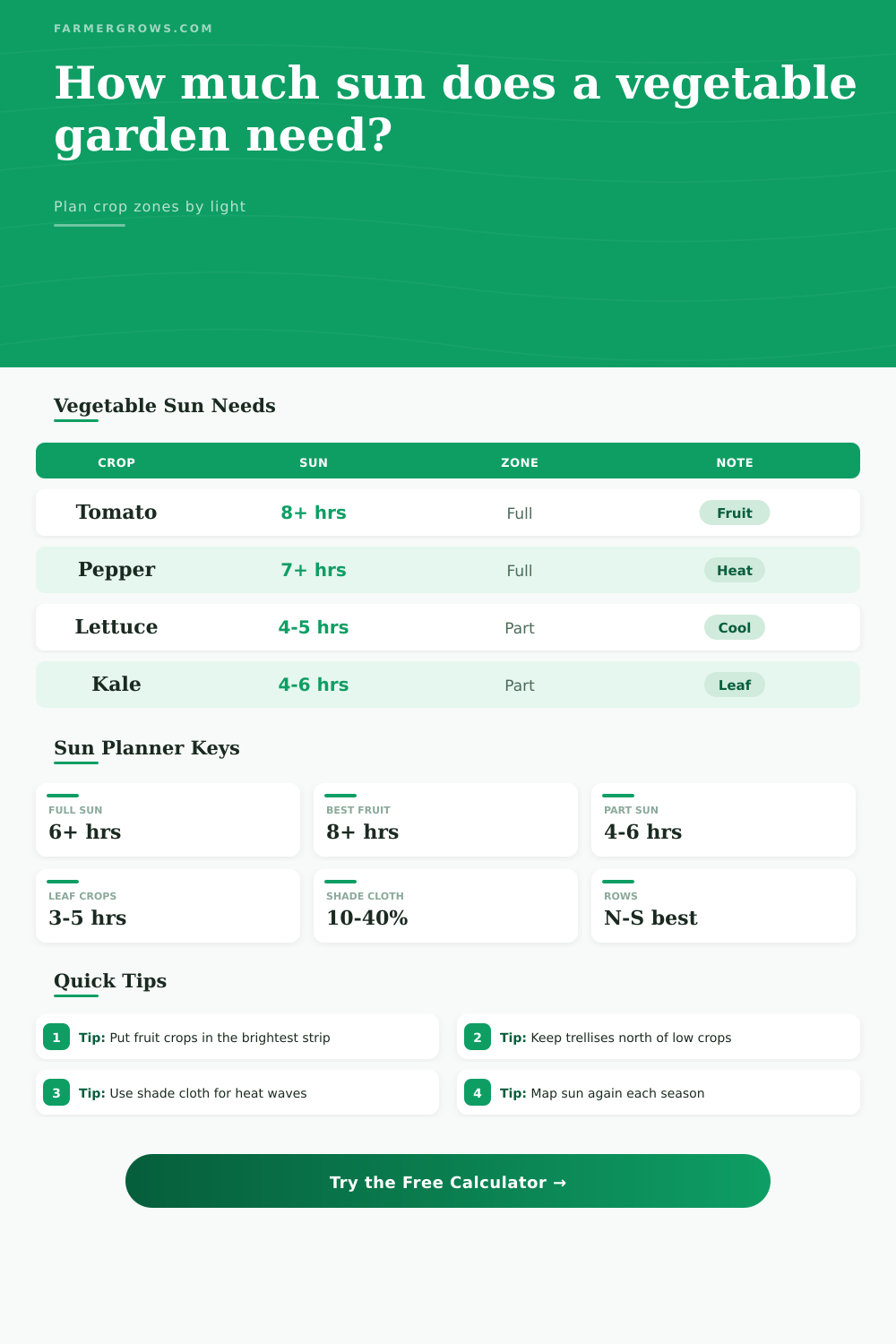
| Full sun | 6 to 10+ hours | Tomato, pepper, squash, melon, corn | Reserve this zone for fruiting vegetables first. |
| Bright part sun | 4.5 to 6 hours | Beans, beets, carrots, peas, herbs | Good transition zone between tall and low crops. |
| Part shade | 3 to 4.5 hours | Lettuce, spinach, kale, chard, cilantro | Useful for cool-season leaves or summer protection. |
| Low light | Under 3 hours | Mint, parsley, nursery starts, paths | Use sparingly for vegetables; improve light if possible. |
| Shade Source | Typical Effect | Best Response | Good Crop Choice |
|---|---|---|---|
| Fence or wall | Hard edge shade | Place tallest crops along the shaded side | Lettuce, kale, parsley |
| Tree canopy | Dappled shade plus root competition | Use containers or raised beds near drip lines | Greens, herbs, starts |
| Trellis row | Narrow moving shade | Run north to south when possible | Cucumbers, pole beans |
| Shade cloth | Even light reduction | Use only during heat stress periods | Peppers, lettuce, seedlings |
| Season | Sun Angle Pattern | Common Risk | Planner Adjustment |
|---|---|---|---|
| Spring | Lower angle, lengthening days | Cool soil and morning shade | Favor leafy crops in edge zones. |
| Summer | Highest angle, strongest heat | Afternoon scorch in hot regions | Shade cloth can help heat-sensitive crops. |
| Fall | Lower angle, shorter days | Fast loss of direct sun | Move fruit crops to the brightest strip. |
| Winter mild zones | Lowest angle | Long shadows from fences and trees | Use compact rows and avoid south-side barriers. |
| Row Orientation | Light Distribution | Trellis Placement | When To Choose |
|---|---|---|---|
| North to south | Most even all-day exposure | North or west edge for tall supports | Best default for mixed vegetable gardens. |
| East to west | South row gets more light | North edge if possible | Useful on narrow beds or sloped sites. |
| Diagonal | Moderate, flexible exposure | Keep tall crops away from low greens | Good for irregular yards and curved beds. |
| Block planting | Dense canopy once mature | Group by height from north to south | Good for raised beds and small plots. |
There is A typical mistake we all make when beginning to garden.
Because you love to eat tomatoes, you buy some tomato seeds, then plant them where only light hits in a corner of your yard, where it’s bright in the morning but casts shade by noontime. At first, everything look fine; the seedlings leaf out, seeming happy. Then comes fruit set, and what an under-performing mess! You get small tomatoes and green, unripe-looking peppers. No matter how much water you give them, or what kind of soil you have, something isn’t right. What is it?
Don’t Make This Sun Mistake
It is sunlight. Tomatoes don’t care if you want them to harvest. What they care about is energy. And the energy come from sunlight, sunlight converts carbon dioxide and water into sugar, which makes a tomato taste like a tomato. If the plant isn’t getting enough sun, it will focus on growing leaves and stems instead of fruit.
The math runs like this: Use the calculator up top to help you map exact point where your bright zones end and shade begins. Consider how far away adjacent trees are, how high your fence is, and how much shade tall trellis may cast on your low-lying crops. It’s primarily a question of knowing what you’re really measuring.
Full sun isn’t necessarily part sun, which is something many people get confused about. Full sun mean six or more hours of direct (unfiltered) light, and part sun means four to six hours. What happens if you grow things in a dappled space beneath an oak tree? That’s not full sun. It’s far less intense.
Asking how many direct sun hours each part of bed gets can help you separate those zones and match them up with your crop mix. Half leafy greens, half fruiting crops? Will the greedy ones fits into the biggest of your areas? The algorithm will check that.
There’s more about latitude than most hobbyists know. Even in summer, sun sits low in the northern part of the country. Long shadows are cast by things and they stick around longer, too. A twelve-foot fence in Maine creates a vastly longer shadow different than one does in Florida. By allowing you to choose which latitude band you’re in, the calculator take all this into account. It may seem small but it matters. If you have a perfect layout in say, zone seven, it could of been a total flop in zone four; the angle of incidence makes a difference. You may discover that to get your trellised beans to do their job you’ll have to plant them farther north to keep from shading out carrots behind.
The other thing it addresses is managing heat. That can also be an issue out here in the deep south. Too much sun and tomatoes closes up their pollination. Peppers blister. That’s when the shade cloth option kicks in.
You can reduce intensity without killing the quality of the light, like using sunglasses for your plants. A shade cloth with about twenty percent or thirty percent reduces the intensity. The calculator takes that into account so you don’t accidently turn a full sun zone into a part sun one and wonder why your peppers aren’t setting fruit as fast. So you won’t wonder why your peppers aren’t setting fruit as fast.
One last aspect of the puzzle is how you orient your rows. If your longest plants is north-south, light will hit both sides throughout the day; east-west oriented rows mean the north side of them will be shady all day, but the south side sunny. In general, with mixed beds, north-south works best as it provides at least some midday light to even the shortest plant. The table on the page explains this in detail, showing impact of each orientation on the pattern of light on the plants.
And really: A vegetable garden is just a farm of solar panels. You’re attempting to catch as many photons as you can, and point them where they do the most good, to the crop that needs it most. Plant the greedy eaters of sunlight in the sunniest locations; plant the ones that will tolerate less sun in the shadiest places. It is not guesswork; it is data-driven decision-making. The closer the plant is to the light, the less work the garden have to do. And when you don’t make this rookie error, what you wind up with at the end of the day is a harvest that truly tastes like summer.