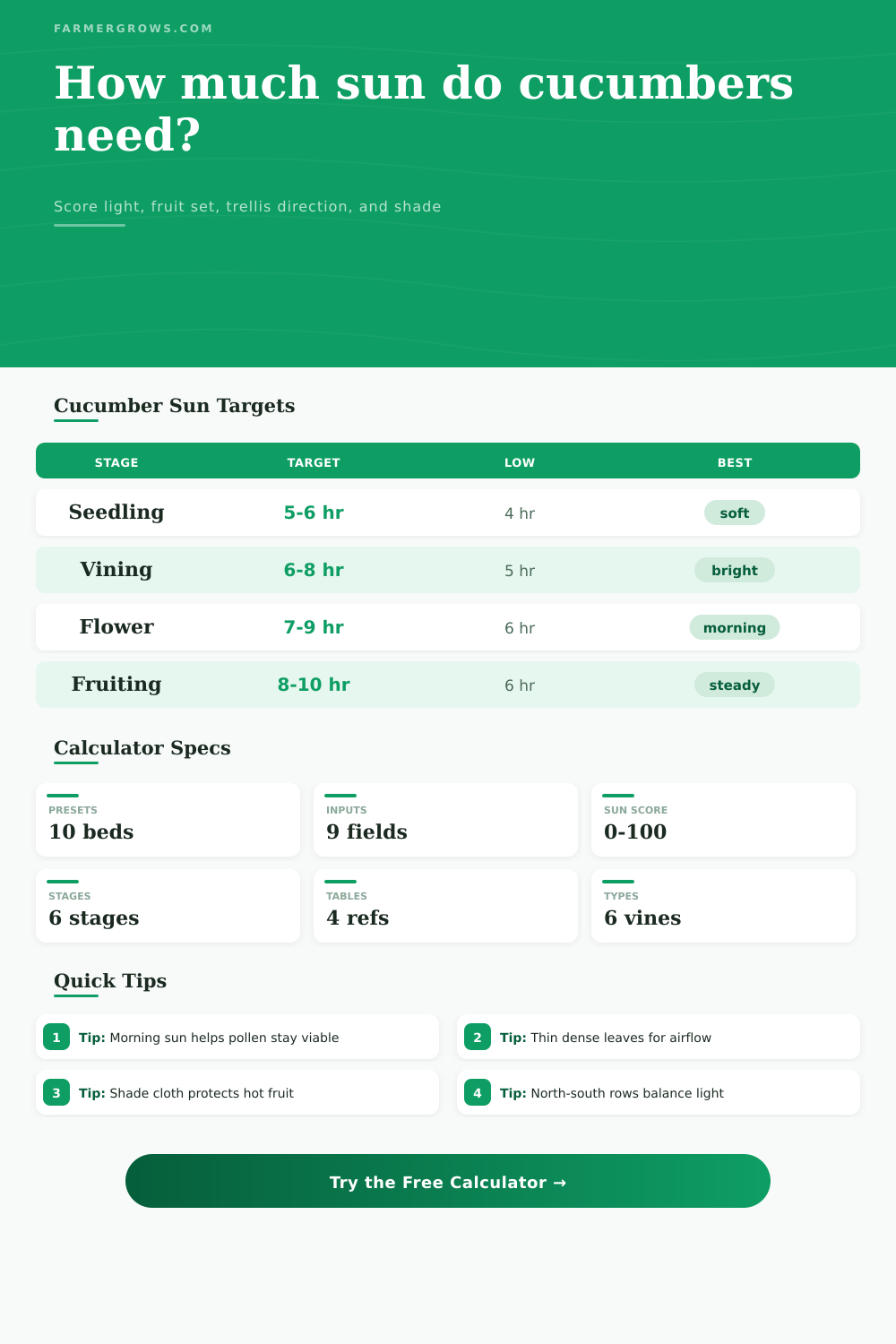
Sun For Cucumber Plants Calculator
Estimate effective cucumber light from direct sun hours, trellis orientation, vine type, flowering or fruiting stage, season, heat, spacing, leaf shade, and disease airflow pressure.
🥒 Cucumber Light Presets
Load a common cucumber bed, patio planting, high tunnel row, or hot-climate fruiting setup, then adjust the measured sun and canopy details.
☀ Sun and Canopy Inputs
Cucumber Light Result
Your cucumber sun score will appear here.
📊 Light Quality Checks
🌱 Cucumber Type Comparison
Reliable with full sun, a vertical trellis, and enough airflow to keep broad leaves dry after irrigation.
Often sets well in slightly tighter plantings, but dense foliage needs pruning when humidity rises.
Likes steady bright light, even trellis exposure, and afternoon relief in very hot gardens.
Compact fruit size can tolerate modest shade, especially with strong morning light and open leaves.
Needs open spacing because leaves overlap close to the soil and can shade inner flowers quickly.
Benefits from bright, even canopy light; heat and leaf disease matter even without bee pollination.
📋 Cucumber Sun Targets by Stage
| Growth Stage | Minimum Direct Sun | Preferred Effective Sun | Light Risk |
|---|---|---|---|
| Seedling or transplant | 4 to 5 hours | 5 to 6.5 hours | Too much midday heat can stall new roots. |
| Active vining | 5 to 6 hours | 6 to 8 hours | Low light stretches vines and delays branching. |
| Flowering and first set | 6 hours | 7 to 9 hours | Weak sun reduces female flower energy and bee activity. |
| Regular fruiting | 6 to 7 hours | 8 to 10 hours | Low light makes misshapen fruit and slower fills. |
| Peak harvest load | 7 hours | 8.5 to 10 hours | Fruit set drops fast when shade and heat stack. |
| Late season maintenance | 5 to 6 hours | 6.5 to 8 hours | Short days and disease pressure reduce leaf output. |
🧭 Trellis Orientation Guide
| Orientation | Best Use | Sun Pattern | Field Adjustment |
|---|---|---|---|
| North to south | Most open gardens | Balanced light on both sides | Keep vines tied so leaves do not mat together. |
| East to west | Hot zones needing afternoon relief | One side brighter, one side cooler | Plant on the sunny side if morning light is limited. |
| Morning-facing fence | Hot summer patios | Gentle morning sun, cooler afternoon | Works best if total sun still reaches 6 hours. |
| Afternoon-facing fence | Cool spring or fall beds | Strong late heat and glare | Add light shade when highs exceed 93 F. |
| Diagonal A-frame | Mixed beds and small spaces | Good exposure with some self-shade | Thin inner leaves near flower clusters. |
| Overhead arbor | Vigorous slicers or greenhouse vines | High leaf area, shaded lower fruit | Prune lower leaves and watch mildew pressure. |
🌡 Heat and Shade Adjustment Table
| Condition | Sun Impact | Fruit Set Impact | Best Correction |
|---|---|---|---|
| Cool or cloudy week | Effective sun feels 10% lower | Flowers may open slowly | Use the brightest available exposure. |
| Ideal 75 to 85 F | Full value from measured sun | Best pollen and fruit growth | Prioritize even light and steady water. |
| Warm 86 to 92 F | Light remains useful | Some afternoon stress possible | Mulch and avoid water swings. |
| Hot 93 to 98 F | Afternoon sun can overheat leaves | Pollen viability and fruit shape decline | Use 15% to 25% shade after midday. |
| Extreme above 98 F | More sun is not always better | Aborted flowers become common | Protect vines, cool roots, and delay pruning. |
🍃 Spacing, Leaf Shade, and Airflow Table
| Canopy Factor | Good Range | Warning Sign | Adjustment |
|---|---|---|---|
| Vertical spacing | 12 to 24 inches | Leaves cover flower clusters | Train one or two leaders per plant. |
| Bush spacing | 24 to 36 inches | Inner leaves stay damp | Thin older leaves and widen paths. |
| Moderate leaf shade | Lower leaves get filtered light | Fruit still fills well | Keep if hot afternoons are intense. |
| Dense leaf shade | Useful only in extreme heat | Pale leaves or dropped blooms | Prune gradually, not all at once. |
| Poor airflow | Leaves dry after morning dew | Powdery mildew or leaf spot appears | Improve spacing before adding more shade. |
💡 Cucumber Sun Tips
Fruit set: If blooms appear but small cucumbers yellow and drop, check morning sun, heat spikes, water swings, and bee activity before removing shade.
Airflow: In humid beds, a little less leaf density often improves cucumber yield because dry leaves stay productive longer than shaded, diseased leaves.
When your cucumbers look yellow and stunted, the culprit is almost never water. No. But there is such a thing as under-lighting them. That is often what goes wrong when those beautiful seeds you planted so carefully turn out looking yellow and stunted.
No, it’s not lack of water (though checking soil moisture each morning are a good practice). It’s lack of sunlight; or rather the wrong kind of sunlight at the wrong time in plant’s development.
How to Fix Yellow Cucumbers
The right amount of sunlight is not just any light. Most gardeners believe they have a clue about their growing conditions, and most don’t. What would you say if I told you that an inch of shadow can be the difference between a full vegetable crop or no crop at all?
This is a snapshot of how canopy density, heat stress, trellis orientation, and measured sun hours are translated by the tool into fruit set score. Why does this matter? Because cucumbers aren’t just sensitive to overall amount of light; they also care about timing of it.
Morning sun is good. The plant warm gradually, and then the dew dries from its foliage. This means there is less chance of developing powdery mildew, among other things. But afternoon sun are not great because it is so strong. When temperatures rise over ninety, the combination of intense sunlight and high heat can cause fruit drop from heat exhaustion.
The calculator takes all this into account. It will tell you if you’re in shade-deficient territory or heat-exhaustion land, or if your existing set-up support flower retention.
The other factor is orientation. If the trellis runs north-to-south, both sides gets even sun for constant photosynthesis. An east-to-west row will have one side hot and one side cool. That can be good: In a warm climate, a cool side is desirable since it shields the fruit from sunburn, or sun damage. But in a cool spring garden like mine, it may mean half the plant are always in the dark, and there won’t be any fruit set until things warm up.
Match the direction of the rows to your particular temperature profile. Those details are broken out in the reference tables on the page by growth stage, such as gentle light for seedlings. Use higher intensity for fruiting vines. As the plant ages, target changes.
Most failures with cucumbers comes down to a little-mentioned factor: heat. Above ninety-five degrees Fahrenheit, pollen viability drops sharply. That said, even if your air temperature is ninety-five degrees, you’re not going to be at full power; you won’t get ten hours of productive light because the heat make it stressful for the plant. You’ll get six hours at high efficiency followed by four hours of stressing the plant.
The calculator accounts for that fact: It discounts light arriving under an extreme-heat wave. So even in late July, what may look like a shady plot might actualy outproduce a fully sunny one. Why? Because the shade protects the fruit; the full sun cooks it.
The other side of this equation is airflow. Leaves that are dense block not only light, but also trap humidity. Wet leaves allow for the spread of disease. Disease lead to less leaf area. Less leaf area mean less photosynthesis. It’s a chain reaction toward failure.
Want to grow cucumbers? You may want to think you get more if you sow them close together. The numbers say otherwise. More air flow (with extra wide spacing) is better. More air flow = healthier leaves. Healthier leaves intercept more light.
Sounds counter-intuitive? Leave space in there, with empty dirt between plants. That dirt’s your ventilation system. Iterate. That’s the best strategy.
Use the calculator settings as a starting place then scroll through the scenarios and see what it comes up with compared to your own garden: Will it ding your score because that dense canopy is trapping humidity and risking disease? Yeah, time to do some pruning. If you have morning sun and high heat, it’ll probably recommend shade cloth for later in the day. It’ll probably recommend shade cloth for later in the day. Not numbers; they’re talking about adjustments you make in the field.
You can adjust the direction a trellis faces. You can thin the lower foliage. You can grow a heat-resistant variety. You can’t adjust the sun. But you can adjust its impact on your vines.
We want to have stable fruit set. We don’t want the largest vine or most leaves, we want the right amount of light for fruit set. Light translates into energy, but we need a stable environment too, too much light mean heat stress; too little light means weak pollen. There’s a sweet spot in between.
It asks us to measure what we believe we already know. We must admit that our side yard isn’t quite as sunny as we recall. We adjust the trellis so it catches the good light and blocks the bad.
Once you get the score, the rest is maintenance, baby. No more guesswork. Now we’re talking data-driven gardening. And that makes all the difference.