Sun For Pepper Plants Calculator
Estimate effective pepper sun, fruiting potential, shade cloth strength, and heat balance from sun hours, afternoon shade, pepper type, growth stage, latitude, season, heat index, spacing, airflow, and container or bed growing.
Choose a common pepper light setup, then adjust the heat, spacing, airflow, season, and container setting to match your garden.
Pepper Sun Results
Your pepper light balance will appear here.
Large fruit and wide leaves need strong light, but fruit scald can rise during hot afternoon exposure.
Usually tolerate bright sun better than large sweet peppers when water and airflow are steady.
Set best with bright light and warm roots, but benefit from light afternoon shade in heat spikes.
Large green fruit can sunscald, so balanced canopy cover often matters as much as raw sun hours.
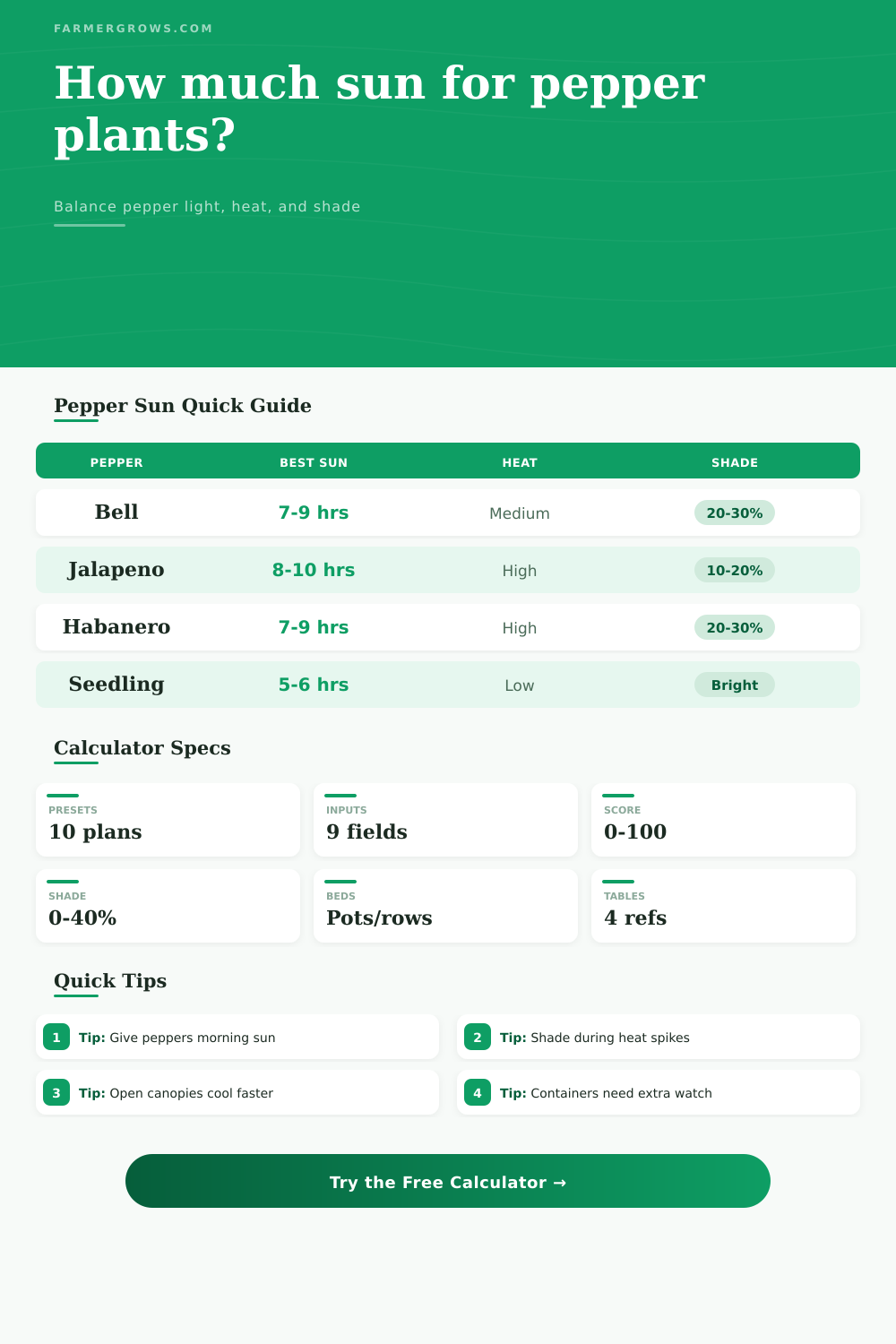
| Pepper group | Target effective sun | Best use | Heat caution |
|---|---|---|---|
| Bell and sweet peppers | 7 to 9 sun-equivalent hours | Full fruit sizing and color | Use shade if fruit scald appears above 95 degrees F. |
| Jalapeno, serrano, cayenne | 8 to 10 sun-equivalent hours | High flower and pod production | Watch blossom drop if heat index stays above 100 degrees F. |
| Habanero and superhot peppers | 7 to 9 sun-equivalent hours | Warm, bright, slightly protected sites | Containers need root cooling and steady moisture. |
| Poblano and Anaheim peppers | 7 to 9 sun-equivalent hours | Large green fruit with leaf cover | Filtered afternoon shade helps exposed fruit. |
| Seedlings and transplants | 4 to 6 sun-equivalent hours | Hardening off before full sun | Increase exposure gradually over 7 to 10 days. |
| Heat index at canopy | Sun strategy | Shade cloth guide | What to watch |
|---|---|---|---|
| Below 85 degrees F | Maximize direct sun | Usually none | Slow growth if total sun is under 6 hours. |
| 85 to 94 degrees F | Full sun to light afternoon shade | 0% to 20% | Normal pepper range if roots stay moist. |
| 95 to 101 degrees F | Morning sun, afternoon relief | 20% to 30% | Blossom drop, leaf curl, and fruit scald. |
| Above 101 degrees F | Protect hottest afternoon hours | 30% to 40% | Stalled fruit set and overheated containers. |
| Latitude or season | Intensity factor | Calculator effect | Garden note |
|---|---|---|---|
| Low latitude summer | 1.12 | Sun hours count stronger | Shade is often more useful than adding exposure. |
| Mid latitude summer | 1.00 | Baseline pepper setting | Most peppers want 6 to 10 direct hours. |
| High latitude summer | 0.92 | Long day, softer angle | Extra hours can compensate for lower intensity. |
| Spring or fall | 0.82 to 0.88 | Lower effective sun | Choose the brightest warm site available. |
| Greenhouse or tunnel | 0.78 | Film reduces usable light | Prune and space for airflow and penetration. |
| Spacing and airflow | Light effect | Heat effect | Adjustment idea |
|---|---|---|---|
| 16 to 20 inch spacing, open bed | Good leaf light | Heat disperses well | Keep lower leaves tidy and irrigate evenly. |
| Under 14 inch spacing | Canopy self-shade rises | Humidity and heat linger | Prune lightly or improve row spacing next crop. |
| Containers on pavement | Light can be intense | Root zone heats fast | Use pot shade, mulch, or afternoon relocation. |
| Greenhouse dense canopy | Interior leaves get dim | Stagnant heat can build | Vent, prune, and avoid heavy shade cloth unless needed. |
Prioritize morning sun. Peppers use bright morning and midday light efficiently, while afternoon shade is most helpful when leaves wilt, blossoms drop, or exposed fruit develops pale scald patches.
Fix heat before removing light. In containers and dense beds, mulch, steadier water, wider spacing, pruning, and airflow may solve stress without cutting too much photosynthesis.
Sunlight is an ingredient, yes, one most gardeners think off as an on switch. If there’s sun, they reason, then there must be happiness in pepper plants, right? Not so. To gardeners, light can also be a weapon.
Too little, and the plant stretch toward the sky in leggy shadow, making only leaves, no fruit. Too much (particularly combined with excess heat) will cause the fruit to cook on the vine. It will tear open with scars that never heal, leaving behind pale marks that will never close up again.
How to Balance Sun and Heat for Peppers
Understanding the distinction between what daylight hours you have and how many hours of that light your plant really process can mean the difference between a burnt crop and a bumper one. And there it is: Those raw hours of sun transformed into a score that takes heat and shade into consideration. Because an hour of sun under a tree at dawn in May will feel different from an hour of midday July sun on the same canopy. That’s what the calculator does for you; recognizes that difference.
Enter in your number of sun hours. Enter what percent of each day’s hours are in afternoon shade. It also factors in ambient temperature and the angle of light. The more you crank up the heat index (that’s the part it cares about most), the lower the score will go.
Why? Because peppers is warm season plants, not cacti. They have a thermal limit. Once the air at their top layer nudge beyond ninety-five degrees, photosynthesis slows. Their leaves shuts down their stomata and begin conserving water. No more taking in light.
Maybe it is a day of blazing sun, but the heat index read one hundred and five. Maybe those final three hours are counterproductive to the first seven or eight. The calculator raises flag on such a trade-off… And alerts you to where your light turns from fuel to stress.
Spacing and airflow are the silent variables that kill so many well-intended gardens. To conserve space people put their peppers too closely together, forming a humid and dense canopy of leaves that hold heat in at the stems. Even with ideal sun exposure on paper, it may be a sauna underneath all those leaves. This tool adjust the effective sun score based off your own spacing and airflow conditions.
Growing in containers? Things work differently again. Soil in the ground heats up more slowly than the root zone in a pot. Roots of plants growing in pots in direct sun can get hot enough to literal cook root hairs…if the pot’s in direct sun on concrete. It gets weighted for that kind of growing (as it should). It also reminds you that what’s happening in the root zone is every bit as important than how much light the leaves see.
Some varieties fare better then others. Large-leaf types such as bell peppers tends to be more susceptible to sunscald on those thick-walled fruits. They will also absorbs more heat. When the temperature rises, a little afternoon shade is beneficial for them. Superhot varieties and other hot ones will hold up a little better to the glaring sunshine but can’t take the hardest hit of that midday light in the hottest places. As the chart on that page shows, the range of desired sun hours differs by variety type.
Obviously seedlings should of recieve an easier transition: not only to the outdoors, but to the actual amount of UV exposure, which their tender leaves won’t handle all at once, without a gradual acclimation. Hardening off isn’t just getting them “outside”; it’s also about exposing them gradually to more intense levels of sunshine without frying their leaves.
To use the tool well, consider both the shade cloth recommendation and the fruiting score. Is the fruiting score low because it’s too hot? The tool may recommend a 20 percent shade cloth for example. It is not meant to block out the sun completely, but rather diffuse it. Under that shade, the plant can keep its stomata open and continue processing light without overheating. Again, it’s a subtle change, but one that saves the harvest.
And really, that’s the point of growing anything. Gardening is all about balance. Yes, you’re not just chasing hours of light, but you’re also creating an environment where light, heat, and air work in concert. You don’t want maximum exposure; you want optimal conditions. Get the balance right and those peppers won’t just survive the summer. They’ll thrive in it, each hour of effective sun converted into spicy-sweet fruit.