Sun for Tomato Plants Calculator
Estimate usable tomato light from direct sun, filtered shade, latitude, season, row direction, spacing, growth stage, heat stress, reflective mulch, and trellis style.
Start with a common tomato planting situation, then adjust the shade, stage, and spacing to match your garden.
Tomato Light Plan
Your tomato light estimate will appear here.
Sets small fruit with slightly less sun, but still tastes sweeter at 7 or more strong hours.
Needs a clean light window during bloom because most fruit sets in a shorter flush.
Responds well to vertical support, leaf thinning, and north to south rows for even canopy light.
Large fruit and dense vines need the highest usable light and widest air space.
Handles warm, bright rows well and usually tolerates moderate spacing pressure.
Works in small spaces if the plant gets a bright morning window and reflected light.
Needs strong sun but may need afternoon shade in hot spells to protect pollen and fruit.
Can run high yields with trellis training, clear glazing, and venting during high heat.
| Growth stage | Minimum usable sun | Strong target | Low-light symptom |
|---|---|---|---|
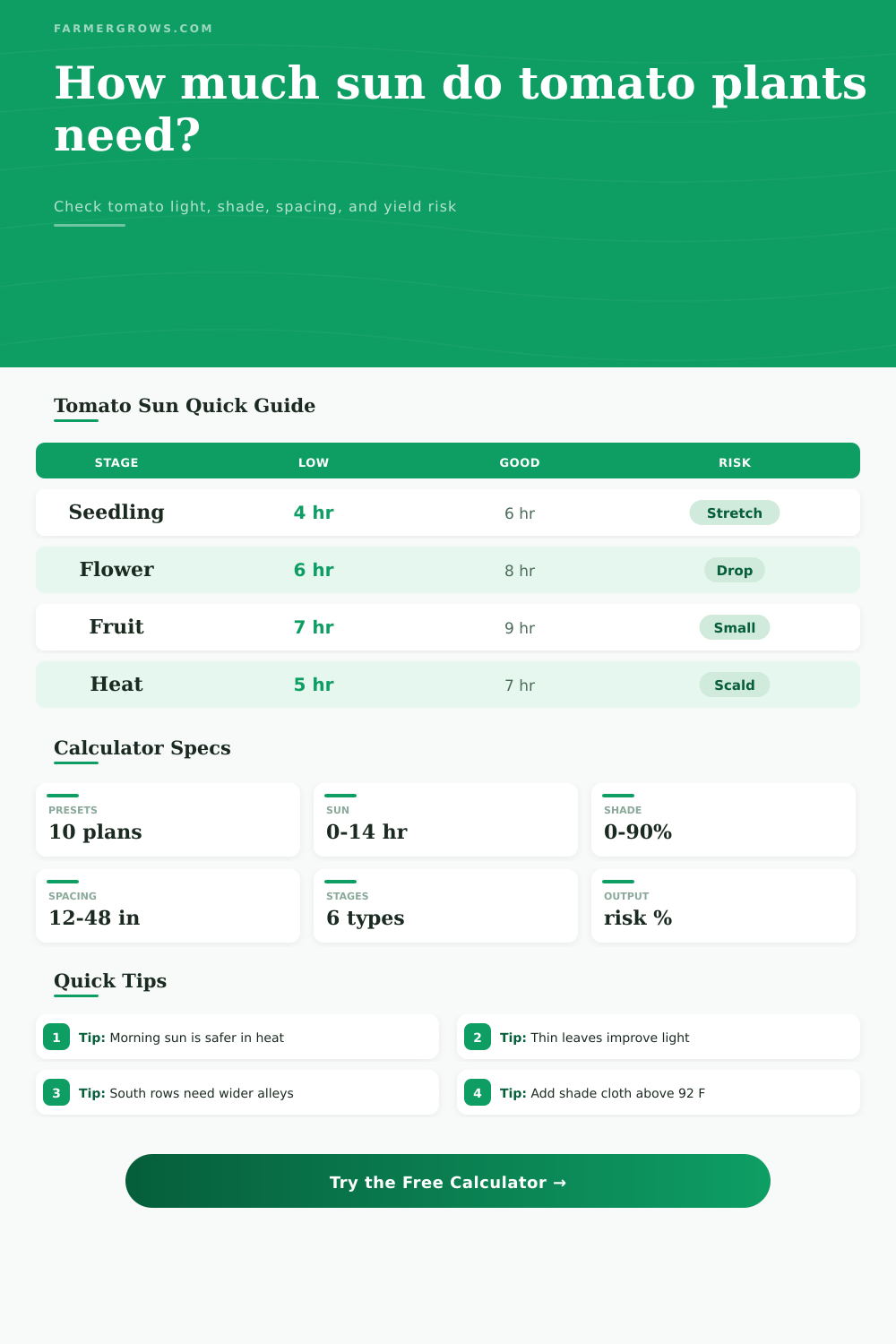
| Seedling or hardening off | 4 to 5 hours | 6 hours | Stretching and weak stems |
| Vegetative growth | 5 to 6 hours | 7 to 8 hours | Thin canopy and slow roots |
| Flowering and fruit set | 6 to 7 hours | 8 to 9 hours | Fewer blossoms and poor set |
| Fruit sizing | 7 hours | 8 to 10 hours | Small fruit and late harvest |
| Ripening and late harvest | 5 to 6 hours | 7 to 8 hours | Slow color and bland flavor |
| Filtered shade | Light multiplier | Best use | Watch point |
|---|---|---|---|
| 0 to 10% | 0.95 to 1.00 | Main season open beds | May need mulch and water in heat |
| 20 to 30% | 0.78 to 0.86 | Hot afternoon protection | Keep morning sun strong |
| 40 to 50% | 0.60 to 0.70 | Heat rescue or seedlings | Too low for heavy fruit set |
| 60% or more | Below 0.55 | Temporary stress cover | Remove when heat breaks |
| Layout | Light effect | Spacing guide | Calculator action |
|---|---|---|---|
| North to south rows | Even east and west exposure | 24 to 36 in plants, 42 to 60 in rows | Best default for field rows |
| East to west rows | South row can shade north row | Use wider row spacing | Adds spacing caution |
| Single row or containers | Good side light if unobstructed | 18 to 30 in depending type | Rewards open edges |
| Wall or fence planting | Can reflect or block light | Keep vines 12 in from wall | Depends on wall direction |
| Condition | Light goal | Heat response | Tomato note |
|---|---|---|---|
| Spring transplant | Build from 4 to 7 hours | Protect cold roots first | Gradual sun prevents scorch |
| Main summer crop | 7 to 9 usable hours | Shade only in hot afternoons | Best yield balance |
| Very hot spell | 5 to 7 strong morning hours | Use 20 to 40% shade cloth | Pollen protection matters |
| Fall ripening | 6 to 8 direct hours | Remove shade if weather cools | Light speeds color change |
We talk about it in terms of hours, hours from dawn to dusk is what we call sunshine. It sounds precise until you remember that an hour of direct sun in the open ground are more intense than an hour of filtered light beneath a shade cloth.
Intensity… Not time… Is the factor that determines if the fruit on your vine will be sweet or green. Use the calculator on that same page to get a better idea of how much light you actualy have; it takes into account spacing, orientation, row shading, and heat stress.
How to Manage Sunlight for Tomatoes
Begin with a pre-set such as Morning Cherry Bed or Full Sun Beefsteak; see what happens under typical circumstances. Then adjust variables to suit your own garden design.
Is there a fast method to stop guessing? Manage light as a real resource rather than hoping for the sun to appear. Your starting point is direct sun hours, but what about filtered shade? That decreases the amount of available light, which can impact photosynthesis during peak heat.
To make up for it, the calculator take into account the energy that reaches the leaves through an applied multiplier. Why does that matter? Because tomatoes aren’t too fond of super-hot weather: When temperatures reach over ninety-two degrees F., pollen viability drops; flowers abort. Filtered shade in the afternoons protect your crop. Sugar is still produced in the morning, no loss there.
Another factor is frequently neglected: which way do the rows run? When they’re oriented north to south, light filters through canopy equally. As the sun shifts, it shine on both sides of each plant. With east to west rows, however, the south side cast long shadows that create dark spots on the north side. In this shade, fruit has trouble ripening and disease loves it.
To compensate for this situation, you probably want to space rows farther apart… If not by a couple feet. The calculator consider whether your plants are planted close together or widely spaced.
Light requirements depend on variety. With cherry tomatoes you’re forgiven for being a little shy on the amount of light; they will set fruit even in dimmer light. The big beefsteak types needs plenty of energy to really plump up. The indeterminate ones continues all season long, which is great, but they require regular pruning (to remove bottom leaves) and vertical support (as in this story) because of that.
Too much foliage, especially without any thinning, leads to shade inside those cages and reduced air circulation, inviting mildew. Removing some lower leaf allows more sunshine into the interior. That’s an easy adjustment that helps.
It is about how long it lasts. Yes, high temperatures create heat stress. But it is more about how long those high temperatures lasts. Prolonged heat prolongs water stress… Days of being dry. Lower leaves receives more reflected light with reflective mulch. More light equals more photosynthesis, but also warmer soil. If you don’t provide consistent water, that added warmth in very hot climates becomes harmful.
The tool flags such concerns. The tool flags these risks so you can balance light gain against thermal stress.
Light is a negotiation. Tomato growers seeks enough light to set fruit and develop sugars, but not too much, which will cook the plant. What’s “too little”? Or “too much”? That’s where the calculator comes in. It gives the negotiations some context. It can convert all those hazy observations into something useful.
Adjustments, like pruning more aggressively, perhaps; or maybe widening the spacing; or adding some shade cloth. It lets you know if you’re going to get a bumper crop from what you’ve got, or if you should of change things up.
REMEMBER: Good light management is about reading the sky but also about reading the plant itself. Are stems starting to stretch? That’s a sign of not enough light. Is there any scorch on your fruit shoulders? That means there is too much light.
The numbers are a guide; let the garden reality check the math. Once you learn what makes tomato plants happy; how light and heat and space all relate, you stop fighting the weather. You start working with it. And your tomatoes will thank you with vigor.