Water for Fruit Trees Calculator
Estimate weekly fruit tree irrigation from tree species, age, canopy diameter, trunk caliper, soil texture, mulch radius, useful rain, heat or evapotranspiration, and emitter flow.
Start with a real orchard situation, then tune canopy diameter, rain, mulch, and emitter flow for your own fruit tree block.
Fruit Tree Watering Estimate
Results are adjusted for crop type, tree age, canopy area, caliper establishment demand, soil, mulch, rain, heat, and irrigation efficiency.
Works well with deep drip zones near the canopy edge. Avoid drought swings during fruit sizing.
Fast summer growth and fruit load raise water demand. Sandy peach blocks need shorter intervals.
Evergreen canopies benefit from steady soil moisture and wide wetting patterns below the drip line.
Shallow feeder roots need mulch and good drainage. Avoid both dry pockets and waterlogged soil.
Moderate water with careful timing helps limit stress while avoiding soggy conditions near harvest.
Established olives tolerate deficit irrigation, though consistent water improves growth and fruit fill.
Warm climates and broad canopies can drive high ET, especially on exposed orchard floors.
Handles dry spells better than many fruits, but fruit sizing still improves with planned deep watering.
| Fruit tree species | Calculator factor | Typical pattern | Watering caution |
|---|---|---|---|
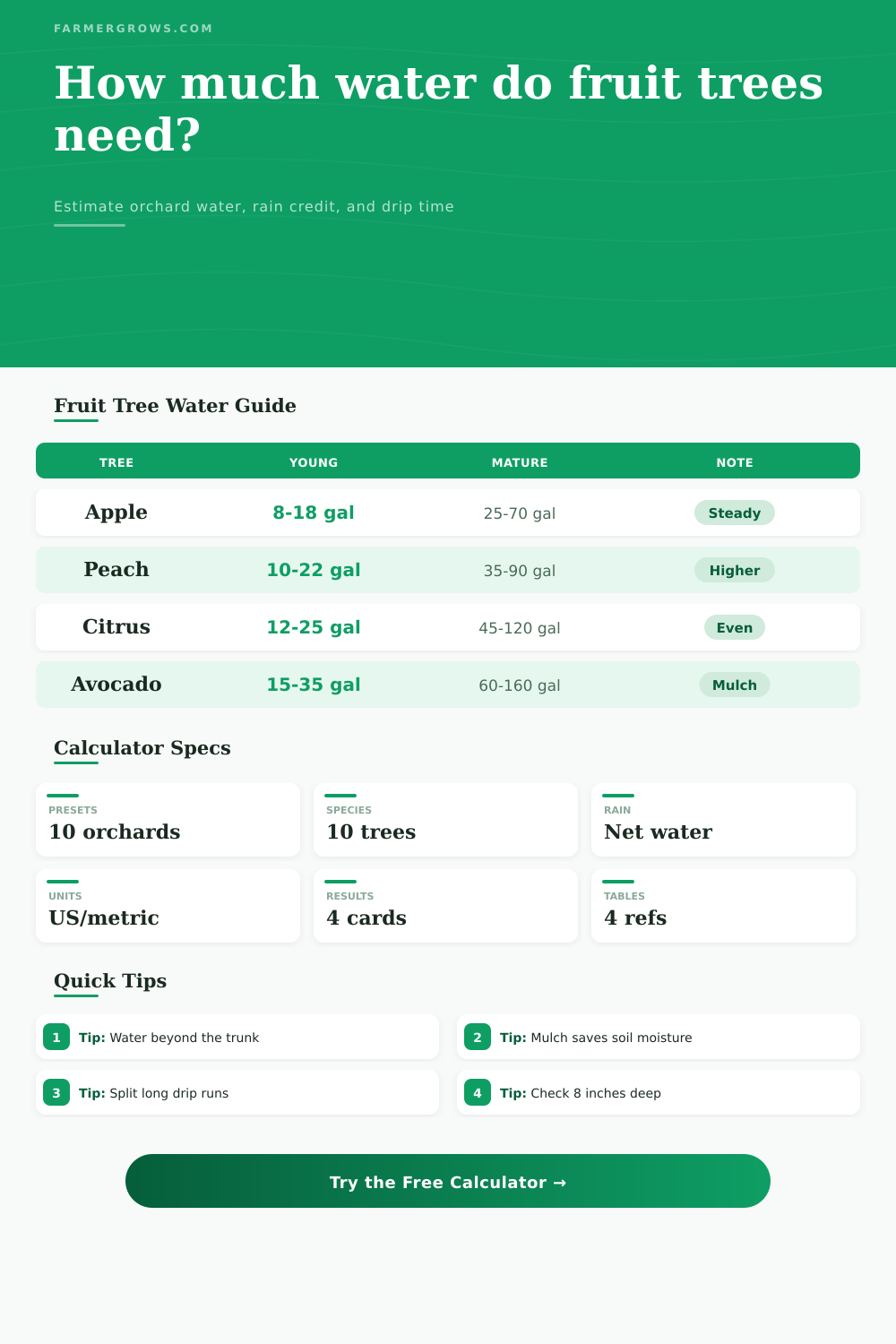
| Apple | 1.00x | Moderate deciduous demand | Keep even during fruit swell. |
| Peach or nectarine | 1.12x | Higher summer demand | Do not var sandy soil crash dry. |
| Citrus | 1.10x | Evergreen, steady demand | Wet beyond the trunk basin. |
| Avocado | 1.20x | Shallow feeder roots | Mulch well and avoid saturation. |
| Cherry | 0.92x | Moderate, timing sensitive | Avoid prolonged soggy soil. |
| Pear | 0.98x | Moderate, steady growth | Split water in heavy clay. |
| Olive | 0.80x | Drought tolerant when mature | Young olives still need regular water. |
| Almond | 1.08x | Large canopy orchard crop | High heat raises ET quickly. |
| Mango | 1.12x | Warm climate canopy | Protect young trees from dry wind. |
| Pomegranate | 0.86x | Deficit tolerant fruiting tree | Regular water improves fruit sizing. |
| Weather setting | ET depth used | Best match | Scheduling note |
|---|---|---|---|
| Cool or cloudy | 0.55 in/week | Cool spring, low wind | Check soil before adding water. |
| Mild week | 0.75 in/week | Moderate temperatures | Often pairs with one deep soak. |
| Warm growing week | 1.00 in/week | Normal active growth | Good default for established trees. |
| Hot dry week | 1.30 in/week | High sun, dry air, wind | Split irrigation to reduce runoff. |
| Extreme heat or wind | 1.65 in/week | Heat wave or exposed slope | Watch young trees and containers closely. |
| Irrigation method | Efficiency used | Good use | Runtime note |
|---|---|---|---|
| Drip emitters | 90% | Young and mature trees | Use several emitters around canopy edge. |
| Micro-sprinkler | 85% | Wider root-zone wetting | Check spray pattern and wind drift. |
| Bubbler basin | 78% | Basins around young trees | Run slowly so the basin infiltrates. |
| Slow hose basin | 72% | Occasional backyard soaking | Measure bucket fill time for real flow. |
| Soaker ring | 80% | Small orchards and tree rings | Keep the ring outside the trunk flare. |
| Tree stage | Age guide | Calculator behavior | Field check |
|---|---|---|---|
| New planting | 0 to 1 year | Uses strong caliper minimum | Keep original root ball moist. |
| Establishing tree | 1 to 3 years | Blends caliper and canopy demand | Expand emitters as canopy grows. |
| Young bearing tree | 3 to 6 years | Canopy area becomes primary | Wet near the drip line, not just trunk. |
| Mature tree | 6 plus years | Uses full canopy root-zone area | Probe 8 to 12 inches deep after watering. |
Wetted pattern: Move irrigation outward as the tree grows. Fruit tree feeder roots are usually more active under and just beyond the canopy edge than right against the trunk.
Soil check: After a calculated watering, dig or probe 8 to 12 inches deep. If the zone is dry below the surface, split longer runs into soak cycles.
It feels right to pour some water at the trees base, so most beginning orchardists do just that, pouring water on the trunk. Don’t get into this bad habit; you’re not likely to hit any feeder roots, which tend to live a ways out from the trunk, under the drip line of canopy, and sometimes as much as several feet beyond it. More important than how much water is applied is where: When you miss the mark (as with all irrigation), you’re basically watering dirt.
Plugging in information about size of your canopy spread and your soil type into the calculator above do the math for you, so you don’t have to guess how much effort or time it will take to reach them. The thing that most throws people off about the inputs is the first one: How old is the tree? Two- and ten-year-old apple trees may appear roughly equal in size. However, a ten-year-old drinks different from a two-year-old. The two-year-old has a tiny little ball of roots atop ground, which is easy to dry out. An older tree have a complex network of roots capable of holding water, and the tool accounts for that. It mixes in canopy area with the caliper size to adjust to the fact that a big diameter mean potential for lots of water, while a small canopy transpires less. This gives you a mix of both factors, creating something closer to reality then just a straight-up average. That’s a small difference, but avoids what many people do wrong… Either drown their young trees, or starve their old ones.
How to Water Your Trees Correctly
The other big variable is soil texture. For instance, sand drains quickly, so you need to water it more often with smaller amounts. With clay, it acts like a sponge: Push it down by soaking deeply, infrequently, never letting it sit in the root zone long enough to create airless pockets. The table on the page spells all that out, including what the efficiency rating will be depending on whether you have bubbler or drip emitters. Drippers are most efficient (why? They deliver water only where plant wants it. Basins are easier to install but lose some to evap & runoff. Know thy soil, and know which way to go.
And then there’s heat and there’s rain. To factor that in, the calculator has you adjust its setting for water loss, the amount of water the air sucks up from the soil (and moves out of plants). A tree lose water more quickly on a hot, breezy week than it does on a cool, cloudy one, regardless of what your soil probe reads. Enter your rainfall each week; it will help compensate. Remember: Even if you have a shower, just wetting the leaves doesn’t count, unless it actualy penetrates the root zone. That is important. A lot. Too many gardeners think a tree is recharged when leaves are wet, so they go out and water again after a gentle rain. No such luck.
In this game, mulch is your best friend. Straw or wood chips within a four-foot radius really reduce evaporation, keeping that root zone stable and cool. The estimate for watering takes into account how much mulch you have applied. Meaning: without mulch, odds are you’ll be adding more water. Simple tradeoff: Spread mulch now, or pay money for water later.
Notice the species coefficients: High-demand, shallow-rooted avocado. It needs constant moisture and must not be soggy. Once established, olive trees can handle less water. Citrus: In-between, wanting even moisture so that the trees’ evergreen canopy don’t suffer. These are built into the tool, but knowing why will allow you to tweak accordingly. For example, maybe you’re planting avocado on heavy clay and want to avoid waterlogged conditions, so you override the default frequency with multiple shorter cycles instead. That’s what I mean by the tool providing a starting point that you then tweak based off your own observations.
Water…then check. Dig in eight- to a dozen-inches deep. Mud? You drowned the roots; go shorter or less often. You drown the roots; go longer or slower. Is it dry? You missed or went too fast; tweak the run time (or number of sessions). More important than all those presets: this instant feedback loop. Your hands and eyes is more accurate than that calculator will ever be, and they can show you what the calculator gets right.
The how: When do you water? Where? How much? The “when” matters. So does the “where.” So does the “how much,” too. Water stress at fruit-sizing time (drought) means small fruit that tastes worse. Wet feet (soil) means rotten fruit. Practice finding the sweet spot. Follow the estimates; watch your tree; tune accordingly. Get it out to the edges of canopy. Not into the middle of things. That’s not where the action is.