Water for Succulents Calculator
Estimate a careful soak amount and watering interval from plant type, pot diameter, pot material, drainage, growing location, light, season, humidity, last watering date, and root depth.
🌱Succulent presets
Choose a named starter profile, then adjust the fields to match your actual pot and growing conditions.
💧Watering inputs
Your succulent watering estimate
Adjust inputs and calculate to see a pot-specific recommendation.
Calculation breakdown
🌵Succulent type comparison grid
🏺Pot material drying reference
📋Reference tables
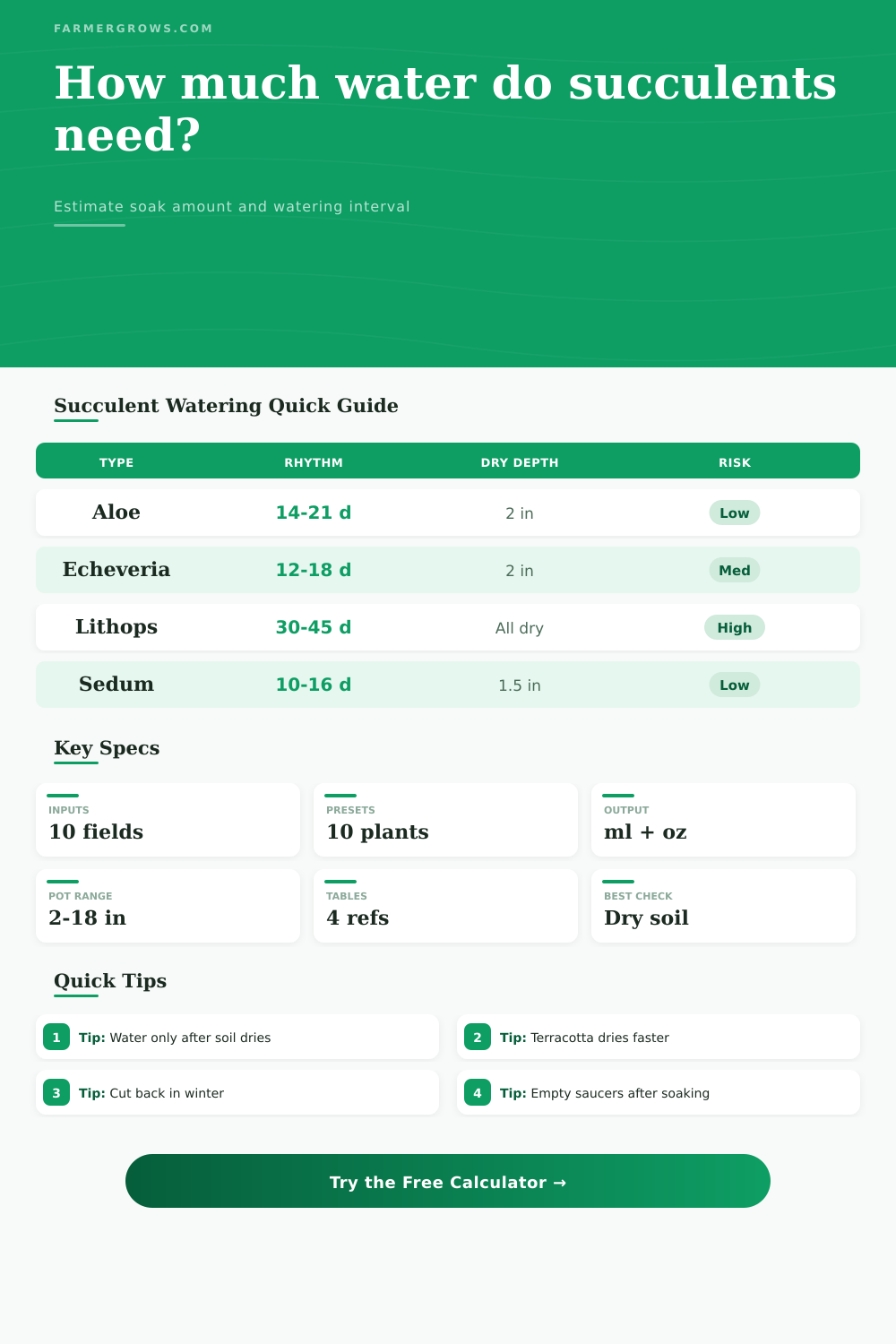
| Succulent type | Base interval | Water style | Dryness check |
|---|---|---|---|
| Aloe vera | 18 days | Deep soak | Top 2 in dry |
| Echeveria | 16 days | Soil-level soak | Crown dry, mix dry |
| Jade plant | 17 days | Slow soak | Pot feels light |
| Haworthia | 21 days | Small soak | Mostly dry root zone |
| String of Pearls | 14 days | Even shallow soak | Top half dry |
| Lithops | 35 days | Very light soak | Fully dry, no splitting |
| Sedum | 14 days | Deep tray soak | Top 1.5 in dry |
| Sempervivum | 20 days | Outdoor soak | Full dry-down |
| Pot diameter | Typical root depth | Starting soak | Notes |
|---|---|---|---|
| 2-3 in nursery pot | 1-2 in | 30-60 ml | Dries fast, easy to overpour |
| 4 in windowsill pot | 2-3 in | 60-120 ml | Common for rosettes and offsets |
| 6 in container | 3-5 in | 140-260 ml | Good for aloe, jade, trailing types |
| 8-10 in planter | 4-7 in | 280-650 ml | Check weight before repeating |
| 12 in bowl or agave pot | 5-9 in | 650-1200 ml | Water slowly for even wetting |
| Soil drainage | Interval effect | Water amount effect | Best use |
|---|---|---|---|
| Very fast cactus mix | 3 days sooner | About 8% more | Hot patios, bright sun, clay pots |
| Gritty succulent mix | 1 day sooner | Baseline amount | Most container succulents |
| Standard bagged mix | 2 days later | About 8% less | Bright indoor pots with drainage |
| Dense or peat-heavy mix | 6 days later | About 18% less | Use cautiously; high rot risk |
| Condition | Interval change | Amount change | What to watch |
|---|---|---|---|
| 8+ hours strong light | 4 days sooner | About 8% more | Wrinkling leaves between soaks |
| Winter rest | 8 days later | About 18% less | Cool soil that stays damp |
| Humidity above 65% | 5 days later | About 8% less | Slow evaporation near windows |
| Hot dry spell | 6 days sooner | About 12% more | Rapidly light pots and leaf puckering |
💡Succulent watering notes
This calculator estimates container watering. Reduce watering for unrooted cuttings, recently repotted plants, damaged roots, cold rooms, or pots without drainage holes.
That’s where calculator up top comes in. It figures out exactly how much and when for you (at least based off your particular set-up). But that’s not enough. You have to know why it changes so the plants will live.
Being succulent means they can tolerate drought, but cannot stand excess water. And that’s what’s stressful about watering as a beginner. The single greatest overlooked variable are pot material. Unglazed terra cotta is basically a sponge, its porous walls literally pull water out of potting medium and hasten drying time. Glazed or plastic pots aren’t porous; their interior remains noticeably moister much longer. You might move an otherwise happy Echeveria from a clay container into a glossy ceramic one. You can no longer maintain same watering schedule. The change in soil environment will occur. Even though the plant itself doesn’t change. That’s why the calculator adjusts the interval different than your choice of pot material. Trust me, it matters.
Why Pot, Soil, and Season Matter
The soil has another negative impact. How many times have you seen someone buy a random potting mix because it was on sale? Most bagged potting soils is often peat-heavy and hold water like a wet towel. A succulent wants a fast-draining, gritty, medium so air gets down into the roots. According to chart on the page, a peat-heavy mix can extend the interval by nearly a week. In that time, rot will begin and the roots will suffocate if left in moist soil. A small change in ingredients can greatly change how long plant survives.
Season and light matter, too. Succies grow more vigorously in spring/summer when they use more water and food and will need more frequent deep soaks. Most succulent plants enters dormancy in winter, with slowed growth (to crawl-speed) and a serious reduction in water needs. If you water a dormant plant as often as you do in July, you’ll harm it. That’s why the calculator factors in the seasonal change. The number it recommends goes down and the interval lengthens. If you’re not using the calculator, you should of follow suit yourself.
Your final safety net is checking if anything is drying out. Because no formula can be perfect: Every house heats up (or not); air circulates differently; humidity varies. You’ll get a good guess with the calculator, but the truth will come when you reach in with a finger or chopstick. Is the top inch or so still moist? Wait. Is the top inch or two bone dry and light as a feather? Time to water. The physical test overrules the schedule. Responding to the true needs of the plant, not just mindlessly following some rule; makes all the difference.
It’s easier to overwater than underwater. Succulents will get sad (wrinkling their leaves) if they is thirsty, but then perk up again. If you drown them, they’ll go all brown and soft, and typically can’t recover from that. It is better to wait longer between soaks than to rush it.
The risk output flags when there’s a high likelihood that rotting might happen given your conditions. When it does, the tool tells you: Be extra careful. Listen. A succulent’s care is not so much about nailing down a precise number of days but rather knowing its surroundings. The complexity of the relationship between the light conditions, the size of the pot, how well-draining the soil is, and where in each season the succie falls on this continuum gets simplified into an equation with fewer variables. No guessing required. It is a starting point to respect its biology.
Use the numbers as a guide, but let physical checks override them. Feel around in there with your fingers. Listen to the plant; let it be your teacher. When it says it needs water, then it does.