Water for New Grass Seed Calculator
Estimate how long and how often to water new grass seed from lawn square footage, seed type, soil texture, slope, weather, rainfall, sprinkler output, germination stage, daily cycles, and straw cover.
Choose a named seeding situation, then adjust the sprinkler rate, rainfall, daily cycles, and stage as the seedbed changes.
New Grass Seed Watering Results
Your watering plan will appear here.
Often takes 14 to 30 days to germinate, so it needs the longest stretch of steady surface moisture.
Usually sprouts in 7 to 14 days and handles deeper transition watering better than many fine grasses.
Can emerge in 5 to 10 days, so the calculator shortens the high-frequency germination window.
Needs warm conditions and consistent moisture; dry spells during germination reduce stand density.
Often needs 14 to 28 days or more, so patience and careful light watering matter.
Likes cooler seedbeds and lighter water on shaded soil that dries more slowly.
Ryegrass may appear first while bluegrass or fescue components still need moisture.
Often seeded on larger areas where sprinkler uniformity and runoff control become important.
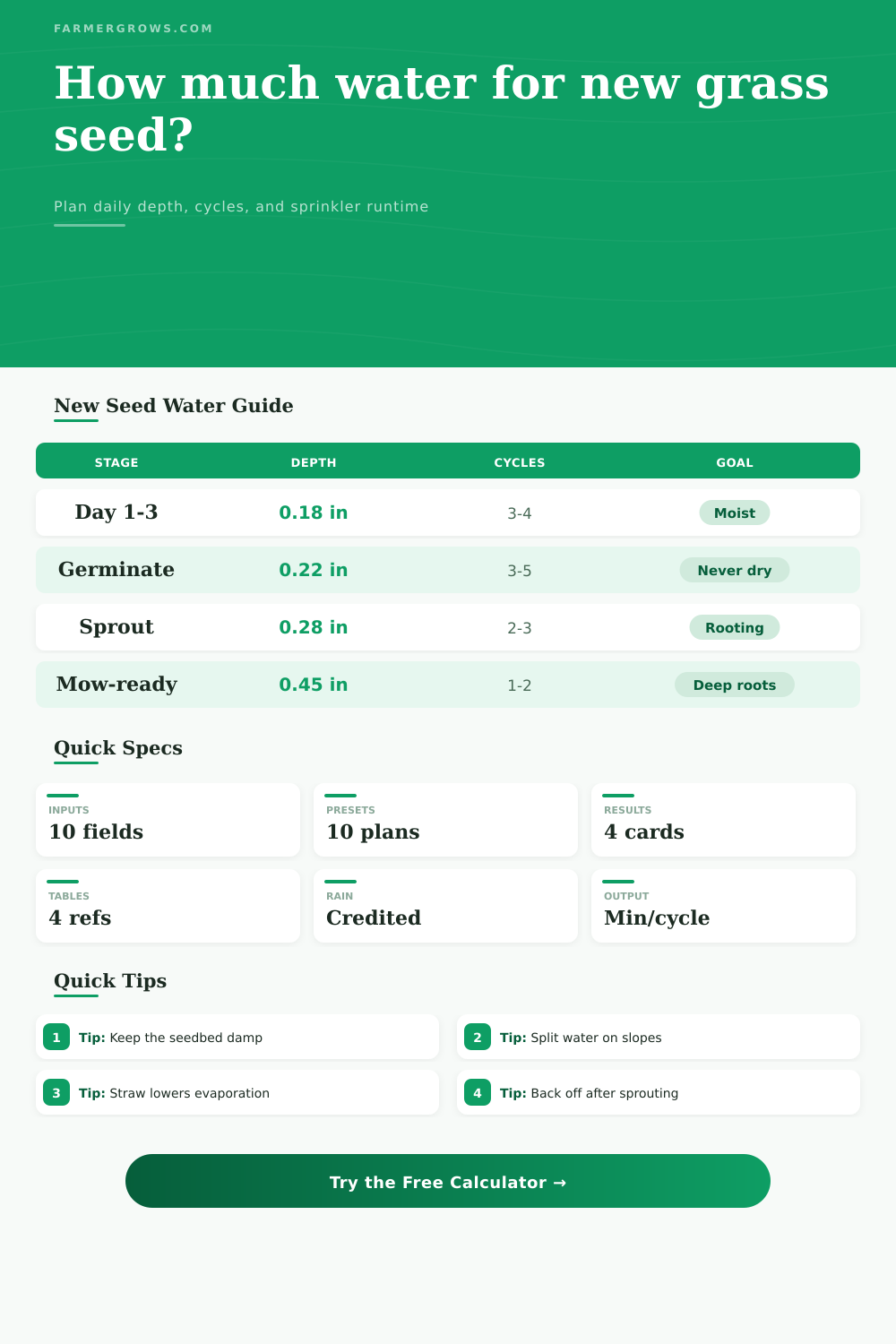
| Germination stage | Typical depth per day | Cycles per day | Moisture goal |
|---|---|---|---|
| Day 1 to 3 after seeding | 0.12 to 0.20 in | 2 to 4 light cycles | Settle seed and moisten the top soil layer. |
| Pre-sprout germination | 0.16 to 0.26 in | 3 to 5 light cycles | Keep the surface from crusting or drying. |
| Sprouts visible | 0.22 to 0.35 in | 2 to 3 cycles | Start wetting slightly deeper for new roots. |
| Rooting after most seed is up | 0.30 to 0.50 in | 1 to 2 cycles | Encourage roots to move below the surface. |
| Near first mowing | 0.45 to 0.70 in | 1 deeper cycle | Transition toward normal lawn irrigation. |
| Condition | Calculator adjustment | Why it matters | Field check |
|---|---|---|---|
| Sandy soil | More frequent water, 1.18x | Fast drainage dries the seeded surface quickly. | Check mid-day and late afternoon. |
| Clay soil | Lower depth, shorter cycles | Water enters slowly and can puddle or run off. | Stop before shine or pooling appears. |
| Moderate slope | 1.15x demand with split cycles | More water is needed to offset runoff losses. | Use short pulses and soak pauses. |
| Hot or windy weather | 1.15x to 1.35x | Evaporation removes surface moisture faster. | Add a mid-day mist if seed dries. |
| Straw cover | 0.82x to 0.92x | Light cover shades seed and slows evaporation. | Soil should stay visible through straw. |
| Sprinkler output | 0.05 in cycle | 0.08 in cycle | 0.12 in cycle |
|---|---|---|---|
| 0.25 in/hr | 12 min | 19 min | 29 min |
| 0.40 in/hr | 8 min | 12 min | 18 min |
| 0.50 in/hr | 6 min | 10 min | 14 min |
| 0.75 in/hr | 4 min | 6 min | 10 min |
| 1.00 in/hr | 3 min | 5 min | 7 min |
| Seed type | Typical germination | High-frequency watering window | Transition cue |
|---|---|---|---|
| Perennial ryegrass | 5 to 10 days | About 7 days | Reduce frequency once most seedlings stand upright. |
| Tall fescue | 7 to 14 days | About 10 to 14 days | Shift from misting to deeper cycles after emergence. |
| Kentucky bluegrass | 14 to 30 days | About 21 to 28 days | Keep watering for slower seeds even after early sprouts. |
| Bermuda grass | 7 to 21 days | About 14 to 21 days | Warm soil and steady moisture speed fill-in. |
| Zoysia seed | 14 to 28 days | About 21 to 28 days | Stay patient before switching to deep watering. |
| Lawn area | 0.15 in/day | 0.25 in/day | 0.40 in/day |
|---|---|---|---|
| 500 sq ft | 47 gal/day | 78 gal/day | 125 gal/day |
| 1,000 sq ft | 93 gal/day | 156 gal/day | 249 gal/day |
| 2,000 sq ft | 187 gal/day | 312 gal/day | 498 gal/day |
| 5,000 sq ft | 467 gal/day | 779 gal/day | 1,246 gal/day |
| 10,000 sq ft | 935 gal/day | 1,558 gal/day | 2,492 gal/day |
Surface cue: During germination, the top quarter inch should stay damp but not shiny. If footprints squish water or seed moves, shorten each cycle.
Transition cue: After most seed has sprouted, reduce the number of daily cycles and increase the soak depth gradually so roots chase moisture downward.
Tackle seeding as a slow process of watering repeatedly (not just an episode of planting). Patience is required. You must also carefuly monitor the soil for dryness or wetness. Too much water can absorbs away the seed, but if it is too dry, the seed won’t germinate.
Once you know what kind of seed and how much lawn area you have, the maths done: Enter it into the calculator up top to calculate how many times to water, and when. No need to guess which conversion factor or coefficient applies.
How to Water Your Grass Seeds
First: Grass seeds is designed to absorb moisture and expand and tear themselves apart. They cannot do that unless the top layer of soil stay moist (even if just for an hour or two). So those first days, especially, are crucial. You’re not watering grass. Not really. You’re watering a delicate blanket of living material with no root system at all. Keep it slightly moist, but not soup.
This is where the different types of soil come in. In sandy soil, for example, water drains fast, so shorter and more frequent cycles are best. Clay tightens up when it gets water. You can go longer between cycles with clay, but then you must pay attention to runoff. The tool takes this into consideration, too, and will adjust its runtime to match depending on soil behavior.
But there’s no blanket schedule that works; the ground beneath your feet dictates how water moves. Success of getting seed to sprout depend heavily on weather conditions. Moisture gets drawn away from the surface more quickly than you can keep up with if there is hot, dry wind blowing. Evaporative loss can be substantial (if you see a lot of dusty-looking, rather than shiny wet, seedbed, then I bet you’re losing too much).
Dusting lightly with compost or laying a layer of straw will help hold that moisture where it belongs. The calculator takes that into account and adjusts downward for needed water depth because a physical barrier slows drying.
Wanting the ground to be green fast causes most people to overwater. “more water, faster growing.” It’s not. Water that puddles will block out oxygen, killing seeds, and can lead to fungal problems. Consistent moistness, but not saturation is what you want. Imagine top quarter-inch of soil feeling like a wrung-out sponge. Shiny? It has gone too far. Cracked? It has gone too little.
Check the chart on the page for when to adjust the depth of your watering daily based on when the seed sprouts and starts to root in. When the grass starts to push through, it’s time to change your plan again. At first you’re misting the surface. Then when those sprouts emerge, you want to train them to grow deep roots. Encourage them to do so. So you’ll have slightly longer runtimes with less cycles.
You’re teaching the lawn to rely on itself, and that’s good. But if you continue mistering it gently indefinitely, the lawn will never learn how to root deeply. It will remain vulnerable to heat and other drought-related stress later in the season. The change is not dramatic, but it can be the difference between a thriving lawn and a barely-getting-by one.
The second part of this equation is timing. Ryegrass pops up within a week; that’s speedy compared to Kentucky bluegrass, which can take weeks to sprout. Water based off the slowest seedling in the mix (if it’s a blend). Kill the stragglers if you stop too soon. According to the calculator, there’s a range of high-frequency watering times (depending upon your selected seed type). No more worrying about whether to stop watering yet or not. Just go by the calendar until the grass gets well-established and can be watered like everything else.
There’s an element of both observation and science to seeding. Get yourself some numbers as a starting point, then look at the ground. Observe in the morning and again later in the day. Do so by touch, how does the soil feel? What about runoff? Use the number as a base, then tweak according to what the soil and weather say. Begin with the numbers; finish with your eyes. Wet that surface, and the rest will come.