Water For Cucumber Plants Calculator
Estimate cucumber irrigation from plant count, row length, trellis style, growth stage, soil texture, mulch, useful rain, heat stress, fruit load, emitter flow, and watering interval.
Load a common cucumber bed, high tunnel row, container group, or peak harvest case, then tune rainfall and emitter flow for your irrigation setup.
Cucumber Irrigation Result
Your cucumber watering estimate will appear here.
Keep the top root zone damp without saturating small roots. Short pulses are better than deep soak events.
Vines start shading the row. Maintain steady moisture so runners and new leaves do not stall.
Uneven watering can raise blossom drop and misshapen fruit. Avoid big swings between dry and soaked soil.
Heavy picking loads require the most consistent water, especially with heat, wind, and vertical trellising.
| Growth stage | Typical water target | Best interval | Management note |
|---|---|---|---|
| Seedling or direct-sown start | 0.3-0.6 gal per plant per week | Daily to every 2 days | Keep shallow roots moist, but avoid standing water and crusting. |
| Transplant establishment | 0.6-1.0 gal per plant per week | Every 1-2 days | Water near the plug until roots extend into the bed. |
| Vining before flowers | 1.0-1.5 gal per plant per week | Every 2-3 days | Build deep moisture before the crop starts carrying fruit. |
| Flowering and first set | 1.5-2.2 gal per plant per week | Every 1-2 days | Even moisture helps steady flowering, fruit shape, and pollination. |
| Regular fruiting | 2.0-2.8 gal per plant per week | Every 1-2 days | Increase runtime during hot, windy, heavy-picking weeks. |
| Peak harvest | 2.5-3.5 gal per plant per week | Daily to every 2 days | Split long runtimes if soil cannot absorb water fast enough. |
| Condition | Multiplier | Why it changes water | Adjustment clue |
|---|---|---|---|
| Sandy soil or fast raised mix | 1.15-1.25 | Stores less plant-available water near cucumber roots. | Shorten interval before adding large single events. |
| Loam or silt loam | 1.00 | Balanced storage and drainage for most garden rows. | Use as the baseline for weekly gallons. |
| Clay loam | 0.88-0.95 | Holds water longer but may absorb slowly. | Use slower, longer drip or split cycles. |
| Straw, leaf, or hay mulch | 0.82-0.88 | Reduces evaporation and moderates soil temperature. | Check under mulch before cutting too much water. |
| Hot sunny week | 1.18-1.35 | Canopy transpiration rises quickly in heat and wind. | Add runtime before midday wilt becomes severe. |
| Emitter flow per plant | Water delivered in 30 min | Water delivered in 60 min | Common use |
|---|---|---|---|
| 0.25 GPH per plant | 0.13 gal | 0.25 gal | Light drip line or one low-flow emitter. |
| 0.50 GPH per plant | 0.25 gal | 0.50 gal | Common button emitter setup for garden cucumbers. |
| 0.75 GPH per plant | 0.38 gal | 0.75 gal | Two small emitters or closer drip tape spacing. |
| 1.00 GPH per plant | 0.50 gal | 1.00 gal | Containers, sandy soil, or high-demand trellis rows. |
| 2.00 GPH per plant | 1.00 gal | 2.00 gal | Large grow bags or short irrigation zones. |
| Useful rain | Gallons per sq ft | 20 ft single trellis | 40 ft double row |
|---|---|---|---|
| 0.25 inch | 0.16 gal | 6-8 gal before capture loss | 16-19 gal before capture loss |
| 0.50 inch | 0.31 gal | 12-16 gal before capture loss | 31-37 gal before capture loss |
| 1.00 inch | 0.62 gal | 25-31 gal before capture loss | 62-75 gal before capture loss |
| 1.50 inches | 0.93 gal | 37-47 gal before capture loss | 93-112 gal before capture loss |
| 2.00 inches | 1.25 gal | 50-62 gal before capture loss | 125-150 gal before capture loss |
Check the root zone: Cucumber leaves can flag in afternoon heat even when soil is damp. Before adding runtime, check moisture 3-6 inches deep beside the drip line.
Split long runs: If water moves past the root zone or puddles on clay soil, split the minutes into morning and evening cycles for steadier cucumber moisture.
How do you know if your cucumbers want watering? How can you be sure? They like to stay on the wet side. They should not be so soggy that their roots drown, of course, but not so dry that they gets tough and lose their crunch.
If they are happy with their water supply, they let you know. They’ll tell you. And cucumbers communicate loudly: if it is too moist, they get root rot. Too dry, bitter fruits.
How to Water Your Cucumbers
It’s better to learn what they realy want by learning how to control conditions in the root zone more better than it is to guess. After entering the number of plant at your current growth stage, the calculator does all the math.
It factors in things we tend not to think about, like how much rain really penetrates soil compared to how much washes over plastic mulch. It factors in wetted area (which depends on what kind of trellis style you use and the row length). Because a tight canopy provides more shade to the soil surface than a sprawling, bush type, the water-saving potential of vertical trellis becomes even greater.
More on that: Shading the soil with vegetation, particularly high-arched foliage like vertical trellises, cool the soil and makes it hold water longer. This is critical.
And the tool also factors in your soil type, whether sandy or clay. Sand drain fast and needs shorter bursts of water more often. Clay soil holds water but absorbs it slowly, so adjust your drip time to match to avoid puddles on surface.
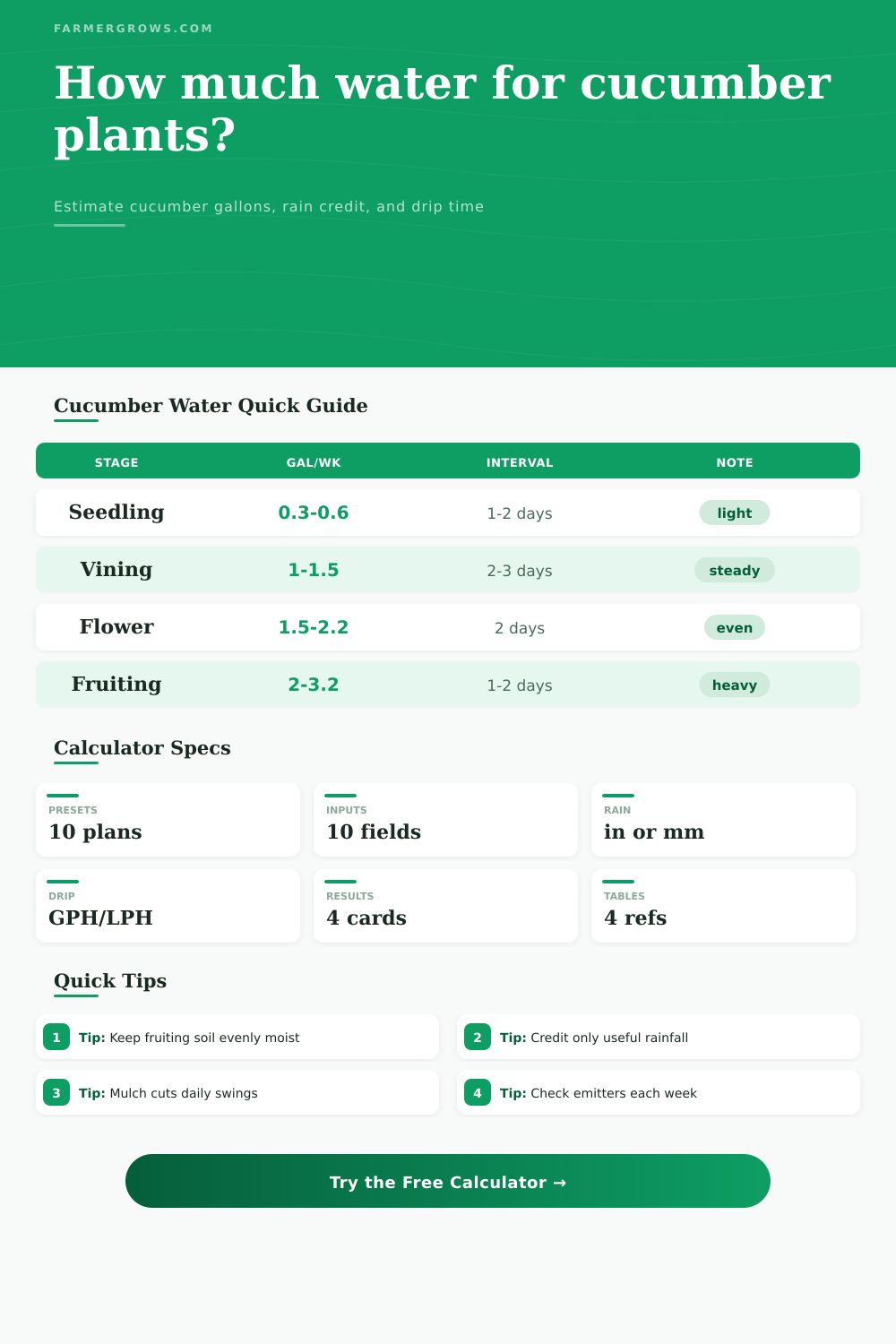
Many don’t realize how important growth stage is. A seedling requires almost no water per week. A plant in full production (peak harvest) drink liters per hour. Look at the comparison chart on the page. It jumps from under a gallon per week to more than three gallons per week.
That’s where the plant transitions from vine growth to fruit fill and that’s why it does not need to be treated as if it were a seedling. Watering a plant in fruit like it was a seedling will cause it to cease fruit production, again: a survival instinct. Fruits will either drop off or get small.
The effects of mulch are dramatic on watering. Insulating layers of leaves or straw keep the root zone stable and reduce evaporation. You’ll be able to run your drip lines for less time with mulch in place because there is less evaporation. That’s why the calculator treats a mulched bed different than a bed of bare soil in the same weather conditions. It assumes the mulch will lower amount needed.
Another thing is heat stress. Quickly, on hot, dry days, the vine begin to transpire more and more. Leaves give off some moisture to try to cool them back down. When they don’t get replaced by the soil, the vines begins to droop.
The leaves might appear thirsty, but sometimes they’re not; the problem is simply too much heat. The best information comes if you check the soil a couple of inches deep. If damp, let it recover. Dry? Add runtime now.
Drip irrigation is best for cucumbers. Powdery diseases like mildew love wet foliage; sprinkler systems wet the foliage. Drip delivers right to root zone. To get the efficiency rating in the tool, assume you have a well maintained drip system. Uneven pressure or clogged emitters will throw it off. Check your lines regularly, once a week, to make sure each plant gets its share of water. You should of checked them often.
It is hard to gauge rain credit. Only include rainfall that was absorbed by the bed. Fast summer storms often run off across bare soil or plastic without soaking into ground. Don’t waste money (and overwater) with useless rain.
Keep it consistent: Cukes don’t like abrupt shifts in water status (that’s why they split and grow weirdly if suddenly wet after being dry). They want an even, gradual amount of moisture. Set the base with the calculator above; go from there as needed.
Feel the soil. Look at the leaves. Numbers are a beginning; your eyes will show you how things is actualy changing. Happy roots = happier crop. Consistent moisture = crunchy, no-bitter cukes all season.