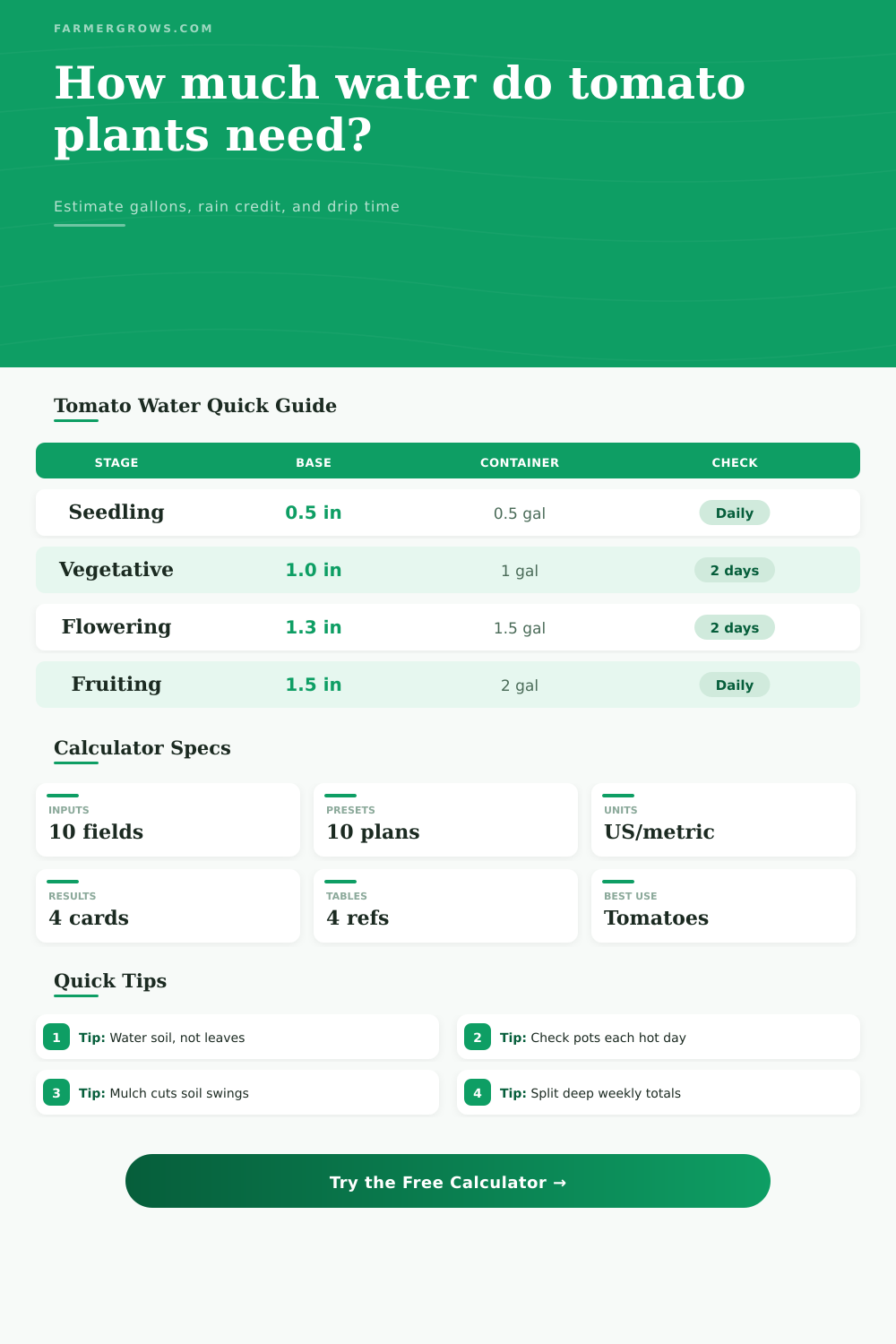
Water for Tomato Plants Calculator
Estimate tomato plant water needs by plant count, spacing or bed area, growth stage, soil, mulch, rain, temperature, drip emitter flow, and irrigation efficiency.
Tomatoes usually prefer deep, even moisture rather than frequent shallow splashes. Use this calculator as a planning check, then confirm with soil feel, pot weight, leaf posture, and local weather.
Tomato Irrigation Estimate
Results include rain credit, soil and mulch adjustments, temperature pressure, container demand, and irrigation efficiency.
| Growth stage | Planning depth | Typical gallons per plant | Watering rhythm |
|---|---|---|---|
| Seedling or small plug | 0.45 to 0.65 in/week | 0.25 to 0.75 gal/week | Small amounts often; avoid saturated trays. |
| New transplant | 0.75 to 1.00 in/week | 0.75 to 1.25 gal/week | Keep root ball evenly moist while roots expand. |
| Vegetative plant | 0.90 to 1.15 in/week | 1.00 to 1.75 gal/week | Deep watering two or three times weekly. |
| Flowering and fruit set | 1.10 to 1.35 in/week | 1.50 to 2.25 gal/week | Keep the moisture pattern steady. |
| Fruit sizing and harvest | 1.30 to 1.70 in/week | 2.00 to 3.50 gal/week | Split into several irrigations during heat. |
| Condition | Multiplier | What it means | Field check |
|---|---|---|---|
| Sandy or fast draining soil | 1.18x | More frequent water because the root zone drains quickly. | Check 4 to 6 in deep after hot afternoons. |
| Loam or balanced mix | 1.00x | Baseline tomato irrigation planning condition. | Soil should form a weak ball, then crumble. |
| Clay or heavy soil | 0.88x | Holds water longer, but needs slower application. | Stop if surface stays shiny or sticky. |
| Good organic mulch | 0.85x | Shades soil and reduces evaporation between irrigations. | Pull mulch aside before checking moisture. |
| Useful weekly rain | Subtract depth | Only count rainfall that penetrates the tomato root zone. | Ignore brief showers that wet leaves only. |
| Container size | Typical mature need | Hot weather check | Best practice |
|---|---|---|---|
| 3 to 5 gal pot | 0.5 to 1.5 gal/day | Check daily above 85°F. | Use determinate or dwarf tomatoes. |
| 7 to 10 gal pot | 0.75 to 2.0 gal/day | Check morning and evening in heat. | Mulch the surface and water slowly. |
| 15 to 20 gal tub | 1.0 to 2.5 gal/day | Watch fruit load and wind exposure. | Use two emitters for even wetting. |
| Grow bag | 0.8 to 2.2 gal/day | Fabric sides dry faster than plastic. | Set bags on saucers only if drainage remains good. |
| Emitter flow per plant | 0.5 gal target | 1.0 gal target | 1.5 gal target |
|---|---|---|---|
| 0.5 gal/hr | 60 min | 120 min | 180 min |
| 1.0 gal/hr | 30 min | 60 min | 90 min |
| 1.5 gal/hr | 20 min | 40 min | 60 min |
| 2.0 gal/hr | 15 min | 30 min | 45 min |
Moisture check: Push a finger, probe, or trowel into the root zone before changing the schedule. The best watering number is the one that keeps soil evenly moist without staying soggy.
Drip scheduling: If the calculator gives a long runtime, divide it into two starts with a soak pause between them. That helps clay beds absorb water and reduces runoff on raised beds.
IT’S A HOT DAY, and you see your floppy tomato plant and think: Is it thirsty, or is it just shy? Do you water because the top inch of soil feels dry, or do you wait until you guess its time? That’s often not right; upper layer may be dry but roots is still getting moisture from deeper down. Watering too much (a common error) can be even more damaging than not watering enough, because rot can set in gradualy.
To irrigate well, think of the root zone; not merely the hose. How fast does soil drain? How much moisture is being pulled out of the ground by sun and into the air? And finally: How much does that soil hold? Understanding those variables will help you trust your numbers, and the calculator do the math.
How to Water Tomatoes Correctly
Begin with growth stage. If plant is a seedling in a tray, its tiny root ball needs frequent, shallow watering, or else the medium will harden off around the roots. Once it’s in the fruiting stage, the plants needs have changed. It need enough deep, consistent water to prevent things like blossom end rot or fruit cracking, but not so much water that it rot.
The nature of your soil affect how it behaves with water. Heavy clay soils holds it for longer, so apply slowly to allow soaking in but not run-off. Fast-draining sandy soils require more frequent watering (again, to the roots) because they dry out fast. In both instances, a layer of mulch slow down evaporation and shades soil as well. This means there is less evaporation and you need to water less often. More mulch mean less water week after week, a significant difference that adds up during a long season.
Pots are another matter entirely. Because the soil surface is exposed on all sides (rather than buried inside a bed), they will dry out more quicker than those in the ground. In particular, a tomato plant growing in a five-gallon pot is a risky proposition; especially in high summer, when I may need to check it twice a day. Twenty-gallon tubs has a greater capacity to absorb changes in temperature and hold more moisture, providing you with a broader margin of error. The calculator factors that in, too; the higher number reflect the fact that there’s less soil volume to work with, and therefore less stable moisture conditions.
The schedule gets complicated by rain as well. Not all rain aid roots; a quick summertime shower that merely dampens the foliage doesn’t add to plant’s water balance. Count only rain that reaches root zone; typically an inch or more of steady soaking.
The same goes for temperature. In high nineties days, when plants is trying to cool off, they give up some water (evaporating faster) so they don’t overheat. It is just another physics equation, but it feel messy in the garden.
No more guesswork about how much will get delivered with drip irrigation. Don’t guess when to shut off the hose; time it based off its efficiency and flow rate. Say your emitter delivers one gallon per hour and your plant require two gallons every other day. Do the math. The tricky part is breaking up that long watering into two shorter ones. This allow clay soils time to soak it up gradualy and prevents runoff on raised beds.
But remember: Numbers aren’t a law; they’re just a guide. Your finger remain the best indicator of all: Stick it in the ground a couple of inches. Is it moist? Wait. Dry? Water the plant. Your number is the baseline, the place to begin, but not where you should of start each time you walk into garden.
That way you don’t have to go from scratch each time; you can use the tool to establish your schedule, and then let your hands and eyes do the tweaking. You will worry less and eat more, and your healthy, steady-growing tomatoes will reward you for it.