Compost for Raised Bed Volume Calculator
Estimate total raised-bed volume, compost blend amount, bag count, bulk weight, and annual topdress compost from your bed dimensions and fill plan.
1Raised bed presets
Choose a real bed setup to load dimensions and compost assumptions, or enter your own numbers below.
2Bed dimensions and compost mix
Fill and compost assumptions
Your raised bed compost estimate
Volumes include the portion still needing new mix plus the selected settling factor. Topdress is shown separately so it does not inflate first-fill mix.
Calculation breakdown
3Quick volume reference
4Raised bed comparison grid
Use the full inside length, width, and fill depth. Add settling allowance because new mixes drop after watering and planting.
Enter the usable existing fill percent so the calculator estimates only the remaining new mix and compost share.
Topdress is based on surface area and topdress depth. It is usually much smaller than the first-fill compost need.
5Reference tables
| Bed depth | Best use | Volume for 4×8 bed | 30% compost amount |
|---|---|---|---|
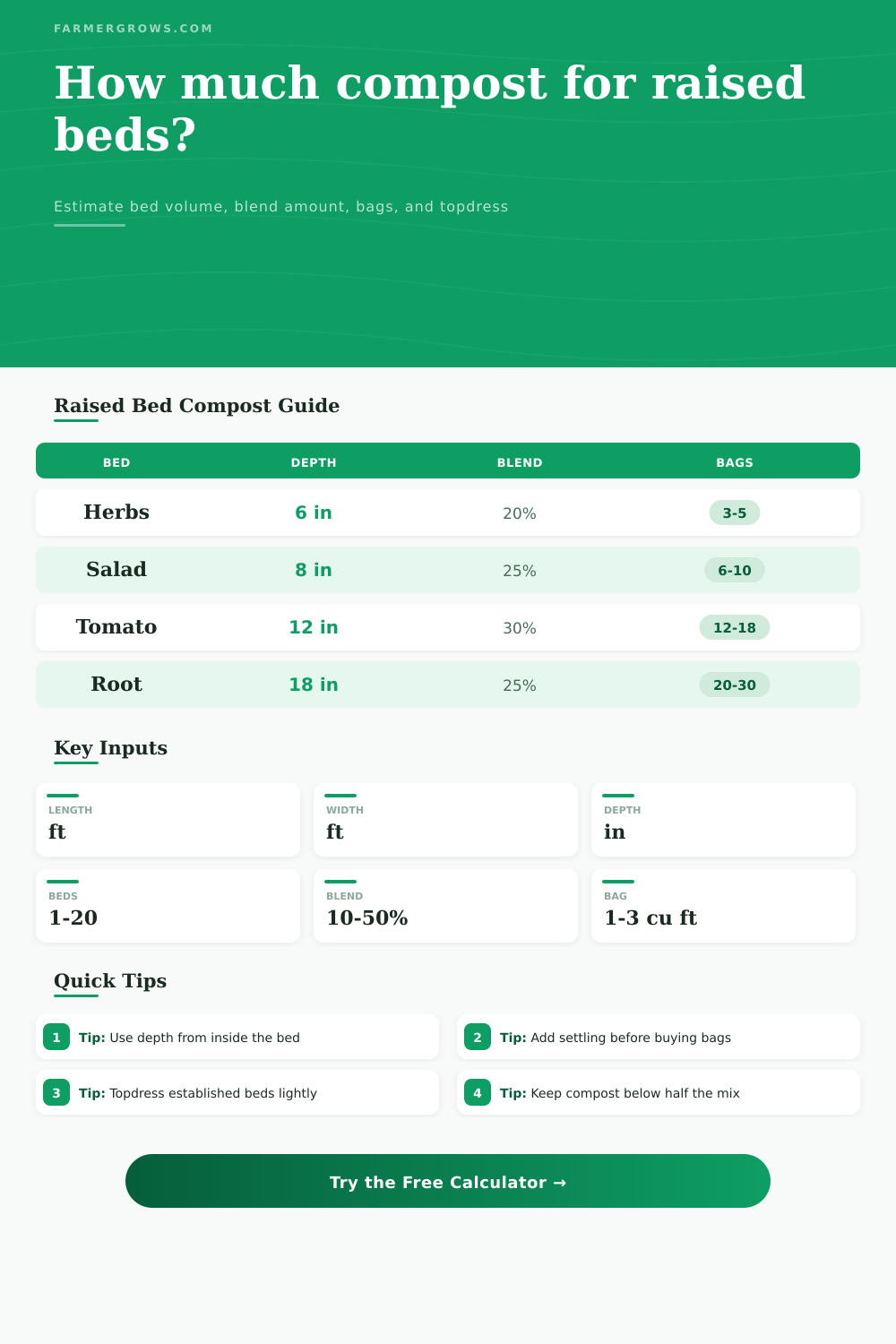
| 6 in | Leafy greens, herbs, shallow boxes | 16 cu ft / 0.59 cu yd | 4.8 cu ft |
| 8 in | Salad crops, beans, compact vegetables | 21.3 cu ft / 0.79 cu yd | 6.4 cu ft |
| 10 in | General mixed vegetable bed | 26.7 cu ft / 0.99 cu yd | 8.0 cu ft |
| 12 in | Tomatoes, peppers, most vegetables | 32.0 cu ft / 1.19 cu yd | 9.6 cu ft |
| 18 in | Deep roots, carrots, potatoes, dry climates | 48.0 cu ft / 1.78 cu yd | 14.4 cu ft |
| 24 in | Very deep beds or poor native soil sites | 64.0 cu ft / 2.37 cu yd | 19.2 cu ft |
| Compost blend | When it fits | For 20 cu ft new mix | Notes |
|---|---|---|---|
| 10% | Refreshing mineral soil or rich native soil | 2 cu ft compost | Gentle organic matter boost |
| 20% | Most established beds with good structure | 4 cu ft compost | Common maintenance blend |
| 25% | Balanced first-fill mix | 5 cu ft compost | Good starting point for vegetables |
| 30% | Heavy feeders and lean base soil | 6 cu ft compost | Often used for tomatoes and peppers |
| 40% | Short-season rich bed mixes | 8 cu ft compost | Use with drainage material |
| 50% | Very compost-rich blends | 10 cu ft compost | Avoid going higher for most crops |
| Compost packaging | Volume per unit | Units per cubic yard | Best for |
|---|---|---|---|
| Small bag | 1.0 cu ft | 27 bags | Small containers and topdress patches |
| Medium bag | 1.5 cu ft | 18 bags | Balcony beds and small garden beds |
| Common bag | 2.0 cu ft | 13.5 bags | Most home raised-bed compost purchases |
| Large bag | 3.0 cu ft | 9 bags | Several beds when bulk delivery is not practical |
| Bulk yard | 27 cu ft | 1 cubic yard | Multiple large beds or full garden builds |
| Crop group | Typical rooting depth | Helpful bed depth | Compost blend guide |
|---|---|---|---|
| Lettuce, spinach, basil | 6 to 10 in | 6 to 8 in minimum | 20% to 25% |
| Beans, peas, chard | 8 to 14 in | 8 to 12 in | 20% to 30% |
| Peppers, eggplant, tomatoes | 12 to 24 in | 12 to 18 in | 25% to 35% |
| Carrots, beets, parsnips | 12 to 24 in | 12 to 18 in with loose mix | 20% to 30% |
| Potatoes and sweet potatoes | 18 to 30 in | 18 to 24 in or mounded | 20% to 30% |
| Strawberries and perennial herbs | 8 to 18 in | 10 to 14 in | 15% to 25% |
6Practical compost notes
Measure inside the boards. Raised-bed lumber thickness can trim several cubic feet from larger layouts, so use the planting area inside the frame for length and width.
Keep topdress separate. A 1 inch topdress over an established bed is a maintenance layer, while a 30% blend is part of the total soil mix for filling depth.
The moment: You enter hardware store standing there trying to figure out how many bags of compost you will need for that perfect garden bed you envision. It’s a moment all raised bed gardeners experience, when good intentions meet not-so-good math.
It’s not even really a gardening issue. It’s an issue of density and shape. Buy too few bag, and you’ll be planting in a compacted mess of dirt. Buy too many, and you’ll end up with a load of rotting stuff based off your driveway.
How to Fill Your Raised Bed
The calculator above does the math on volume; now here’s what it all means, the real work. One common error is measuring the outside dimension of the lumber frame. Remember, lumber are thick. When you say “my bed’s eight feet long and four feet wide,” what you’re measuring is its outside size, the part where there isn’t any space at all for growing things! Get out the tape, get the interior measurements.
Because you enter the fill depth inside the boards, the tool accounts for wood thickness and subtracts the volume of the lumber from your growing space. That half-inch-thick layer of wood on all four sides can take up a cubic foot of space in a small bed. Space that no longer holds tomato but instead pine or cedar.
So now you’ve got your space. What do you put in there? Most of us don’t start out with pure compost, because it’s too wet and slow root growth and causes other drainage problems. You want some sort of combination. A blend with about 20-30 percent compost are usually best; the compost calculator lets you specify the exact amount needed for a well-balanced mix.
Beyond that, typically, it’s either a mineral soil such as peat moss or coconut coir, plus some perlite to aerate it all. How much? The balance is important. Most growers aim for a blend of twenty to thirty percent compost. That provides both structure and food. There’s a chart on the page showing how that mixture vary depending on crop thickness. That chart comes in handy if you’re planning what to grow.
And then there’s the settling factor. That’s the thing nobody sees that fouls up a lot of plans. Fluffy freshly mixed soil collapses when you water it, the surface subsides. If you fill that bed all the way up to the rim, it will be half an inch lower in a week. On the calculator: There’s always some settling factor, usually around ten percent. Why? You add extra volume to your estimate so you’re not stuck with no more mix just as you reach the final stretch. It is a little buffer, but it would of been better than that awkward moment where you have one bag’s worth of empty space you can’t do anything about.
Weight is another useful aspect. Compost is heavy. Wet compost weighs forty-five pounds per cubic foot, and a cubic yard weigh well over a thousand pounds. Know the limits of your deck or patio if you intend to fill a bed on one. How much can it support?
Choose your compost’s bulk density from the list of options (that’s its weight). You’ll get an estimate of how many pounds there is in each bag. This will help you decide if you should call for bulk delivery or haul them yourself. Cheaper with bulk, but that means a tarp and a truck. More expensive per cubic foot with bags… But convenient.
On the other hand: If you have an existing bed, the math are entirely different. Filling in the hole? No. Topdressing. You can use much less material then when building a new bed by adding back the nutrients lost during last year’s harvest, perhaps with a light layer of compost about an inch deep. The calculator distinguishes between the two uses, not inflating the estimate because you’re topdressing rather than creating a whole new bed. It keeps those two functions separate, the build aspect and the maintenance aspect.
The point, realy, is to get it right, which means getting the ratio correct: sufficient compost to nourish the microbes, but also enough of the inert material to aerate their root zones. The tool shows you the volume. You supply the strategy.
Measure the ingredients, account for settling, and mix them carefuly. Even though the soil may look identical with your naked eyes, your plants will reward you for the precision.