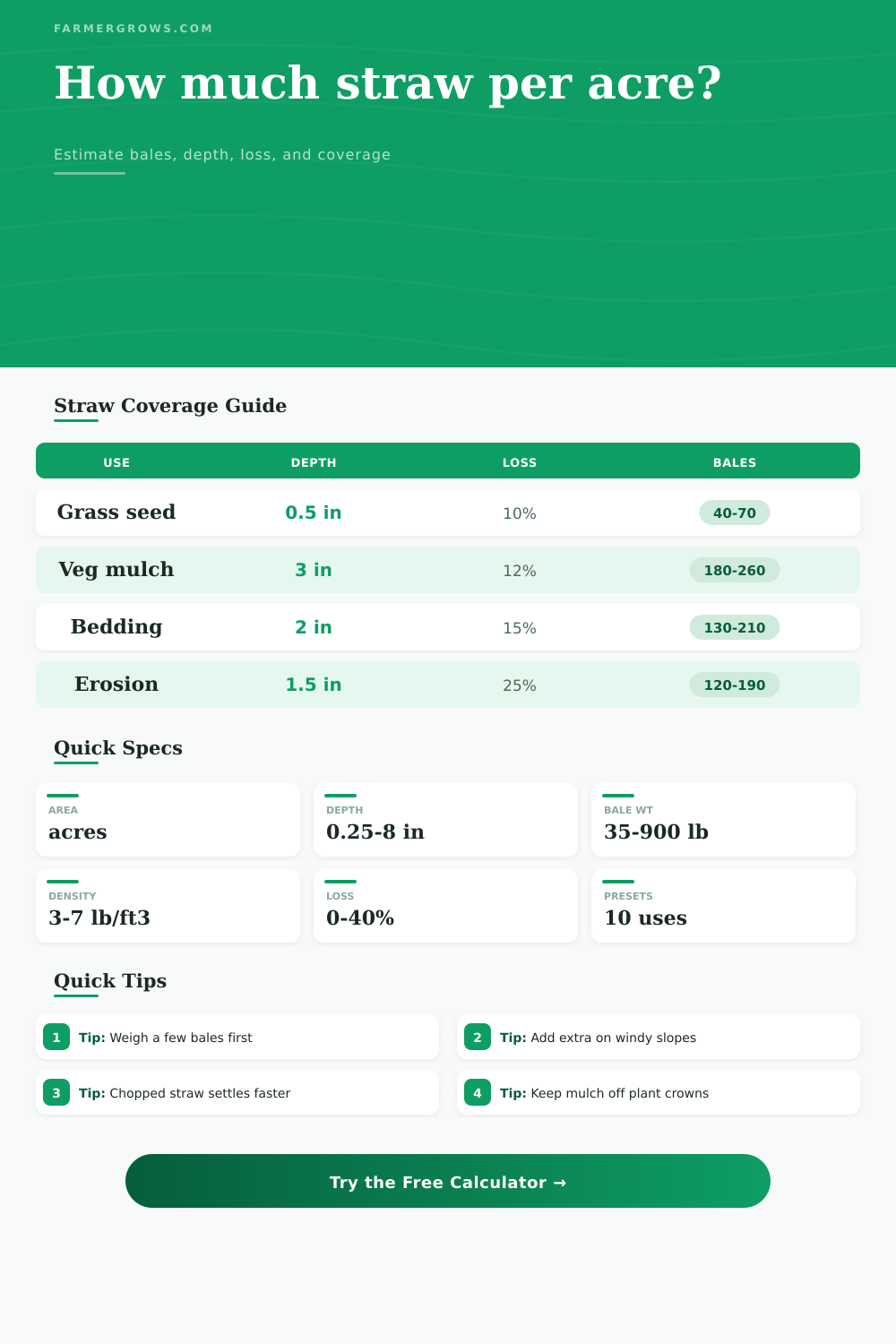
Straw per Acre Calculator
Estimate straw bales per acre from acreage, mulch depth, bale weight, straw density, coverage efficiency, slope or wind loss, overlap, use type, and bale shape.
Choose a common straw job, then tune the acreage, bale weight, density, losses, shape, and overlap to match your actual bales and field conditions.
Straw Coverage Estimate
Your straw bale count, coverage, volume, and loss-adjusted spread plan will appear here.
Common, stemmy, and dependable for seed cover, vegetable mulch, bedding, and general farm use when bales are dry and bright.
Often a little softer and lighter than wheat straw, with good bedding comfort and moderate mulch life in garden rows.
Loose oat straw can spread easily but may mat or break down faster, so coverage estimates benefit from a small reserve.
Longer stems can bridge soil and resist settling, useful for erosion cover and winter protection when anchored well.
Silica-rich stems can last well as mulch but may arrive in heavier bales, so use actual bale weight when possible.
Needles interlock differently from cereal straw and can be useful in orchards, paths, and acid-loving plantings.
Chopped material settles tighter, gives a cleaner bedding layer, and usually needs more pounds for the same loose depth.
Older or damp straw has uneven density and usable volume, so increase loss and reserve instead of relying on label weight.
| Straw type | Typical loose density | Best planning use | Coverage note |
|---|---|---|---|
| Wheat straw | 4.0 to 5.0 lb/cu ft | General mulch, seed cover, bedding | Good default when actual density is unknown. |
| Barley straw | 3.6 to 4.6 lb/cu ft | Bedding and light row mulch | Softer flakes may settle more in wet conditions. |
| Oat straw | 3.4 to 4.4 lb/cu ft | Garden mulch and bedding | Often loose and easy to spread, but breakdown can be quicker. |
| Rye straw | 4.2 to 5.2 lb/cu ft | Erosion cover and winter mulch | Long stems improve anchoring when crimped or watered in. |
| Rice straw | 5.0 to 6.3 lb/cu ft | Durable mulch and wet-region cover | Heavier stems reduce bale volume at the same bale weight. |
| Pine straw needles | 2.8 to 3.8 lb/cu ft | Orchard strips, berries, paths | Interlocking needles can cover more area but behave differently from cereal straw. |
| Chopped straw | 5.5 to 7.0 lb/cu ft | Bedding packs and controlled mulch | Denser material usually means more bales for a deep layer. |
| Weathered loose straw | 4.5 to 6.5 lb/cu ft | Low-value cover or bedding base | Variable moisture and clumping make a higher reserve sensible. |
| Settled depth | Volume per acre | Approx weight at 4.5 lb/cu ft | Common use |
|---|---|---|---|
| 0.25 in | 908 cu ft / 33.6 cu yd | 4,084 lb | Very light visual cover or tackified seed protection. |
| 0.5 in | 1,815 cu ft / 67.2 cu yd | 8,168 lb | Grass seed mulch where sunlight still reaches the seedlings. |
| 1 in | 3,630 cu ft / 134.4 cu yd | 16,335 lb | Light garden mulch, paths, or thin crop residue cover. |
| 1.5 in | 5,445 cu ft / 201.7 cu yd | 24,503 lb | Erosion cover or exposed slope protection with anchoring. |
| 2 in | 7,260 cu ft / 268.9 cu yd | 32,670 lb | Bedding layer, alleys, paths, or moderate mulch. |
| 3 in | 10,890 cu ft / 403.3 cu yd | 49,005 lb | Vegetable mulch, weed suppression, and moisture conservation. |
| 4 in | 14,520 cu ft / 537.8 cu yd | 65,340 lb | Winter protection for strawberries, garlic, and tender crowns. |
| 6 in | 21,780 cu ft / 806.7 cu yd | 98,010 lb | Deep bedding pack or heavy winter cover. |
| Bale shape | Typical weight range | Handling factor | Planning note |
|---|---|---|---|
| Small square bale | 35 to 60 lb | 1.00 | Easy to flake by hand; good for gardens, stalls, and small patches. |
| Three-string square | 80 to 120 lb | 0.97 | Heavier bale with slightly less perfect hand distribution. |
| Large square bale | 700 to 1,000 lb | 0.93 | Efficient for acreage but needs equipment and careful spreading. |
| Round bale 4 x 5 ft | 450 to 750 lb | 0.90 | Unrolling is fast; edges and core can spread unevenly. |
| Round bale 5 x 6 ft | 850 to 1,200 lb | 0.88 | Large fields only; check moisture, core waste, and transport access. |
| Custom bale | User entered | 0.95 | Use when local bale size, compression, or material differs from the list. |
| Situation | Typical adjustment | Why it matters | Calculator input to change |
|---|---|---|---|
| Calm flat seedbed | 5% to 10% loss | Light straw can be spread thinly without much drift. | Lower slope or wind loss. |
| Hand-flaked garden mulch | 8% to 18% overlap | Rows, corners, and plant gaps usually get double coverage. | Raise overlap allowance. |
| Open windy field | 15% to 30% loss | Loose straw moves before rain, crimping, or tackifier locks it down. | Raise slope or wind loss. |
| Steep erosion slope | 20% to 40% loss | Gravity, water flow, and anchoring quality all affect final cover. | Use erosion preset and reserve. |
| Livestock bedding | 10% to 20% reserve | Extra material handles wet packs, feeder zones, and daily refresh. | Raise final reserve buffer. |
| Crimped or tackified straw | Higher retention | Anchored straw can maintain coverage with less drift. | Use crimped field note and lower loss. |
| Project | Example area | Starting depth | Planning range |
|---|---|---|---|
| New lawn or grass seed | 1 acre | 0.25 to 0.5 in | Often 40 to 80 small square bales depending on bale weight and spread quality. |
| Vegetable row mulch | 0.25 acre | 2 to 4 in | Plan heavier where weed pressure, irrigation evaporation, or foot traffic is high. |
| Strawberry winter mulch | 0.5 acre | 3 to 4 in | Apply after hardening and pull back crowns when spring growth resumes. |
| Garlic or onion beds | 0.1 acre | 2 to 4 in | Use clean straw and account for wind movement across raised beds. |
| Poultry bedding | 5,000 sq ft equivalent | 2 to 6 in | Deep litter plans need more reserve than a one-time surface cover. |
| Erosion control | 1 acre slope | 1 to 2 in | Coverage depends on anchoring; increase loss when straw will not be crimped. |
Use real bale weight: Straw bales vary widely by crop, moisture, compression, and size. If the count matters, weigh several bales and enter the average instead of relying on a generic small-bale label.
Match depth to the job: Grass seed needs light cover that still lets seedlings breathe. Vegetable mulch, winter protection, bedding, and erosion work need deeper cover plus extra for overlap and movement.
The straw dilemma: There’s a truckload of doubt. A stack of bales. A field where you want to plant something. Now how much do you need? Forty bales might feel like a lot, but they’ll sit there like a golden mountain. Twenty might dissapears into the wind before your eyes. Volume can be as important than numbers.
How many bale does it take to make a good-looking seedbed? Too few, and you’ll end up with bare patches and weeds. Too many and you’re still out there mowing weeds, with bare spots all over. Most folks just guess. It looks like enough for the job, right? Then go home with a patch of weed.
How to Measure Straw Correctly
Use the calculator above, which takes the guesswork off conversions and coefficients when you plug in your desired depth and area. It turns vague “I’m gonna put some stuff down” plans into concrete volume/weight targets.
What’s key here: Straw isn’t all straw. It’s straw in total, a lot of air and lots of empty tubes called stems. What that means: Density make a difference. Chopped oat straw for bedding is different than the loose-and-fluffy variety (like wheat) spread on top of lawn seed as a cover. To account for that, the tool wants to know about bulk density.
And there lies the main plan-killer: How do you input bulk density? Simple: Weigh a couple of bale from what you’re planning to use. For instance, dry, fluffy wheat-straw bales may be forty pounds per little square bale and seem gigantic. Rye-straw bales may be weathered and dense at sixty pounds apiece; and appear quite modest. If your plan assume that each bale covers the same amount of area, you’ll come up short. Drive back to the barn? No thanks. Spend an extra minute weighing a couple of bales from your real-life haul. That saves hours of driving time. It is a little detail, but it is important.
And then there’s the matter of depth: “Choose your desired depth here (from a quarter inch or so for tackifying seed to six inches for deep bedding).” A quarter inch mostly keeps soil in place until things start growing. About providing visual coverage. Six inches provides physical cushion and thermal insulation. And amount of volume needed skyrockets with each inch of added depth. This isn’t about putting down something to cover the ground; it’s about building up. That means it requires a serious material commitment, which is what the page’s reference table shows, how cubic yards of anything increases rapidly.
A three-inch mulch for veggies is a serious material commitment. That’s a lot. Is it three inches? It is even more. It is not a sprinkle. It is a construction project.
There’s no such thing as perfect spreading; there’s also no such thing as making your tractor go backward in time (or forward). Wind steals light flakes and gravity pulls straw down steep hillsides. Overlap happens from walking the row or turning the truck. The list goes on. Inefficiency and loss are the invisible taxes of field work: wind steals flakes, gravity pulls straw down slopes, and overlap happens when you turn the truck or walk the row. On a windy hillside, you can’t ignore the fact that 20 percent may be lost. That’s not pessimism. That’s physics. A reserve buffer for overlap will make sure you don’t get any half-bare corners. And most folks seriously underestimate how much material gets lost just from handling. Buy the insurance of extra bales before you need them.
The nature of the task varies with the kind of straw selected. Pine straw needles interlock, cereal straw mats down, and chopped straw settles in tight. Under traffic, under rain, each does something different. That’s where the comparison grid comes in: Match your material to your purpose. Don’t expect airy oat straw to work on a heavily trafficked path. It’ll turn to mud. And don’t count on dense rice straw to provide much airflow if you want light seed cover. Fit. You want material that serves its purpose without suffocating the crop or washing away.
The weight estimate lets you load up the truck just right. The bale count helps you budget out your job. You won’t buy too much. It also prevents you from wasting money on things you don’t need and end up storing until they rot. It’s not just a number, it’s a plan. It is a plan that takes away the doubt. Doubt that you bought enough. Doubt that you wasted money on something you won’t use till it rots.
The trick is in knowing what exactly you’re counting or weighing. You’re counting coverage. You are buying security. When you’ve got just enough you can see how the field looks good all bundled up. The crops will sleep warm. Weeds will stay buried. You no longer stand in doubt. You stand with a clear plan and a full truck. That golden mountain is the perfect size for the job.