Turkey Manure Per Acre Calculator
Estimate turkey litter rates from acres, tom or hen litter type, lab analysis, bedding, moisture, N and P2O5 targets, first-year availability, salt or burn risk, setbacks, and incorporation timing.
Start from a turkey-specific litter situation, then adjust the lab analysis and field restrictions to match your flock, bedding pack, and nutrient management plan.
Turkey Litter Application Plan
Recommended rate and nutrient delivery will appear here.
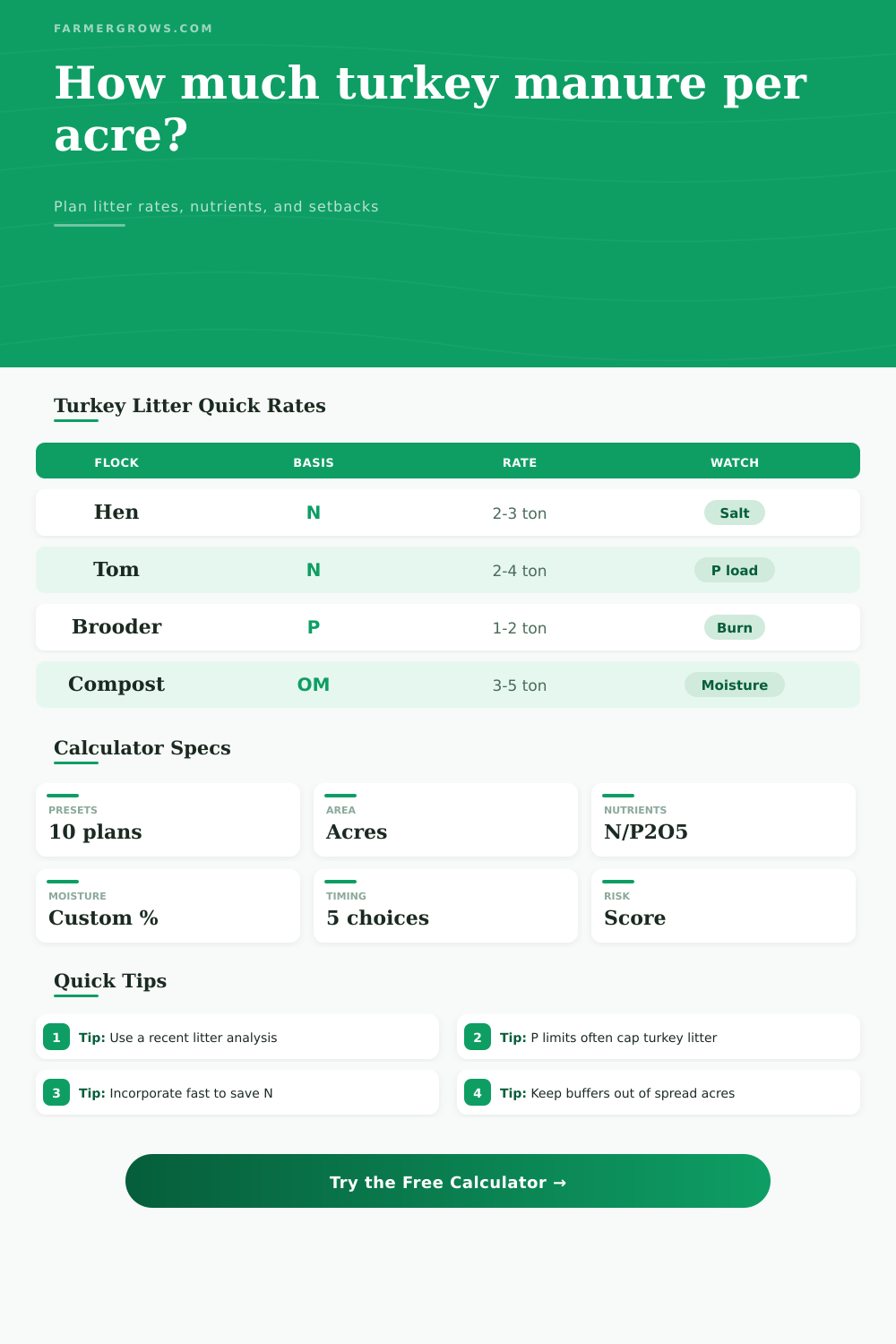
Often has more cake, higher bulk density, and strong N and P2O5 values. Watch P buildup when rates exceed crop removal.
Usually a balanced field litter for small grain, corn, and hay when spread by N with a soil-test P check.
Fine, dry material may have higher salt concentration near seedlings. Keep rates low for vegetables or direct-seeded crops.
More stable organic N and lower ammonia loss, but more tons may be needed to meet the same first-year N goal.
| Turkey litter source | Total N lb/ton | P2O5 lb/ton | K2O lb/ton | Moisture note |
|---|---|---|---|---|
| Tom growout litter | 55 to 70 | 50 to 65 | 35 to 50 | Often 22% to 32% moisture |
| Hen growout litter | 45 to 60 | 42 to 58 | 30 to 45 | Often 25% to 35% moisture |
| Brooder house litter | 50 to 75 | 45 to 65 | 35 to 55 | May be dry and salty |
| Built-up cleanout with cake | 60 to 80 | 55 to 75 | 40 to 60 | Dense material, test each cleanout |
| Composted turkey litter | 35 to 55 | 40 to 60 | 30 to 45 | More stable, slower N release |
| Incorporation timing | N retention factor | Best fit | Management note |
|---|---|---|---|
| Same day incorporated | 1.00 | Corn, sorghum, tilled ground | Best ammonia-N conservation for fresh litter |
| Within 1 day | 0.90 | Most preplant spreading | Good if weather and equipment cooperate |
| 2 to 3 days | 0.78 | Large acreage window | Expect extra N loss from surface exposure |
| Surface applied | 0.65 | Hay, pasture, no-till | Use setbacks and avoid runoff forecast |
| Dormant or winter surface | 0.55 | Cover crop or storage pressure | Higher runoff and N loss risk |
| Setback situation | Common buffer | Calculator entry | Why it matters |
|---|---|---|---|
| Grass waterway through field | 25 to 50 ft | 3% to 8% | Removes narrow no-spread strips from acres |
| Stream, ditch, pond, or wetland edge | 50 to 100 ft | 5% to 15% | Helps control P and sediment movement |
| Well, sinkhole, or intake | 100 ft or more | 2% to 10% | Protects water sources and sensitive points |
| Vegetable or seedling strip | Project-specific | 10% to 25% | Reduces salt and burn exposure near young crops |
| Planning rate | Good use case | N delivered if 60 lb N and 55% available | P2O5 applied if 55 lb/ton |
|---|---|---|---|
| 1.0 ton/ac | Starter or P-limited field | 33 lb available N/ac | 55 lb P2O5/ac total |
| 2.0 tons/ac | Moderate small grain or hay | 66 lb available N/ac | 110 lb P2O5/ac total |
| 3.0 tons/ac | Corn with quick incorporation | 99 lb available N/ac | 165 lb P2O5/ac total |
| 4.0 tons/ac | High N demand, low soil P only | 132 lb available N/ac | 220 lb P2O5/ac total |
Use lab numbers first. Turkey litter changes with flock age, cake removal, bedding depth, drinker management, and storage. Replace book values with a current as-is manure test before final spreading.
Phosphorus can slow the rate. Turkey litter can meet N needs while over-applying P2O5. If soil-test phosphorus is high, choose the P2O5 cap or strict basis and supplement N separately.
So, post-turkey-flock, what’s your logistics problem? You have a whole lot of spent litter in one place and a hungry field lacking nutrients. But you don’t want to apply too much of anything. Too much salt can burns tender plants, too little nitrogen won’t help anybody, and there is also limit on how much phosphorus you can legally apply. Applying the incorrect rate wastes money and deprives the crop of required nutrients.
That’s where the calculator (above) comes into play, it do the complicated math when you input your lab results along with your field limitations. You will no longer have to deal with tedious work of converting nutrients.
How to Use the Turkey Litter Calculator
The first step is a lab test. In theory, book values work fine. But they don’t always in practice. Your litter will not be like anyone else’s because of how you house your birds, the bedding you use, and how many bird you keep in each space. A brooder house litter may be salty and dry. Tom pack litter may be realy high in nitrogen and heavy. Make a good game plan by knowing the real numbers, total nitrogen, phosphorus pentoxide, and potash. Guessing wouldn’t of do you or your soil any good.
Typically your application is limited by phosphorus. One season of a wheat or corn crop removes less phosphate from the soil then is present in turkey litter. Applying enough litter to supply the needed N could lead to an overapplication of P. That excess does not benefit the crop. Instead it stays in the soil where it could wash away into surrounding waterways under high rainfall events, and with this option, you can select a conservative approach that will keep you on the safe side of both farming and legal considerations.
The second point is that there’s a time limit. Ammonia gas also escapes rapid from fresh litter. To avoid losing some of the nitrogen, don’t apply it to the surface and forget about it for three days. Work it into the soil (within 24 hours) and save those nutrients. Avoid waiting until next winter to spread it on the surface because less nitrogen will be available to you the following year. The calculator factors in that timing difference; if you work the manure into the ground soon, it account for more useful nitrogen yield. Why? That makes all the difference when you’re calculating for extra fertilizer.
In addition, consider the physical boundaries of your field. Property lines, streams, wells all create setbacks that limit amount of land on which to make application. For example, if you have a 40 acre field with a 50 foot setback from property lines on three sides, then you’re not applying on 40 acres. It could be as few as 35 acre that you can apply to. If you don’t take this into account, you will either under-apply in the areas you can use or accidental over-apply where you don’t want it (like around those sensitive areas). By taking away those setback percentages, the calculator provide an accurate rate per usable acre. This helps you avoid common error of being too conservative and spreading the application too thin across the entire field.
Another hazard is that salt injury is possible, especially if you use dry, concentrated packs or brooder litter. Direct-seeded grains and young vegetable crops is very sensitive to salt; sod and established hay will be a bit more forgiving. Before firing up the spreader, set your preferred risk tolerance level, which will alert you to any spots that may be at high risk for burn. That comes into play when you find yourself standing out in the field next spring asking “Why didn’t those seedlings come up?”
Fresh pack vs. Composted: Fresh pack is higher in total N. But most of its N are unstable and will be quickly released, while the stable part of a composted pack will release over time as organic matter decomposes. So what you can apply with an equivalent amount of compost may have less N right now, but other factors comes into play too: Your compost will improve your soil structure (which fresh manure lacks). The calculator takes those availability changes into account. That way, you can see how applying a certain amount of compost compare to using just as much fresh stuff.
Careful management of turkey litter can make this resource valuable. Litter is not waste. Litter is a package of multiple fertilizers with a complex chemical profile to be respected. Current information replaces old rules of thumb when applied. Doing so means protecting both the bottom line and the soil.
The objective is clear. Feed the crop, not the runoff. Get the balance correct, and the field repays you in cleaner water and healthier plants. A simple test begins the win; a well-planned spread ends it.