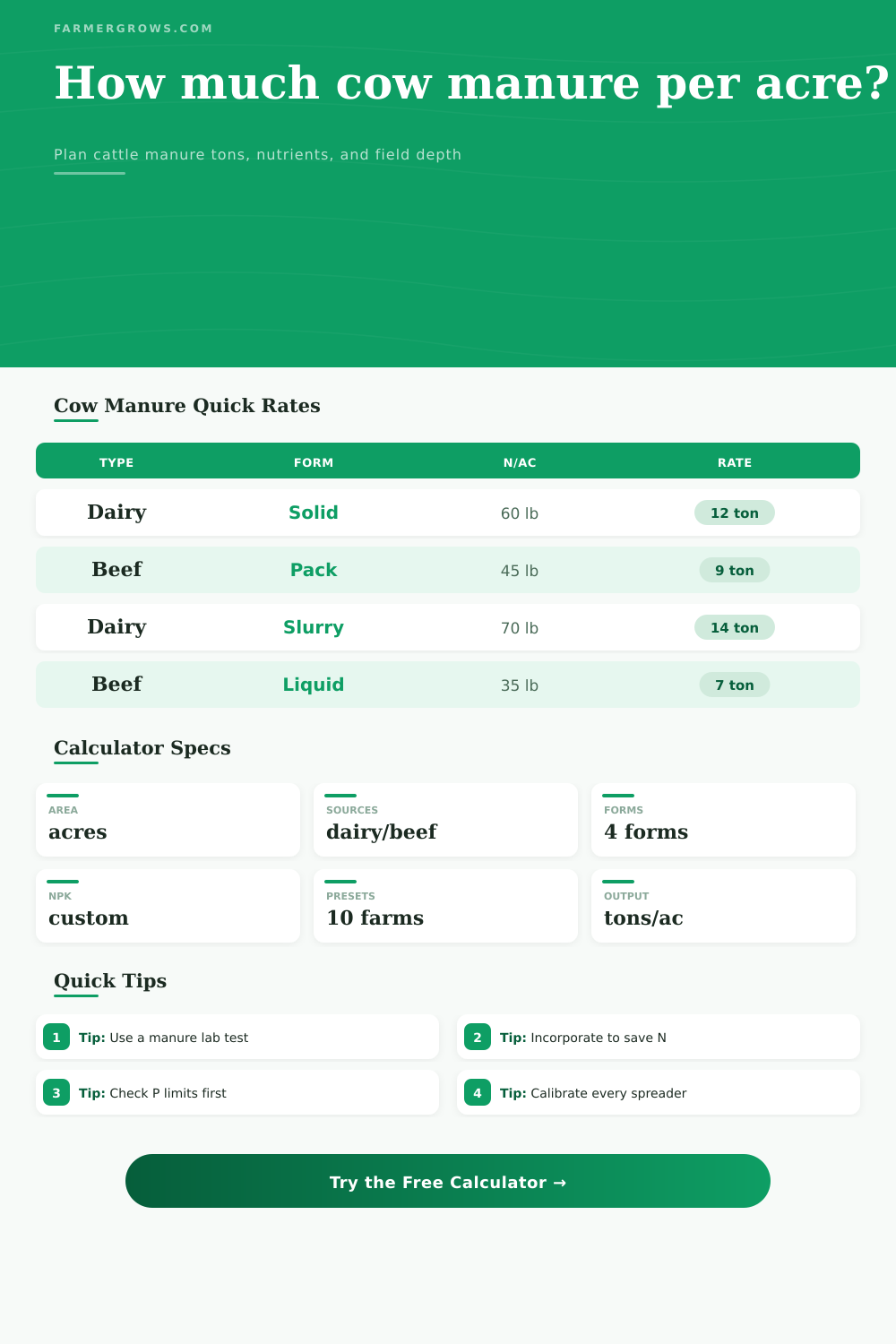
Cow Manure Per Acre Calculator
Plan dairy or beef cow manure applications from acres, solid or liquid form, moisture, N-P-K analysis, bedding dilution, nutrient availability, crop limits, timing, and spreader calibration.
Choose a named cattle-manure scenario, then replace the analysis with your manure test whenever you have one. Presets are starting points for planning, not local nutrient recommendations.
Cow Manure Application Plan
Results are based on as-spread manure analysis, dilution, first-year availability, incorporation timing, crop limits, and the selected spreader calibration.
Common freestall or barnyard manure. Moderate nutrient density, high moisture, and useful organic matter for corn, silage, hay, and cover crops.
Bulky manure with more bedding dilution. Often lower immediately available N, but helpful for soil structure and surface residue.
More uniform than stacked solids. Fast incorporation or injection can preserve ammonium N and improve crop credit accuracy.
Lower nutrient concentration per ton, higher gallon volume, and stronger need for calibrated flow rate and field setback planning.
| Manure source | Usual form | Total N as-spread | P2O5 as-spread | K2O as-spread |
|---|---|---|---|---|
| Dairy cow solid | Scraped or stacked | 0.45% to 0.70% | 0.20% to 0.40% | 0.35% to 0.65% |
| Dairy slurry | Pumpable pit manure | 0.35% to 0.60% | 0.15% to 0.30% | 0.30% to 0.55% |
| Beef cattle lot | Scraped pen manure | 0.45% to 0.75% | 0.25% to 0.50% | 0.45% to 0.80% |
| Bedded pack | Straw, stalks, sawdust | 0.25% to 0.55% | 0.15% to 0.35% | 0.25% to 0.55% |
| Lagoon liquid | Low-solids liquid | 0.05% to 0.20% | 0.02% to 0.10% | 0.05% to 0.20% |
| Timing method | N availability multiplier | Best use | Main planning note |
|---|---|---|---|
| Incorporate within 24 hours | 1.00 | Spring row crops | Highest practical first-year N credit for solid manure. |
| Incorporate within 3 days | 0.88 | Disked or chiseled fields | Some ammonium N may be lost before incorporation. |
| Incorporate within 1 week | 0.75 | Weather-delayed spreading | Use a conservative N credit when manure sits on the surface. |
| Surface applied | 0.62 | Hay or no-till fields | P and K remain valuable, but N credit is reduced. |
| Fall application | 0.68 | Pre-plant nutrient storage | Leaching and denitrification risk depend on climate and soil. |
| Bulk density | 5 tons/ac | 10 tons/ac | 20 tons/ac | Depth note |
|---|---|---|---|---|
| 900 lb/cu yd, loose bedded pack | 0.041 in | 0.083 in | 0.165 in | Bulky material covers more depth per ton. |
| 1200 lb/cu yd, composted pack | 0.031 in | 0.062 in | 0.124 in | Useful for composted beef or calf-pack manure. |
| 1450 lb/cu yd, dairy solid | 0.026 in | 0.051 in | 0.102 in | Good default for scraped dairy solids. |
| 1700 lb/cu yd, wet solid | 0.022 in | 0.044 in | 0.087 in | Wet, dense material adds less visible layer depth. |
| Field rate | 18-ton loads/ac | 100-acre total | Common fit | Check before spreading |
|---|---|---|---|---|
| 5 tons/ac | 0.28 load/ac | 500 tons | P-limited fields or light topdress | Uniformity at low gate settings. |
| 10 tons/ac | 0.56 load/ac | 1000 tons | Moderate N or organic matter plan | Actual swath width and overlap. |
| 15 tons/ac | 0.83 load/ac | 1500 tons | Corn silage or high-removal fields | Soil trafficability and compaction. |
| 20 tons/ac | 1.11 load/ac | 2000 tons | High demand with good soil-test fit | Nitrate, runoff, and P-index limits. |
Test first: Cow manure analysis varies widely with ration, bedding, storage, rainfall, and water dilution. Replace every preset value with a current manure sample before writing a nutrient-management record.
Match the limiting nutrient: A nitrogen-based manure rate can overapply phosphorus on fields with high soil-test P. Use the stricter P2O5 limit when your plan, watershed rule, or soil test calls for it.
That’s the stink of money, and of trouble. Because applying animal waste to crops can be as much an art than science, the margin between success and failure come down to a few numbers. Cattle manure isn’t like ordinary fertilizer. It’s an inconsistent organic substance whose makeup shifts according to rain storms, new bedding and changing rations. When spreading this valuable manure onto cropland, you’re looking for just enough to nourish land without overloading your fields and violating the nutrient limits.
Many growers start with an old extension bulletin or a neighbor’s rule of thumb, such as, “I applied this many tons per acre last year.” However, that do not account for the fact that nutrients vary in their density. Beef manure plus straw bedding isn’t the same as dairy manure from a high-producing herd. One has mostly bulk and carbon; the other’s packed with phosphorus and nitrogen. Either you’ll guess wrong about amount to feed the crop, or you’ll apply too much phosphorus (risking the environment).
How to Use Manure Correctly
Once you plug in your own analysis, the calculator does all the math. No more guessing what coefficient fit your case. Available credit isn’t the same thing as as-spread analysis. Total nitrogen exist in manure, but plants cannot access organic fraction immediately. Adjusting for first year availability (often about forty to fifty percent of solids) is an option with this tool.
Timing also matters. The more quickly you can turn under the manure, the more ammonium you’ll save. Volatilization losses will cut down on that considerably if manure has been sitting on the soil’s surface for a week prior to disking. That’s important if you’re trying to achieve an exact amount of N delivery to your corn, say. Typically, it’s phosphorus. You may need to spread twelve tons/acre of nitrogen, but your phosphorus limits may be capped at six.
The calculator checks both constraints, so you can see which one limit your applied nutrients. That’s important because many soils in the Northeast and Midwest already have higher-than-optimal levels of phosphorus in the soil. Applying additional P doesn’t boost yields; it simply results in a problem, and one that can wash into nearby waterways during heavy spring rains. Best to know the limit first, before firing up the tractor.
Moisture and bulk density are the mechanical details that leads to mistakes. More water = higher weight but lower nutrient contribution because water make up the difference in weight. Lower bulk density = greater volume required to achieve same coverage. The reference table converts tons per acre into inches of spread depth. A thick layer look like five tons of loose bedded pack. A puddle looks like five tons of dense, wet slurry. Know this so you can plan your passes to overlap which prevents streaks and bare spots.
Reality sets in with calibration. On paper you might figure out the exact correct rate. But the reality is, what is your spreader gate set to? If it’s incorrect then it’ll be seen out there in the field. Estimating the total amount your truck will haul lets you use the tool to set up your hauling equipment propery. You will no longer feel frustrated by running out of manure halfway across the field, and you also won’t have leftover tons that you are not allowed to spread anywhere else.
For now: Test before the season begins; presets will never replace a lab report, but they help plan. Then do the math. Knowing what’s in there makes it easy. No more guessing. Just making sure you’re managing.
A waste product becomes an accurate piece of agricultural input. If you get the balance correct, then field rewards you with improved yield, while the bottom line reflects reduced input costs. That’s how it begins: Knowing exactly what’s in that pile before it gets on the ground.