Epsom Salt for Cucumber Plants Calculator
Estimate a cucumber-safe magnesium sulfate dose by plant count, trellis length, stage, deficiency pressure, soil magnesium, pH, water volume, method, fruit load, and salt sensitivity.
🥒 Cucumber Presets
Choose a starting point, then adjust the row and soil details to match your cucumber patch.
⚖ Vine and Mix Inputs
Cucumber Epsom Salt Plan
Use this as a conservative planning rate. If soil magnesium is adequate or high, treat Epsom salt as optional and confirm with a soil or tissue test before repeating.
🧪 Mineral and Mix Reference
🌱 Cucumber Stage Rates
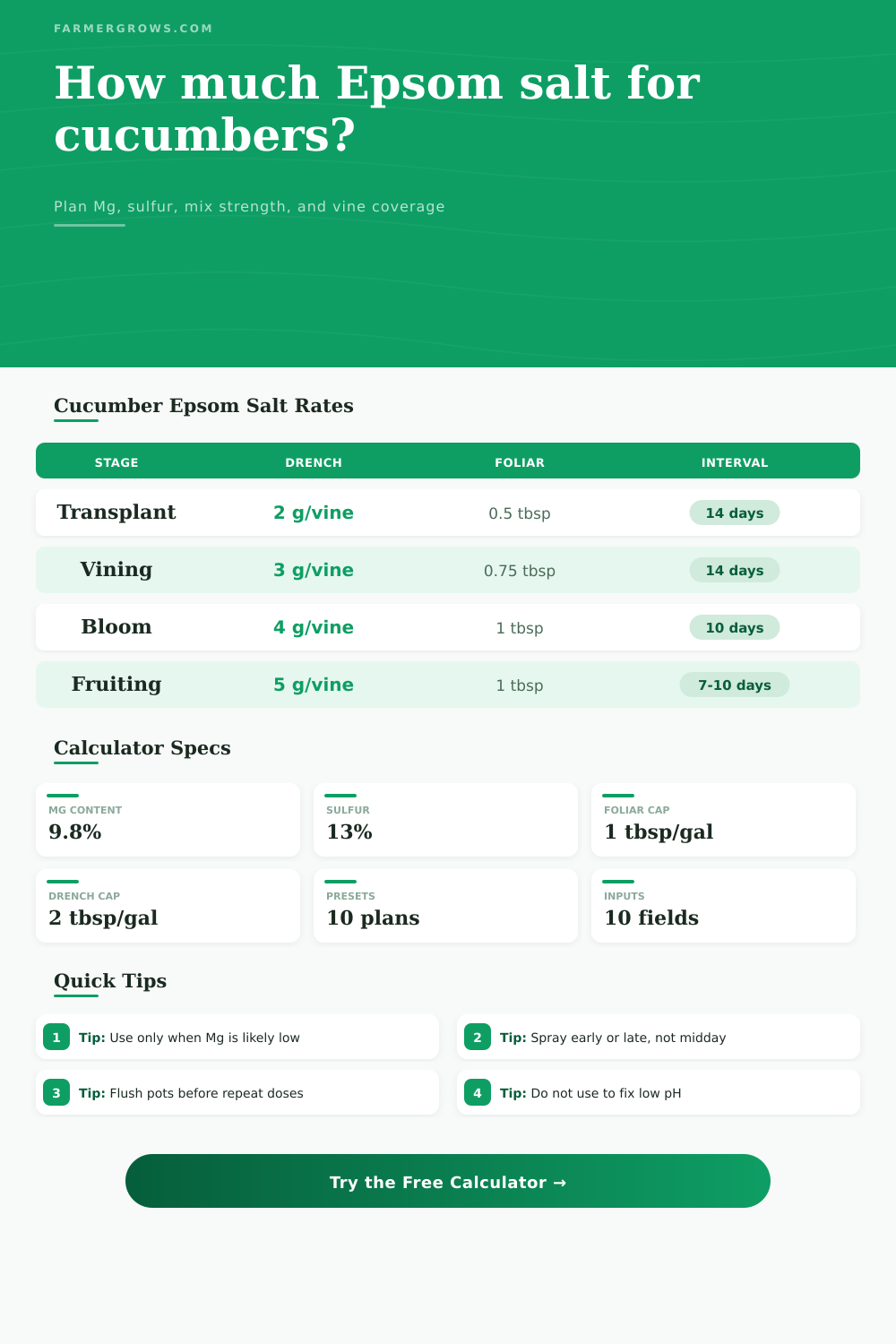
| Growth stage | Base drench rate | Foliar mix guide | Best use |
|---|---|---|---|
| Transplant / 2-3 true leaves | 2 g per plant | 0.5 tbsp per gal | Light support only; young roots are easy to over-salt. |
| Active vining | 3 g per plant | 0.75 tbsp per gal | Use when older leaves show faint interveinal yellowing. |
| Pre-bloom | 4 g per plant | 1 tbsp per gal | Supports Mg demand before flowering and first fruit set. |
| Fruiting | 5 g per plant | 1 tbsp per gal | Useful for confirmed low Mg during steady cucumber picking. |
| Peak harvest | 6 g per plant | 1 tbsp per gal | Reserve for vigorous, well-watered vines with real deficiency pressure. |
📊 Soil Magnesium and pH Table
| Soil clue | Calculator effect | Cucumber concern | Action before repeat |
|---|---|---|---|
| Very low Mg test | Raises dose | Fast-growing vines may yellow between veins. | Retest or tissue test after correction. |
| Adequate Mg | Strongly lowers dose | Extra Epsom salt may unbalance Ca and K uptake. | Use only if symptoms and test agree. |
| High Mg | Maintenance skipped | More Mg can tighten soil and antagonize other nutrients. | Do not repeat without lab guidance. |
| pH below 5.8 | Adds caution | Low pH may stress roots and reduce nutrient balance. | Fix pH and root health first. |
| pH above 7.3 | Adds caution | Yellowing may be lockout, not missing Epsom salt. | Improve pH and water quality. |
💧 Foliar and Drench Mixing Guide
| Method | Conservative strength | Upper planning cap | Application note |
|---|---|---|---|
| Foliar spray | 0.5 to 1 tbsp per gal | 1 tbsp per gal | Spray leaf surfaces in cool morning or evening. |
| Soil drench | 0.75 to 1.5 tbsp per gal | 2 tbsp per gal | Apply to moist soil around the root zone, then water normally. |
| Split method | Half through leaves, half through soil | Foliar cap still applies | Useful when symptoms are visible but roots are also active. |
| Containers | Use 50 to 75 percent of garden dose | Flush between repeats | Salt buildup arrives faster in pots and grow bags. |
🔍 Deficiency Severity Reference
| Severity | Common cucumber signs | Calculator response | Repeat interval |
|---|---|---|---|
| Maintenance | No symptom; soil test uncertain | Half-rate or skip if Mg is adequate | Do not repeat routinely |
| Mild | Older leaves pale between green veins | Standard cucumber-safe correction | 10 to 14 days |
| Moderate | Several lower leaves yellowing during fruit fill | Raised rate with concentration warning | 7 to 10 days if confirmed |
| Severe | Broad chlorosis, weak vines, poor fruit fill | Higher estimate but flags diagnosis risk | Get soil or tissue test first |
🌿 Cucumber and Vine Crop Comparison
Fast vines and steady picking can expose low Mg, but roots dislike salty media. Use small, well-watered corrections.
Melons often need balanced fertility more than quick sprays. Avoid pushing salts during dry spells or fruit sizing stress.
Large leaves can show Mg shortage, but heavy nitrogen or root disease can look similar. Confirm before repeating.
Long vines spread demand across more soil. Per-plant spoon rates are less useful than soil-test-based fertility.
💡 Cucumber Use Tips
Check the pattern: Magnesium shortage usually starts on older cucumber leaves with green veins and yellow tissue between them. New-leaf yellowing often points somewhere else.
Keep salts moving: Apply drenches to already moist soil and use enough plain water afterward so Epsom salt does not sit concentrated near cucumber roots.
A telltale pale yellow spot is forming in the middle of one of your leaves, the one with green veins. You notice it between the others on a tired-looking cucumber vine that ought to be dark and full, but isn’t.
Thinking about grabbing the box of Epsom salt out of shed? Stop right there: That’s when real gardening starts. That kind of spotting can be a sign of magnesium deficiency, and easily confused with other symptoms of general nutrient tiredness, or even a matter of pH lockout.
How to Fix Yellow Cucumber Leaves
Enter the calculator, which will do the math if you’ll just type in your soil conditions and number of vines. You won’t have to guess at concentrations, and neither will you turn your soil into salty soup.
Magnesium is the trouble mineral: Why? It is mobile in plants. When you see symptoms start at the bottom of the vine, what’s happening is that the vine is moving it around, hauling it up from older leaves to feed newer ones. That’s what people don’t get. They’re seeing yellow leaves and thinking the rest of the plant must be starved, but no. The roots is withholding nutrients for later growth (fruit).
You tell the tool which growth stage you’re on (young plant, fruiting vine) because what a seedling needs is different than a super-producing heavy bearer at harvest time. Too little dose to the fruiting vine makes its harvest look bitter and dull; too much to the delicate seedling roots burn them. The calculator will adjust basic rate accordingly, not treating a sprout as if it were a super-producer.
Salt isn’t the only consideration; water quality and even soil pH are involved. “Magnesium can gets chemically locked out from soils with a pH greater than 7.3,” which is alkaline. No amount of extra Epsom salt will help with that, because magnesium is present but not in a form that plant roots can access. A small detail makes a big difference: You would of wasted money if you think adding more magnesium can fix such a pH problem. (And some of the other inputs related to pH help guide whether you should amend the soil structure first, or add salt.)
The actual status of soil magnesium is also key. Adding more when the soil test indicate high magnesium can antagonize uptake of potassium and calcium. The tool flags this, and suggests skipping the dose if the soil are already rich in that element.
The difference comes in how you apply: Foliar sprays hit the leaves fast and address immediate needs like yellowing. That’s great for quick responses where you can see color changing. Soil drenches is applied straight to the roots and correct slowly over time (perfect for a gradual fix). The calculator gives you the strength of both options separately and limits the amount that can be sprayed on the leaves to avoid burning them. The way you apply it makes all the difference.
For moderately stressed vines, it even suggests splitting the dose between leaves and soil. This provides an instant solution to the symptoms while also improving long-term soil health.
And then there’s the matter of salts. Too much salt in the soil solution is something cucumbers don’t like. Because they’re growing in containers (or raised beds), which drain fast, there’s a possibility that salts can build up; and the margin for error are slim. To compensate for this potential buildup, the calculator decreases the suggested dose for container garden. You don’t want to fertilize the plant only to make its work harder by putting its roots under osmotic stress and making it less able to drink.
It’s a balancing act: Feed the plant enough to help it make chlorophyll, but don’t overdo it and create a toxicity situation. It’s all about precision… Not amount. With Epsom salt.
It’s intended as a remedy to address a particular deficit, not simply dumping a blanket of minerals on everything. Knowing the number of plants you’re growing, their fruit set and expected trellis length help turn guesswork into calculation. From there, the tables on the page shows how severity and stage work together to change the dosage. What results: an approach to support your cucumbers but never overwhelm them.
And back to that yellow leaf above, now you know why it happened, and how (in a measured manner) to make it better. Not just another bag of salt to hurl at the issue… You should of seen the moddern way to do it!