Epsom Salt Per Gallon For Plants Calculator
Calculate a plant-safe epsom salt solution from target tablespoons per gallon, water volume, application type, crop sensitivity, deficiency severity, foliar dilution, sprayer coverage, repeat timing, and reservoir loss.
Choose a realistic starting mix, then adjust the exact concentration and water volume. Presets are concentration guides, not a substitute for soil, tissue, or irrigation-water testing.
Uses more water at a moderate strength so magnesium sulfate moves into the active root area.
Best kept lighter. Dilution and sensitivity settings lower the final tablespoons per gallon.
Salt can build faster in pots, so the calculator applies tighter caps for container applications.
Uses the gentlest cap and adds optional loss volume for refill, line hold-up, or discarded mix.
Epsom Salt Solution Result
Enter your water volume and target strength, then calculate the working solution.
| Application type | Gentle range | Normal range | High caution range | Best use |
|---|---|---|---|---|
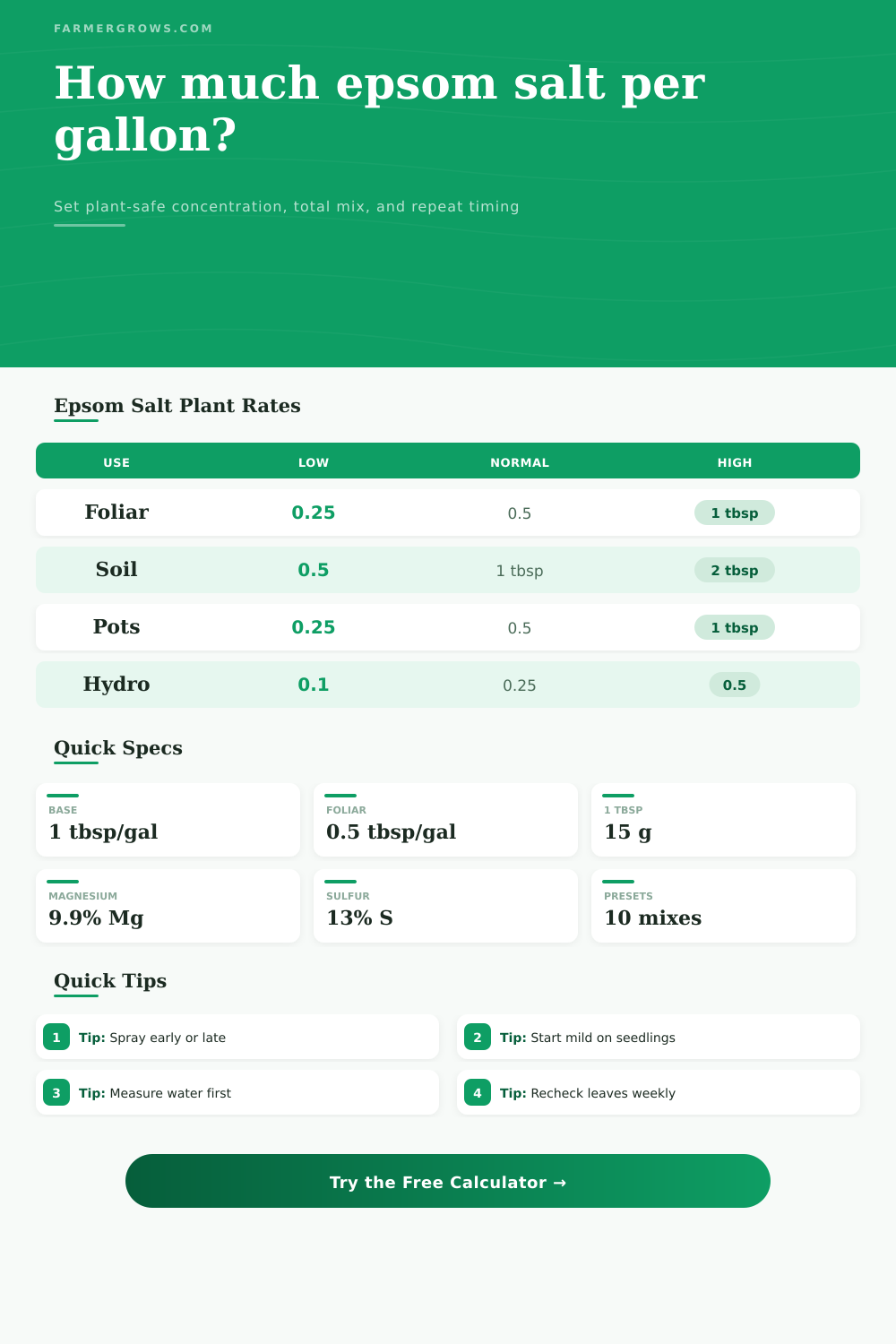
| Foliar spray | 0.25 to 0.5 tbsp/gal | 0.5 to 1 tbsp/gal | over 1 tbsp/gal | Fast leaf correction when heat and sun are low. |
| Soil drench | 0.5 tbsp/gal | 1 to 2 tbsp/gal | over 2 tbsp/gal | Root-zone watering for confirmed magnesium need. |
| Container drench | 0.25 to 0.5 tbsp/gal | 0.5 to 1 tbsp/gal | over 1 tbsp/gal | Pots where salt accumulation must be watched. |
| Hydro reservoir | 0.1 to 0.25 tbsp/gal | 0.25 to 0.5 tbsp/gal | over 0.5 tbsp/gal | Small top-ups after checking EC and nutrient formula. |
| Crop sensitivity | Foliar cap | Soil cap | Container cap | Planning note |
|---|---|---|---|---|
| Sensitive crop or young plant | 0.5 tbsp/gal | 1 tbsp/gal | 0.5 tbsp/gal | Use a test plant or small area before broad spraying. |
| Moderate sensitivity | 1 tbsp/gal | 2 tbsp/gal | 1 tbsp/gal | Common vegetables and ornamentals fit here when established. |
| Tolerant established plant | 1.5 tbsp/gal | 3 tbsp/gal | 1.5 tbsp/gal | Higher rates still need water and spacing between repeats. |
| Hydroponic reservoirs | not a spray | not soil | 0.25 to 0.5 tbsp/gal | Always compare against EC, pH, and full nutrient formula. |
| Severity setting | Multiplier | Typical repeat interval | What to watch | Calculator role |
|---|---|---|---|---|
| Maintenance | 50% of target | 21 to 30 days | No clear deficiency symptoms. | Keeps the mix light and conservative. |
| Mild yellowing | 75% of target | 14 to 21 days | Light interveinal yellowing on older leaves. | Balances correction with low salt pressure. |
| Moderate chlorosis | 100% of target | 10 to 14 days | Pattern matches magnesium deficiency. | Uses your stated target concentration. |
| Severe confirmed deficiency | 125% of target | 7 to 10 days | Confirmed by tissue or soil context. | Raises strength but caps by crop sensitivity. |
| Dry measure | Tablespoons | Approx grams | Approx Mg | Approx sulfur |
|---|---|---|---|---|
| 1 teaspoon | 0.33 tbsp | 5 g | 0.5 g Mg | 0.7 g S |
| 1 tablespoon | 1 tbsp | 15 g | 1.5 g Mg | 2.0 g S |
| 1/4 cup | 4 tbsp | 60 g | 5.9 g Mg | 7.8 g S |
| 1 cup | 16 tbsp | 240 g | 23.7 g Mg | 31.2 g S |
Tip: Foliar epsom salt sprays are easiest on leaves when applied in cool morning or evening conditions. Keep the dilution setting conservative for seedlings, stressed plants, or waxy leaves.
Tip: Epsom salt supplies magnesium and sulfur, not nitrogen, phosphorus, or potassium. If symptoms do not match magnesium deficiency, calculate a lighter maintenance mix or pause until testing confirms the need.
Many swear by Epsom salts (which IS a salt, mind you, so can burn root systems at the wrong strength), as if it’s some magic antidote to brown leaves. If you want to try it, you’re changing osmotic pressure in your soil, and a fraction of a tablespoon can make difference between good growth and harm. The trick isn’t whether or not you add anything but getting the mix correct.
Application method is a first line of defense. Because magnesium gets delivered right into root zone via regular watering when applied as a drench to the soil, you can get away with a somewhat stronger solution and still be safe. With foliar sprays, it’s a bit trickier, since applying any kind of salt to foliage in hot weather result in fast evaporation, leaving you with high concentrations of crystals that steal water from inside leaf cells.
How to Use the Epsom Salt Calculator
The calculator takes into account how sensitive each crop are, and helps you adjust the proper dilution to get the job done right. When spraying tender young plants, you’ll want a gentler solution they don’t burn off but instead take up. This includes the inputs for the severity of the deficiency and the sensitivity of the crop. For example, a young seedling with small roots cannot tolerate as much magnesium than a well-established tomato plant. Based off your selection it will adjust the goal level of concentration in solution, never overdosing a tender root system.
Is this a mild yellowing and simply a maintenance dose? Or is it a severe deficiency that need a corrective boost? It will scale up or down accordingly, within biological limits of the plant.
With containers, it’s even trickier: they hold very little soil, which means salts builds up rapidly during watering, without any buffering depth in root zone. That is why the limits on these reference tables are tighter for use in containers. There’s less margin for error so you need to be more precise with your measurements. To accommodate this, when you choose container mode, the tool puts a tighter cap on concentration to prevent buildup of both sulfate and sodium that closes off water uptake. Better to head off trouble before it happens then try flushing it from the roots.
Practical considerations include timing (and repeating) of treatment coverage. So that’s the number of gallons needed for your desired number of square feet. This means knowing when you might run out mid-job. The tool takes account of typical application output rates to estimate that. It will also help you pace your applications. With magnesium, a little goes a long way and doesn’t have to be applied daily as it rapidly travels through soil. Overwatering with too much nutrient solution can wash other nutrients away and cause an imbalance. Pacing the applications at two- or three-week intervals lets you see whether treatment is taking hold, and gives time for plants to absorb the nutrients from the solution.
Knowing the breakdown of sulfur and magnesium content can also be helpful from a nutritional perspective. Fifteen grams of magnesium sulfate (what you get in one tablespoon of Epsom salt) breaks down to certain amounts of elemental magnesium and sulfur. It’s not a full-blown fertilizer, though, it lacks any nitrogen, phosphorus, or potassium. So what? It’s supplemental. And using it in place of an overall balance of feedings would of be like living exclusively on vitamin supplements and never eating anything else. It will help fill a particular gap, but not keep you alive all by itself. That’s why the tool shows both these numbers (percentages and weights), so that you can incorporate this solution into a more complete nutritional program.
You can eliminate guesswork and add measurement. Magnesium deficiencies can look like many things: Nitrogen deficiency, perhaps? It could be poor drainage. But by adding a measured small amount of magnesium you are testing your theory without endangering the plant. Greening of leaves confirms the diagnosis. Applying a calculated dose prevents you from poisoning the plant with an overdose. So the calculator help you go from a hunch about something to a controlled experiment.
It moves from anxiety over making and mixing to paying attention again by observing. Measure, measure, wait for the plant to respond and let it tell you what’s up next.