Epsom Salt for Tomato Plants Calculator
Estimate tomato-specific Epsom salt amounts from plant count, bed area, growth stage, deficiency severity, soil magnesium status, pH, method, water volume, interval, and fruiting stress.
Choose a tomato situation, then adjust the stage, soil magnesium reading, pH, water volume, and application interval for your planting.
The calculator treats garden Epsom salt as magnesium sulfate heptahydrate. It estimates nutrient delivery; it does not diagnose every yellow leaf or replace a soil test.
Tomato Epsom Salt Results
Recommended magnesium sulfate amount for this tomato planting.
Use only when symptoms fit and media is not already fertilized. Foliar rates stay very light.
A small drench can supply Mg as roots settle, especially in sandy or low-Mg beds.
Mg demand rises with canopy growth, but excess salt can compete with calcium and potassium.
Blooming tomatoes often show nutrient stress first on older leaves if Mg is short.
Use conservative repeat intervals and keep watering consistent while fruit is sizing.
Large indeterminate plants may justify the upper end only when Mg status is low.
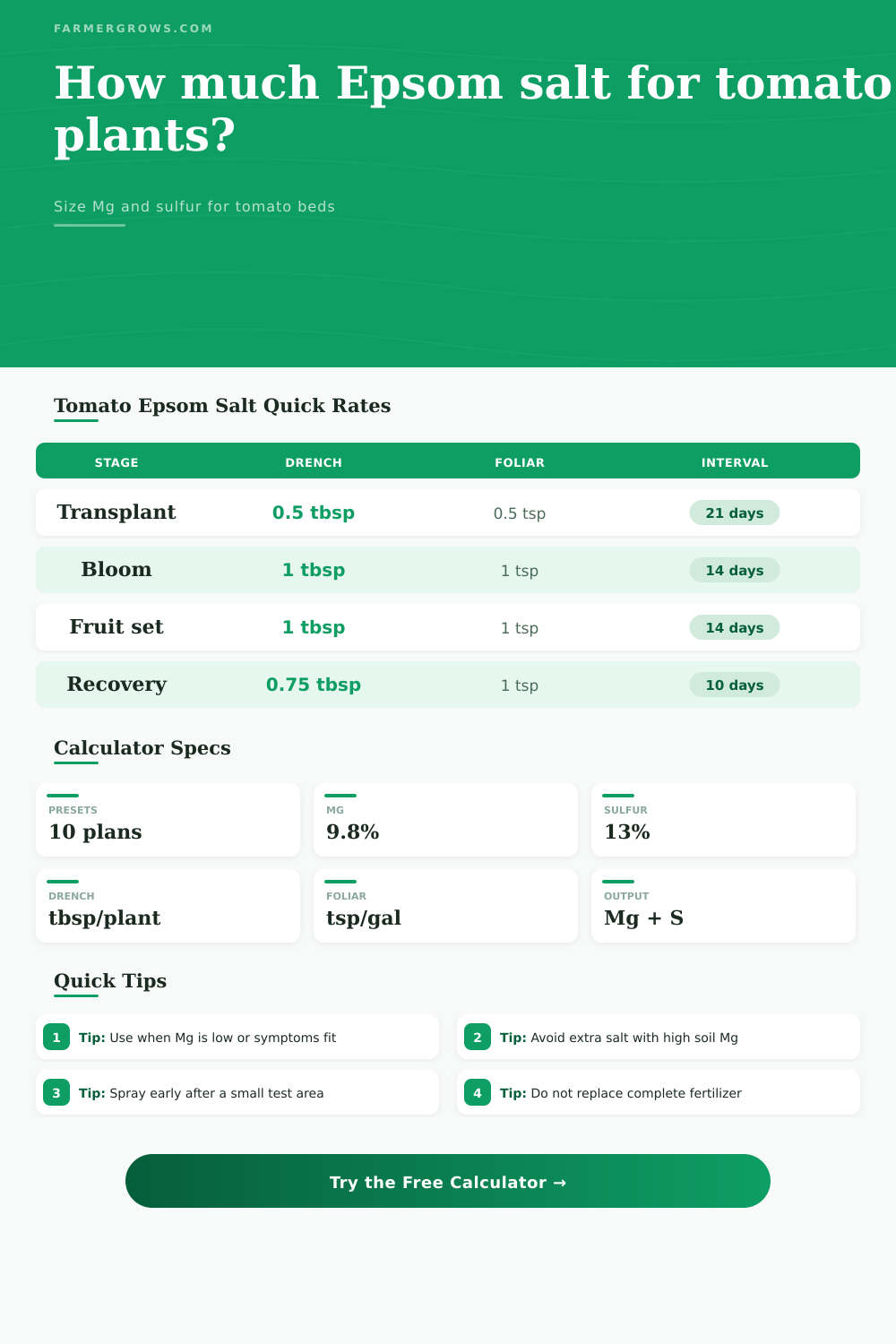
| Tomato stage | Base drench | Base foliar | Typical interval |
|---|---|---|---|
| Seedling or plug tray | 0.15 tbsp per plant | 0.35 tsp per gallon | 21 to 30 days |
| New transplant | 0.50 tbsp per plant | 0.50 tsp per gallon | 21 days |
| Vegetative growth | 0.75 tbsp per plant | 0.75 tsp per gallon | 14 to 21 days |
| First bloom | 1.00 tbsp per plant | 1.00 tsp per gallon | 14 days |
| Fruit set | 1.00 tbsp per plant | 1.00 tsp per gallon | 14 days |
| Heavy fruiting | 1.25 tbsp per plant | 1.25 tsp per gallon | 10 to 14 days |
| Deficiency recovery | 0.75 tbsp per plant | 1.00 tsp per gallon | 7 to 14 days |
| Condition | Calculator adjustment | Tomato meaning | Use caution when |
|---|---|---|---|
| Very low Mg | Raises rate strongly | Soil test supports Mg addition | Watering is uneven |
| Low Mg | Uses full rate | Mg may limit leaf color and growth | Calcium is also low |
| Adequate Mg | Cuts rate nearly half | Symptoms may have another cause | Leaves are yellow from disease |
| High Mg | Uses a very small rate | Extra Mg is usually not needed | Soil is tight or high in salts |
| pH above 7.5 | Raises caution flag | Nutrients may be less available | You have not checked alkalinity |
| Method | Best tomato use | Calculator rate basis | Practical limit |
|---|---|---|---|
| Soil drench | Low-Mg beds, containers, sandy soil | Tablespoons per plant | Keep near 1 tbsp per gallon |
| Foliar spray | Fast correction on active leaves | Teaspoons per gallon of spray | Test a few leaves first |
| Container drench | Pots with frequent leaching | Reduced gallons per plant | Let mix drain freely |
| Bed drench | Root-zone Mg support | Total plants times per-plant rate | Avoid dry soil application |
| Repeat spray | Recovery monitoring | Interval drives monthly total | Stop when new leaves look normal |
| Preset | Plants | Stage | Starting method |
|---|---|---|---|
| Seedling Cups Yellowing | 24 | Seedling | Foliar spray |
| New Transplant Bed | 10 | Transplant | Soil drench |
| Roma Production Row | 18 | Fruit set | Soil drench |
| Cherry Tomato Patio Pots | 6 | Bloom | Container drench |
| Greenhouse Heavy Fruiting | 32 | Heavy fruiting | Soil drench |
| Container Recovery Spray | 8 | Recovery | Foliar spray |
Check the symptom pattern: Magnesium shortage often starts as interveinal yellowing on older tomato leaves while veins stay greener. New-leaf yellowing, spotting, wilting, or one-sided damage can point to other causes.
Keep the dose conservative: Epsom salt adds magnesium and sulfur only. It does not add nitrogen, phosphorus, potassium, calcium, or boron, so stop repeating if soil Mg is adequate or leaves improve.
For tomatoes, in spring, when their oldest leaves show some yellow along the veins, it’s tempting to get out the Epsom salt bottle. It feels like magic because of how it look.
But the real story with magnesium nutrition is that it’s a chemical story, not one of instant gratificaton. Once you know how many plants is growing where, and what size each one is, the calculator (above) do the numbers for you. You won’t have to wonder whether to use this or that conversion factor or coefficient, and there will be no more guesswork. You get an informed, accurate dose based off your specific soil conditions instead of folklore.
Why Epsom Salt Is Not Magic
Why would I care about this? Magnesium move easily through the plant. If your soil isn’t providing enough magnesium, the tomato will start eating itself by using older foliage to nourish the new crop. Top remains green but lower leaves turn yellow. That’s magnesium, or the start of it.
But not all yellow leaves are magnesium-related. Without diagnosing what caused the problem in the first place, you could add unneeded salts to a soil that may already be balanced, which can be bad for the soil (and potentially harmful to the root zone).
The tool makes you think through magnesium and pH in the soil before you even consider treating it, because treating with nutrients without considering whether they’ll actualy get absorbed is a waste of effort, and worse, possibly toxic to the root zone. The tool also know that you’re either spraying something onto the foliage (a foliar spray) or drenching it in the soil (soil drench), which serves two very different physiological functions.
Soil drench is direct root-zone feeding, which is best for sandy soils that rapidly lose their fertility as nutrients leach out. It establishes a reserve in the root zone of Epsom salt for gradual uptake by roots.
Foliar sprays are temporary and act more quickly by being absorbed via the plant’s pores after sitting atop the leaf. They are good for a fast fix when the plant is under high fruiting stress, but they are not for correcting a severe underlying deficiency in the soil itself. The calculator tweaks the rate amounts appropriately. Too-strong a solution will burn your plants; too-weak a mix won’t do enough good.
Another variable many of us forget is timing. Magnesium is typically not needed in seedlings unless the media is absolutely barren, which is unlikely. Demand increases a lot as flower buds expand (bloom) and fruit set begins. At this time, plant draws resources for building cell walls and sugars. The demand for this nutrient ramps up significantly during bloom and fruit set. That requires a lot more than just feeding them vegetables! As shown in the chart, rates shifts from basic maintenance during early growth to active support during harvest.
Metabolically speaking, it makes sense to match your nutrient input to the plant’s actual output. Don’t flood an immature plant with things it can’t handle. Conversely, don’t deprive a heavy producer just when it require maximum support.
There’s also an issue of soil pH here. If your soil is either too acid or too alkaline, it can lock up magnesium and make it unavailable for the roots to take in. It won’t matter how much you apply. The pH adjustments on the calculator will flag this if they thinks it may affect the reliability of its result. It’s a reminder that nutrients are not in a vacuum, they react with each other (including with calcium and potassium), and with the makeup of your growing medium. You may have low mag and high calcium, so adding more mag could of help, but only if you’ve got the right balance.
No, Epsom salt is no miracle drug. Yes, it contains sulfur and magnesium, two critical nutrients that plants need for protein synthesis and chlorophyll production. No, it doesn’t contain nitrogen, phosphorus, or potassium. Sprinkling it around as a general-purpose fertilizer will result in a lopsided plant that misses out on what it needs.
That’s where this tool comes in, getting you to calculate exactly how much is needed given your specific circumstances. This isn’t random salt-spreading time here. This is a measured choice to help build up your plants’ biological systems.
Too many people view using Epsom salt as if it were some magic bullet rather then a targeted nutritional supplement. Done right, it can really help bring the dark green back to old foliage and contribute to the heavier crops. It makes gardening less about guessing and more about doing.