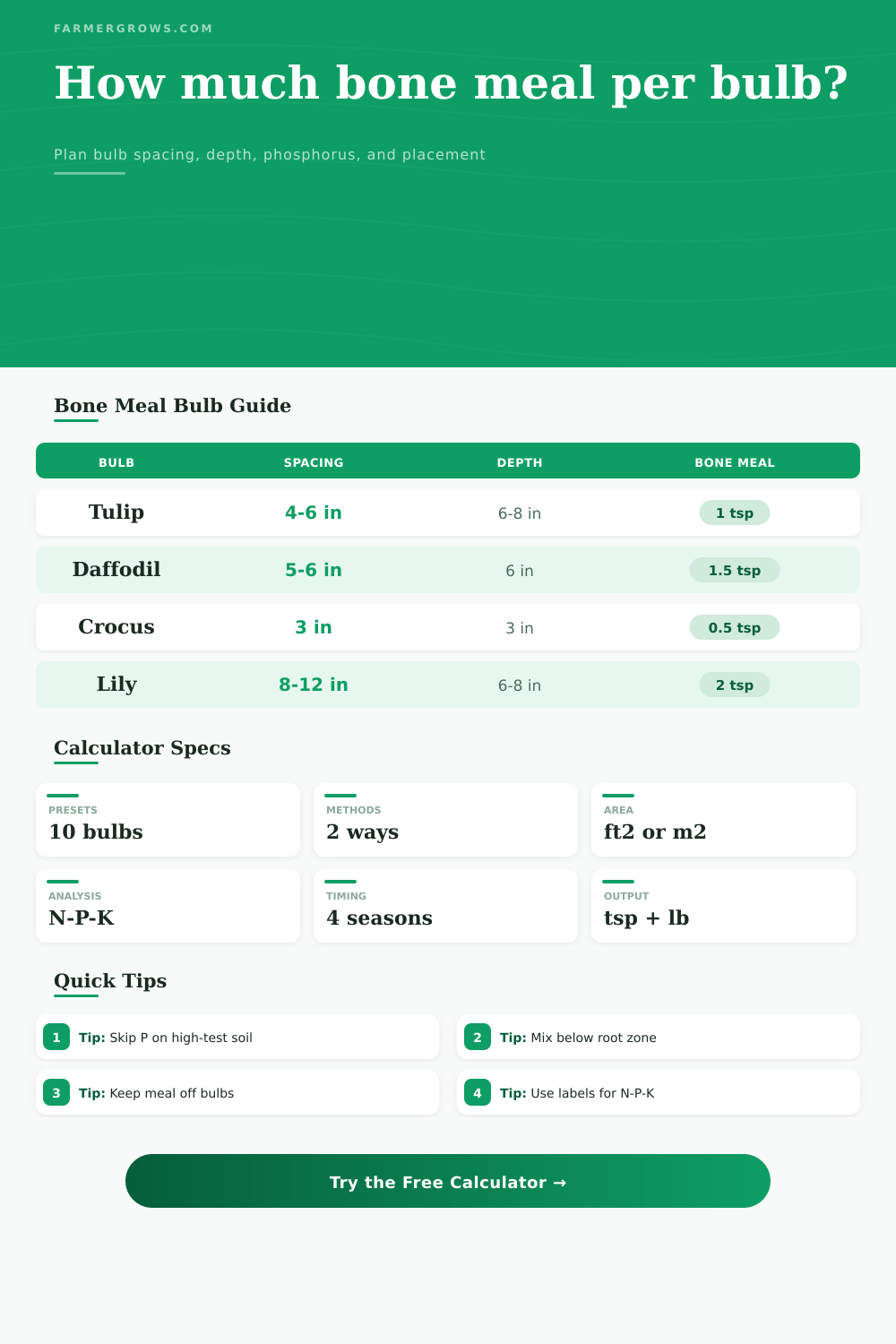
Bone Meal Per Bulb Calculator
Estimate bone meal for tulips, daffodils, crocus, lilies, garlic, alliums, iris, gladiolus, and other bulbs from count, spacing, depth, soil phosphorus, N-P-K analysis, timing, and placement method.
Choose a named bulb planting scenario, then adjust the count, spacing, depth, soil phosphorus, product analysis, season, and placement method for your bed.
Bone Meal Plan
Your bulb planting calculation will appear here.
Often spaced 4 to 6 inches and planted 6 to 8 inches deep. Use a modest below-bulb mix on low-P soil.
Usually tolerate wider naturalized spacing. They can use slightly more starter P where a soil test is low.
Dense plantings need tiny per-corm amounts. Broadcast math is often easier for lawn clusters.
Use deeper planting and a wider root zone. Keep concentrated bone meal separated from the bulb plate.
Big ornamental alliums are widely spaced, so per-hole feeding is cleaner than treating empty bed space.
Garlic needs balanced fertility. Bone meal may help low-P soil, but nitrogen planning still matters.
Spring rows respond better to banded, mixed fertilizer than a heavy concentrated dose in one spot.
Small bulbs need light rates and good organic soil. Overfeeding is easier than underfeeding.
| Bulb type | Typical spacing | Typical depth | Bed planning note |
|---|---|---|---|
| Darwin or Triumph tulip | 4 to 6 in center-to-center | 6 to 8 in to bulb base | Plant in blocks for best spring color; keep fertilizer below the root zone. |
| Daffodil or narcissus | 5 to 6 in in beds, wider in drifts | 6 in to bulb base | Naturalized plantings can be lighter because bulbs are farther apart. |
| Large ornamental allium | 8 to 12 in center-to-center | 6 to 8 in to bulb base | Per-hole feeding avoids treating open soil between widely spaced bulbs. |
| Oriental or Asiatic lily | 8 to 12 in center-to-center | 6 to 8 in, deeper in sandy soil | Mix amendments into the lower planting zone rather than against the bulb. |
| Crocus or snowdrop | 2 to 3 in center-to-center | 2 to 3 in to corm or bulb base | Use very small per-bulb amounts or a light broadcast rate. |
| Garlic clove | 5 to 6 in in-row, rows 9 to 12 in | 2 to 3 in to clove base | Garlic is a crop; phosphorus should follow soil-test need. |
| Soil P status | Calculator factor | Starter P2O5 intent | Use with bulbs |
|---|---|---|---|
| Very low | 125% of species starter amount | Build and place starter P near roots | Suitable for new bulb beds when soil testing confirms low phosphorus. |
| Low | 100% of species starter amount | Standard low-P starter estimate | Best match for default per-hole rates in the calculator. |
| Medium | 70% of species starter amount | Light maintenance only | Use conservative amounts and rely on compost or balanced fertility if needed. |
| High | 25% of species starter amount | Minimal P addition | Often skip bone meal unless a crop adviser or label direction says otherwise. |
| Excessive | 0% of species starter amount | No added phosphorus | Avoid bone meal and use non-P fertility if plants need nitrogen or potassium. |
| Bulb type | Low-P per-hole range | Broadcast guide | Placement caution |
|---|---|---|---|
| Tulip, hyacinth, Dutch iris | 0.75 to 1.25 tsp per bulb | About 0.35 to 0.55 lb per 100 sq ft | Mix into soil below the bulb, not as a raw layer touching it. |
| Daffodil and large allium | 1.25 to 2 tsp per bulb | About 0.45 to 0.70 lb per 100 sq ft | Use the lower end on medium or high-P soils. |
| Lily bulb | 1.5 to 2.5 tsp per bulb | About 0.45 to 0.75 lb per 100 sq ft | Deep planting zones need thorough mixing, not a concentrated pocket. |
| Crocus, snowdrop, small bulbs | 0.25 to 0.6 tsp per bulb | About 0.20 to 0.35 lb per 100 sq ft | Dense clusters can exceed broadcast P quickly if each bulb gets too much. |
| Garlic clove or gladiolus corm | 0.5 to 1 tsp per clove or corm | About 0.30 to 0.55 lb per 100 sq ft | Combine with complete fertility planning for edible crop rows. |
| Timing or method | Calculator factor | Best fit | Practical note |
|---|---|---|---|
| Fall planting for spring bloom | 100% | Tulip, daffodil, crocus, hyacinth | Place and mix before bulbs root in cool soil. |
| Spring planting for summer bloom | 90% | Lily, gladiolus, some alliums | Moisture and root growth decide how quickly nutrients become useful. |
| Late winter dormant planting | 80% | Dormant lilies, emergency bulb moving | Cool soil slows release; avoid heavy top concentrations. |
| After planting top-dress | 60% | Established bulb clumps | Surface bone meal is slower and less targeted than mixed placement. |
| Per-hole mixed placement | 100% | Individual bulbs and small clusters | Blend into the soil below and around roots, then set the bulb above it. |
| Broadcast over row or bed | 115% | Dense beds or garlic rows | Uses a slight coverage factor because fertilizer is spread through more soil. |
Keep phosphorus soil-test driven. Bone meal is mainly a phosphorus source. If the soil already tests high, use the calculator's high or excessive soil-P setting and consider skipping the product.
Mix, then plant. Do not pour bone meal directly against bulbs. Blend it into the planting soil below the future root zone, set bulbs at depth, and water the bed in.
Is there magic dust called bone meal? No, no, no! It’s a physical form of fertilizer. Applied correctly, it can help. However, if used incorrecty, it can stop bulbs from getting their root plates well established before winter. Too-little means a struggling bulb; too-much may mean burnout, or leaching away other nutrients (including phosphorus) via runoff in our groundwater.
A bulb-feeding calculator like this one will do your math for you, taking into account the species, type of soil and strength of product, so you can finally stop second-guessing, and get on to some real planting.
How to Use Bone Meal Correctly
The amount of fertilizer needed vary among bulbs. A tiny crocus corm doesn’t need as much food as a big daffodil bulb does. To match that, you just choose which species you’re treating. It’s good to know WHY that adjustment happens; when a plant grows a generous root system and stores up energy reserves, it can handles a bigger dose of phosphate at the start (like a big bulb does). Too much concentrated fertilizer will overwhelm smaller bulbs because their roots aren’t strong enough yet. Don’t fertilize a bed of lilies the same way you do a patch of snowdrops or you’ll probably be doing them more harm then good.
The reference tables in the tool shows wide ranges for the suggested number of teaspoons per bulb. These numbers aren’t chosen at random; they are based off biology.
The other half of the equation is the one everyone skips: soil testing. Why spend good money on a bag of an ingredient (like bone meal) if you’ve got too much of it in your soil already, due to past overfertilizing? That’s why there’s an option in the calculator for soil phosphorus status. If your soil test reveals your soil has high or excess phosphorus, the calculator will adjust downward accordingly, sometimes eliminating recommendation entirely for bone meal. It’s not about skimping on fertilizer; it’s about science. The soil can only take so much phosphorus, and once saturated, it won’t absorbs any more, anyway, it just wastes money. What could of been illogical is ignoring what condition your soil starts out with; the base level it needs, or thinking it can somehow hold and use added nutrients.
Where you put it and when you use it is just about as important as how much to use. Because bone meal is slow-release, none of that goodness are available instantly; it takes time to break down. This may seem like no big deal if your bulbs will be planted in fall, but again…time. To account for this, the calculator considers when you’ll plant, such as lilies in spring versus tulips in fall. It also looks at when the lily roots arrives in spring, which requires some extra time for the meal to start breaking down beforehand.
It also wants to be incorporated into the surrounding soil beneath the bulb, not touching its surface. Direct contact risks either burn or rot. Instead of wrapping the bulb in fertilizer, envision the meal as an underlying floor. This gets the root systems grow downward into the enriched area instead of directly into a concentrated lump of raw product. Proper placement methods is guided by the results of the tool.
There isn’t just one kind of bone meal. There is fine-grind steam-ground bone meal and coarse bone meal, as well as other types that combine it with other nutrients. The calculator allows you to enter N-P-K breakdown on your particular bag to account for exactly what’s in the package you hold in hand. For a rough guess, maybe an estimate will do. But for precise planting, you need precise data. Match the strength of product to the type of bulb and your soil condition. This transforms a mad dash around planting time into a managed event. It is less about magic dust and more about measured attention.
Plant like this, and you’re creating the base to build upon for a show of color next spring.