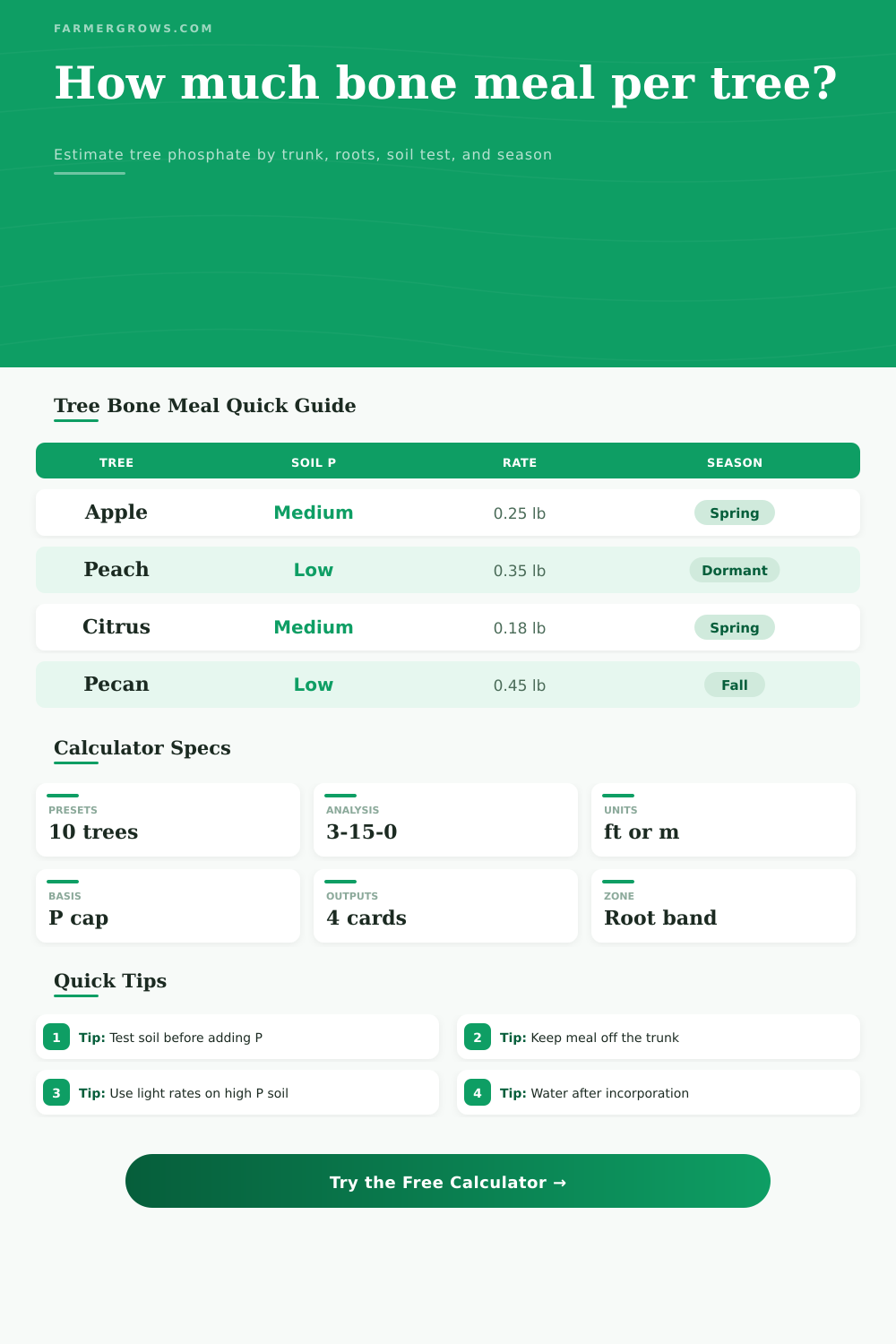
Bone Meal Per Tree Calculator
Estimate bone meal for a single tree from age, trunk caliper, dripline radius, tree type, soil phosphorus status, product analysis, feeder-root band, season, and a phosphorus cap.
Pick a named tree scenario, then adjust the product label, soil test, and root-zone band to match your orchard, yard tree, or container-grown tree.
Tree Bone Meal Estimate
Estimate updates as inputs change.
Moderate P demand. Use soil tests because excess nitrogen can favor shoots over fruiting wood.
Often responds to balanced fertility. Avoid piling bone meal near graft unions or shallow crowns.
Likes steady nutrition but rarely needs heavy phosphorus on medium or high P soils.
Large canopies create wide feeder zones, so the cap may matter more than caliper demand.
Shallow feeder roots need gentle surface incorporation and protection from root disturbance.
Use modest P rates unless soil tests are low; mulch and moisture often matter more.
Bone meal is usually only justified at planting or with a documented phosphorus deficiency.
Small root volumes need low rates and careful mixing to avoid salty or uneven pockets.
| Feeding-zone choice | Inner radius | Outer radius | Tree use |
|---|---|---|---|
| Outer feeder band | 50% of dripline | 100% of dripline | Default for established fruit trees |
| Wide feeder zone | 33% of dripline | 125% of dripline | Large trees with roots past canopy edge |
| Narrow dripline strip | 70% of dripline | 110% of dripline | Low-disturbance correction near canopy edge |
| Mulch ring band | 40% of dripline | 90% of dripline | Backyard trees under existing mulch |
| Young tree ring | 25% of dripline | 85% of dripline | Newly planted and training-stage trees |
| Soil phosphorus status | Calculator factor | Bone meal decision | Cap caution |
|---|---|---|---|
| Very low soil P | 1.40x | Strongest case for bone meal | Still respect the per-area cap |
| Low soil P | 1.15x | Likely useful for young and fruiting trees | Spread over the feeder-root band |
| Medium or unknown P | 0.70x | Use a conservative maintenance dose | Test soil before repeating yearly |
| High soil P | 0.25x | Usually skip or use a very light rate | Runoff risk may outweigh benefit |
| Very high soil P | 0.00x | No bone meal recommended | Use non-phosphorus fertility instead |
| Tree category | Base P2O5 per caliper inch | Typical reason | Adjustment note |
|---|---|---|---|
| Pome fruit | 0.22 lb | Flowering and fruit bud support | Use moderate rates on bearing apples and pears |
| Stone fruit | 0.28 lb | Rapid spring growth and fruit set | Avoid excess near shallow roots |
| Citrus | 0.18 lb | Maintenance nutrition | Reduce if leaves are already vigorous |
| Avocado | 0.16 lb | Gentle subtropical feeding | Do not cultivate deeply around roots |
| Nut tree | 0.32 lb | Large canopy and crop load | Wide root zone usually controls the rate |
| Ornamental tree | 0.10 lb | Deficiency or planting support | Skip on medium or high P soil |
| Application season | Factor | Best fit | Tree-care note |
|---|---|---|---|
| Early spring | 1.00x | Most fruit and nut trees | Apply before active growth, then water in |
| Post-harvest | 0.85x | Bearing fruit trees after crop removal | Useful while leaves still feed roots |
| Dormant season | 0.70x | Mild climates or fall soil work | Keep away from frozen, saturated soil |
| At planting | 0.60x | New bare-root or container trees | Mix broadly, not in a concentrated hole |
| Hot summer correction | 0.45x | Only when deficiency is confirmed | Water first and avoid root disturbance |
Feed the feeder roots, not the trunk. Scratch bone meal lightly into the active root band and keep it several inches away from bark, graft unions, crowns, and exposed surface roots.
Use the soil test to decide repeat use. Bone meal is a phosphorus source, so repeated use on high-P soil can create runoff risk and can interfere with balanced micronutrient uptake.
If you’re thinking: Stick some fertilizer in one hole at the base of the trunk, you’re making a common mistake with tree care. But no: Tree roots spreads out wide into area underneath their drip line, and beyond.
To help shift perspective from trunk to dripline, there’s even this handy calculator for bone meal per tree which shows your phosphate requirements based off that actual feeder root zone.
How to Use the Bone Meal Calculator for Trees
Know the location of the tree’s roots? Now you need to know how much phosphorus it require. Bone meal supplies slow-release phosphorous. Unlike quick dissolving salt forms of synthetics, bone meal doesn’t break down immediatly. Acid soil micro-organisms works to digest it over time. For that reason, it’s good for use in the springtime after plants start pushing again.
The calculator takes into account the time of year and scales back accordingly (the rate goes up for spring application since roots is busier). In July nothing much get taken up, but nutrient just waits there unused.
Your soil test result is one of major inputs into the tool. That’s important because you don’t want to add more of something that’s already abundant. Too much phosphorus can blocks absorption of other nutrients such as iron or zinc and can cause runoff. If your soil tests “very high” in phosphorus, the calculator reduce the recommendation down to nearly nothing, protecting the environment and avoiding waste. Follow the soil test, not your gut urge to just add more.
The type of tree also come into play. For example, a large tree with a wide canopy such as a pecan is heavy feeder; it will require more nutrients, while a smaller ornamental maple will not have so many requirements. Depending on species, the base phosphorus requirement are adjusted based on an inch of tree caliper. So shade trees gets a multiplier, while nut trees get a larger one. After all, they’re expected to bear crops which requires energy. Apples is moderate feeders. That’s why the calculator has preset options for varieties like Meyer Lemon or Honeycrisp.
The default presets makes reasonable assumptions about root zone width and age. But you’ll still want to enter your own measurements of trunk diameter. On younger trees, use the measurement taken six inches off ground. For older ones, go for diameter at breast height.
Then there’s the matter of choosing the right bands to be more precise. Fertilizing by sprinkling around the tree will do nothing but harm (the bark) and waste fertilizier. In fact, how close to the trunk should it goes? You tell the calculator to specify a band within the dripline radius, from half-radius outward to full radius. That’s where the feeder roots is active. There they will get the meal, where it can be absorb.
How much meal? The answer is weight required for the specified area. And the calculator does the math to convert that into cups for small application. And why cups rather then pounds or ounces? Because few of us have an accurate scale we’d carry outside in the garden when applying small amounts.
Another variable is product analysis. Not all bone meals is created equal. Some have lower phosphorus (P) content; some has more. Enter the N-P-K numbers on the bag with the calculator. Fish bone meal may be listed as 4-18-0. Maybe steamed meal is only 3-15-0. The more P there is, the less you’ll need in terms of pounds. It will adjust your end result weight based off nutrients required. So no matter what brand you use it’s going to be consistent. You can shop different brands and see how that rates differ. This allows for a precise plan despite vague labeling.
It is not about how much, but where. Oh yeah, it’s all about tree placement. Trees don’t eat the trunk; they eat what their roots take up from the ground. So focus on where that happens, which is a band between 50% and 100% of the dripline radius. That way you feed them just enough for good results, no more, no less.
Plug in your information into the calculator, and it figure out the rest. No more conversions, no more coefficients. No more wondering. No more thinking. Just start with your soil test. Then measure your canopy. Next plug it into the calculator. How many? And repeat.
Over time, consistent placement lead to consistent growth. Not bark; roots.