Bone Meal To Add To Soil Calculator
Estimate a soil-safe bone meal application from garden area, target P2O5 rate, soil phosphorus status, crop feeding class, product N-P-K analysis, incorporation depth, timing, and organic matter context.
Choose a named garden situation, then adjust the soil test, crop class, product label, and timing. Bone meal is phosphorus-forward, so a recent soil test should lead the decision.
Bone Meal Application Estimate
Enter your bed and product details to calculate an amendment rate.
Carrots, onions, garlic, and beets may justify a full soil-test P2O5 recommendation worked into the seed or transplant zone.
Tomatoes and peppers can use preplant phosphorus, especially in cool soils where early roots develop slowly.
Bulbs, roses, and flowering shrubs often need only a maintenance dose when the test is already adequate.
High phosphorus soils rarely need bone meal. Compost, nitrogen, potassium, pH, or micronutrients may matter more.
Mix lightly with compost and avoid over-application near runoff paths; phosphorus can move with eroded soil particles.
Bone meal can attract animals. Incorporate fully, water it in, and cover treated beds where pets dig or chew.
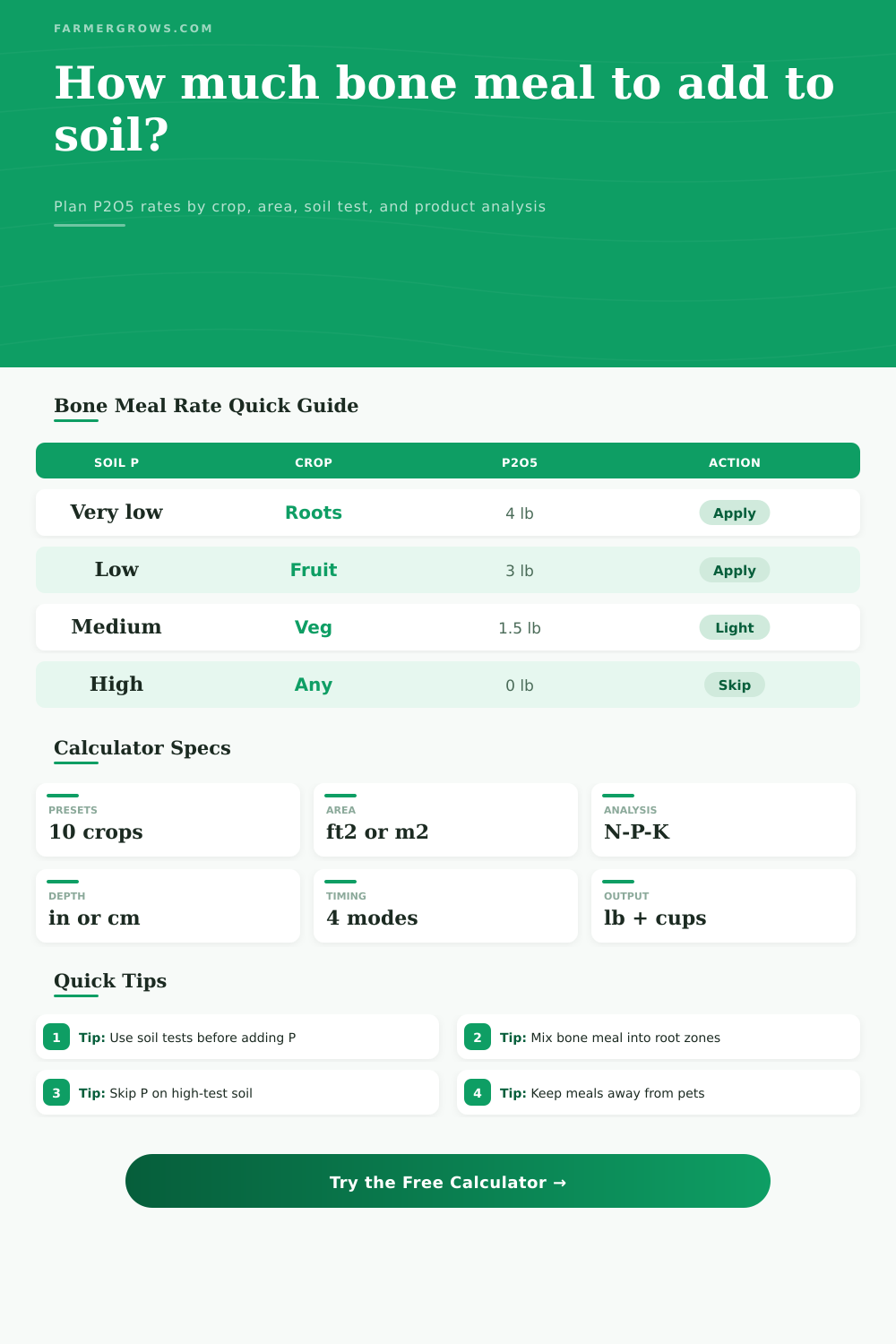
| General garden situation | Planning P2O5 rate | Bone meal at 15% P2O5 | Best use |
|---|---|---|---|
| Very low phosphorus soil | 4 to 6 lb P2O5 per 1000 sq ft | 27 to 40 lb product per 1000 sq ft | Full preplant correction when soil test supports it |
| Low phosphorus soil | 2 to 4 lb P2O5 per 1000 sq ft | 13 to 27 lb product per 1000 sq ft | Vegetable beds, berries, new ornamentals |
| Medium phosphorus soil | 0.5 to 2 lb P2O5 per 1000 sq ft | 3 to 13 lb product per 1000 sq ft | Maintenance only, especially for demanding crops |
| High or excessive phosphorus soil | 0 lb P2O5 per 1000 sq ft | Skip bone meal | Use non-phosphorus amendments instead |
| Bone meal label | P2O5 per pound | Product for 1 lb P2O5 | Notes |
|---|---|---|---|
| 2-14-0 pelletized bone meal | 0.14 lb | 7.14 lb | Good spreadability; confirm cup weight |
| 3-15-0 steamed bone meal | 0.15 lb | 6.67 lb | Common default for vegetable and flower beds |
| 3-16-0 fish bone meal | 0.16 lb | 6.25 lb | Similar slow-release planning, often finer texture |
| 2-20-0 bone and mineral blend | 0.20 lb | 5.00 lb | Concentrated; reduce total product weight |
| Soil phosphorus status | Calculator factor | Interpretation | Recommended action |
|---|---|---|---|
| Very low or deficient | 1.25x | Phosphorus likely limits roots or early growth | Use soil-test P2O5 rate and incorporate well |
| Low | 1.00x | Amendment is usually reasonable for demanding crops | Use target rate; retest after a season |
| Medium | 0.55x | Soil supply is partly adequate | Use light maintenance only if crop needs it |
| High or excessive | 0.15x to 0x | Extra phosphorus can be wasteful or risky | Skip bone meal unless local guidance says otherwise |
| Application timing | First-season availability | Where it fits | Practical handling |
|---|---|---|---|
| Fall, 3 to 6 months ahead | About 65% | Permanent beds, bulbs, and slow soil building | Best when erosion and runoff are controlled |
| Preplant, 2 to 4 weeks ahead | About 75% | Vegetable beds and annual flowers | Mix through the active root zone, then water in |
| At transplant | About 60% | Tomatoes, peppers, shrubs, berries | Blend with backfill; do not pack raw meal against roots |
| Surface side-dress | About 40% | Established perennials and no-till beds | Scratch in where possible and cover with mulch |
Use the soil test as the limit. Bone meal adds phosphorus slowly, but overbuilt phosphorus can still accumulate. If your test reads high, use compost, nitrogen, potassium, lime, sulfur, or micronutrients only when those are actually recommended.
Put it where new roots will grow. Bone meal moves slowly in soil. Mix it into the top few inches for seedbeds or through transplant backfill, then water the area so particles settle into the root zone.
Most gardeners think of bone meal as kind of magic dust. They toss some into the planting hole, set tomato in place, and hope its roots grows with strength. When you’re staring at a struggling young transplant in hot sun, doing anything proactive for soil feels good! But no: Bone meal is slow-release fertilizer, something that relies totally on how much of it get dissolved by what’s in your soil and when. Apply blindly? It is a waste of money and may harm your local waterway.
The calculator above do the math for you. Entering data from your product label and bed size eliminates guesswork about conversions and coefficients.
How to Use Bone Meal Right
Phosphorus is the problem: Phosphate (P2O5) are part of bone meal, which is high in this substance necessary for fruit set and strong root growth in plant. But phosphorous doesn’t travel far through soil. It quickly attaches to available clay molecules and becomes unusable until it reach the area intended for root growth. This brings us back to why depth matter. You’re not fertilizing a lawn by casting it broadcast style. You’re incorporating it into certain depth, typically four to six inches, and the hope is that roots can reaches it. Otherwise, you’ve tossed it on top where it wait, hoping either worms will pull it slowly downward or some rain will come along and wash it away.
Your soil test result matters. This is single most important piece of information you will feed into tool, but a lot of us home gardeners don’t do the test at all. Adding more bone meal won’t make your plants grows any faster if the soil they’re in already contains plenty of phosphorus. All that bone meal simply sits there; building up, over time; and can actualy begin to prevent absorption of other nutrients, such as zinc and iron. You know what happens then: stunted growth, yellowing of leaves.
The tool uses your soil-test results (whether the soil is high, medium, low or even deficient in phosphorus). Is yours high? Skip it. Message is simple: Add compost. Compost doesn’t just give an extra boost of phosphate. It is also good for soil structure and holds moisture, which may help plant roots more different than adding another dose of phosphate ever could.
And then there’s the matter of when: People misunderstand bone meal. Because it breaks down slowly, releasing nutrients over a period of weeks; or even months… The phosphate becomes available to the plant only gradualy. Applied at planting time, it provides a tiny bit of an extra boost. Added in fall, just before frost hits the ground, you’re betting on long game. As the material breaks down during winter and spring, it will be ready when those plants begin to grow again. The calculator takes this into account: It provides several options for how you wish to apply the timing of your amendments. For most vegetable, preplant application is the sweet spot. That way it has time to incorporate in the soil, but it also places the nutrients close to where the plant’s roots is beginning to spread out.
Oh, and then there’s variation among products. Bone meal isn’t one-size-fits-all. For example, some are steamed. Some come as pellets. Some are blended with ground-up fish bones. Some have more or less nitrogen (good for early leaf development); others is focused on phosphorus. There’s also varying densities; that means certain packages will contain X pounds per cup while another will be denser and have fewer cups per pound. Doing the wrong calculation in your head will cause you to apply too much. That’s why the table on the page spells it all out neatly, so you know exactly what you need to order based off the percentage on the label. A mystery bag of stuff becomes an exact amendment.
It’s also a little bit of a safety issue. Though we might smell a whiff of bone meal, dogs thinks it’s dinner time. They’ll get after it and dig it out. That could of lead to some severe stomach problems should they eat enough. So if you have dog: Be sure to really work the meal right into soil and water it down. Don’t let them access it, because it stinks. Toss some topsoil on it or better yet, a nice layer of mulch. It is a slight inconvenience for you, but it is a big one for your dog and your fertilizors.
Bone meal is no tonic but rather a tool. It makes a positive difference if needed, such as where there’s already a diagnosed problem or when creating a new bed to grow something with many root. Used with purpose, it can mean a stronger foundation. Used out of habit, it’s merely more weight in the soil. Measure up, take your test, then apply. Apply with intention. The roots will appreciate the precision.