Pelletized Lime for Lawn Calculator
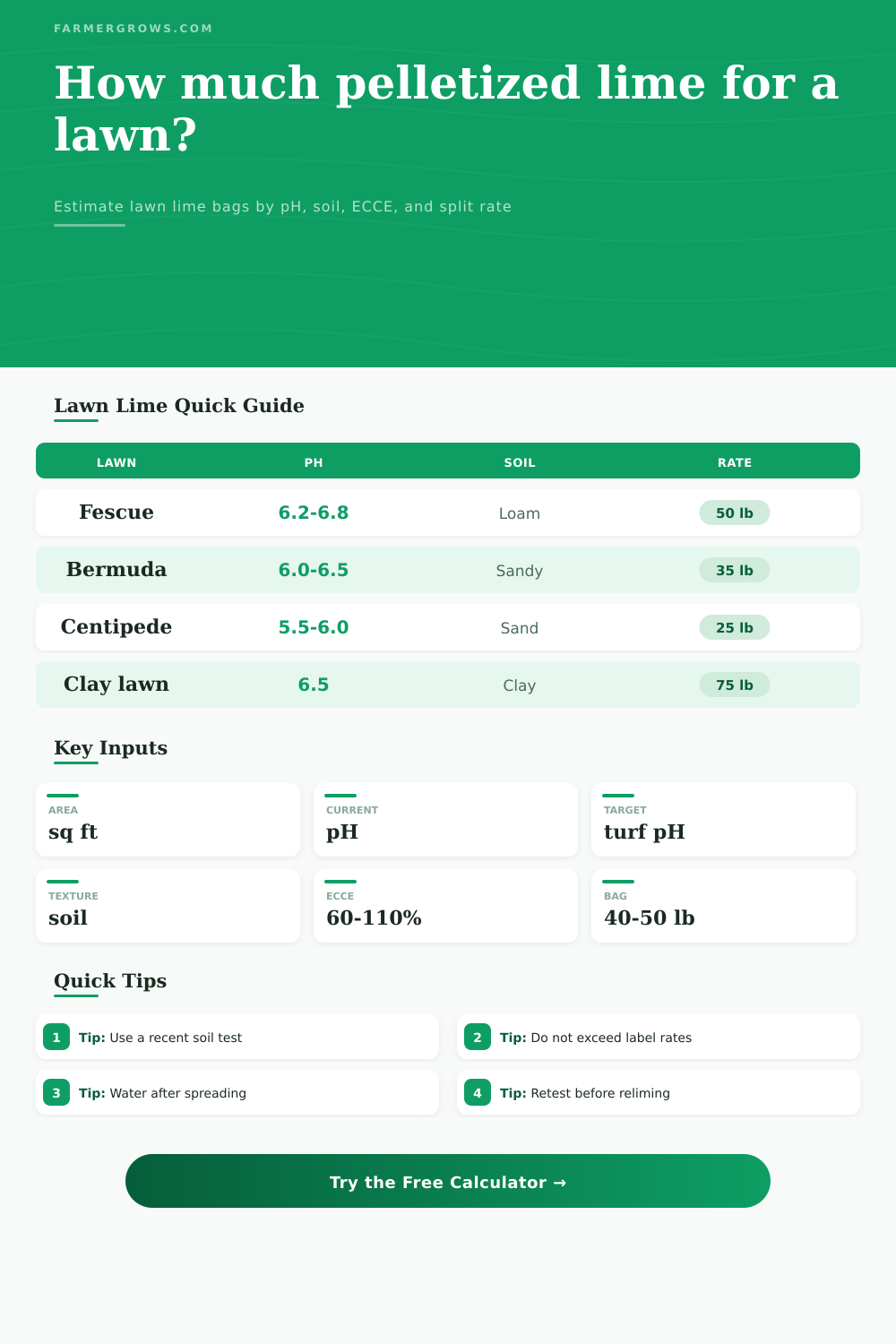
Estimate pelletized lime for a lawn from lawn area, current pH, target turf pH, soil texture, pellet lime ECCE, bag size, maximum label rate per 1000 sq ft, and split schedule.
Choose a lawn situation, then adjust the soil-test pH, turf target, texture, pellet lime ECCE, bag size, maximum label rate, and split plan.
Lawn Pellet Lime Estimate
Your lawn lime estimate will appear here.
Best when pH is just below target and a soil test does not call for a full correction.
Works for modest rates that stay under the product label maximum per 1000 sq ft.
Useful for lower pH lawns, clay soil, or heavier total lime needs that exceed one pass.
Core aeration before spreading can improve granule-to-soil contact on established turf.
| Turf or lawn type | Common pH target | Watch point | Calculator use |
|---|---|---|---|
| Cool-season lawn mix | 6.2 to 6.8 | Most fescue, ryegrass, and bluegrass lawns prefer near-neutral soil. | Use 6.5 as a practical target unless the soil report says otherwise. |
| Bermuda or zoysia lawn | 6.0 to 6.5 | Warm-season turf is often comfortable a little below cool-season targets. | Use 6.2 for routine planning. |
| Centipede lawn | 5.5 to 6.0 | Over-liming can push centipede grass out of its preferred acidic range. | Use 5.8 and avoid aggressive corrections. |
| New lawn seedbed | 6.3 to 6.8 | Incorporated lime works faster than granules left on thick turf. | Use the turf target and a lower surface factor if soil is open. |
| Soil texture | Planning CCE lb per 1000 sq ft for 0.5 pH | Why it changes | Split tendency |
|---|---|---|---|
| Sand or loamy sand | 30 lb | Lower buffering means less lime changes pH. | Often one light pass. |
| Sandy loam | 40 lb | Moderate buffering with faster response than clay. | One or two passes. |
| Loam | 50 lb | Balanced texture; good default when no buffer pH is available. | One or two passes. |
| Silt loam | 60 lb | More reserve acidity than sandy soil. | Often split if pH is low. |
| Clay loam | 75 lb | Higher buffering makes pH changes slower. | Commonly split. |
| Clay or high organic soil | 90 lb | High exchange capacity needs more neutralizing material. | Split strongly preferred. |
| Pellet lime ECCE | Product lb for 50 lb CCE need | 40 lb bags per 1000 sq ft | Planning note |
|---|---|---|---|
| 60 percent ECCE | 83 lb | 2.1 bags | More product is needed when neutralizing value is lower. |
| 75 percent ECCE | 67 lb | 1.7 bags | Common practical label value for blended products. |
| 90 percent ECCE | 56 lb | 1.4 bags | Efficient pellet lime reduces total bag handling. |
| 100 percent ECCE | 50 lb | 1.3 bags | Equal to the CCE need used by the estimate. |
| Max label rate | Best use | What the calculator does | Follow-up timing |
|---|---|---|---|
| 25 lb per 1000 sq ft | Light maintenance or sensitive turf | Creates more split applications for heavier needs. | Retest after visible response and weathering. |
| 40 lb per 1000 sq ft | Typical homeowner spreader limit | Keeps each pass at or below the selected cap. | Leave several weeks between passes. |
| 50 lb per 1000 sq ft | Common bag-label planning cap | Allows modest correction in one or two passes. | Water in after spreading if rainfall is absent. |
| 75 lb per 1000 sq ft | Renovation or bare-soil work only | Still flags heavy total lime plans for caution. | Confirm with product label first. |
Soil test tip: Use this calculator as a planning estimate when the soil report gives only pH. If your report gives a lime recommendation, enter product ECCE and use the report as the final authority.
Spreader tip: Split the total into crossing passes when possible. A half-rate north-south pass plus a half-rate east-west pass usually gives a cleaner lawn pattern.
Remember when you guessed at lowering your lawn’s pH? Got some lime; spread it on. Did the lawn turn yellow or maybe it stayed green? Now you’re not sure if your application was weak or just spotty.
No, the problem isn’t typically with the lime. The problem is treating what’s essentially a chemistry problem as though it were a watering one. Lime is no fertilizer. It doesn’t fertilize; rather, it change the soil so that the plant can use the available nutrients. That makes all the difference in approaching this chore.
How to Use Lime Correctly on Your Lawn
Not all lime are the same. Many homeowners believe that all lime products are equal, but they’re not. The amount of lime required is calculated using a measure of its strength called its “effective calcium carbonate equivalent,” or ECCE. A higher number mean your lime is stronger. Other types of lime may be made from a blend of other materials that dilute there strength. To adjust the pH, you’ll require more if your lime has a lower ECCE.
Based off the percentage value entered, the calculator will automatically adjust amount of lime you’ll need. In other words: no overbuying and no underbuying.
The other big factor is soil texture. Sandy soils is not good at holding nutrients, nor do they buffer acidity well. Because sand provides less resistance, less lime are required in a sandy soil. Conversely, clay has a tight hold on hydrogen ions. To alter the pH of clay require more time and effort. More lime per thousand square feet is required in clay different than sand, as indicated in reference tables above. Did you treat clay like sand? You will get no results.
But it’s here that patience comes into play: Because people want results fast, they tend to go ahead and dump entire amount. That burns the turf, and it also leads to uneven distribution. Granular things like pelletized lime form clumps in spreaders. Applying in increments over several weeks allow for more thorough coverage, with more time for soil to react.
The maximum application rate per pass (the cap) is set by label limit. This is a basic rule to keep you from applying too much in a single sitting.
The last thing it needs is water. No, lime will not work on top of things. It dissolves and has to works its way down into the earth. Spread it on a dry spot and it just waits till it rains. In fact, if dry, do what the tool tells you to do and spread it and then lightly water it in.
It reminds you to wait a few more months to retest your soil. It’s a slow chemical reaction. It is not fast than fertilizer. It is slow.
You should of waited for rain. Knowing those variables takes the guesswork out of it. It’s not about throwing down some rock and calling it good. It’s about managing chemistry, and when we know what to do with soil texture and ECCE, we’re solving the root cause of the problem.
The math will provide the map. Understanding the soil is the actualy work.