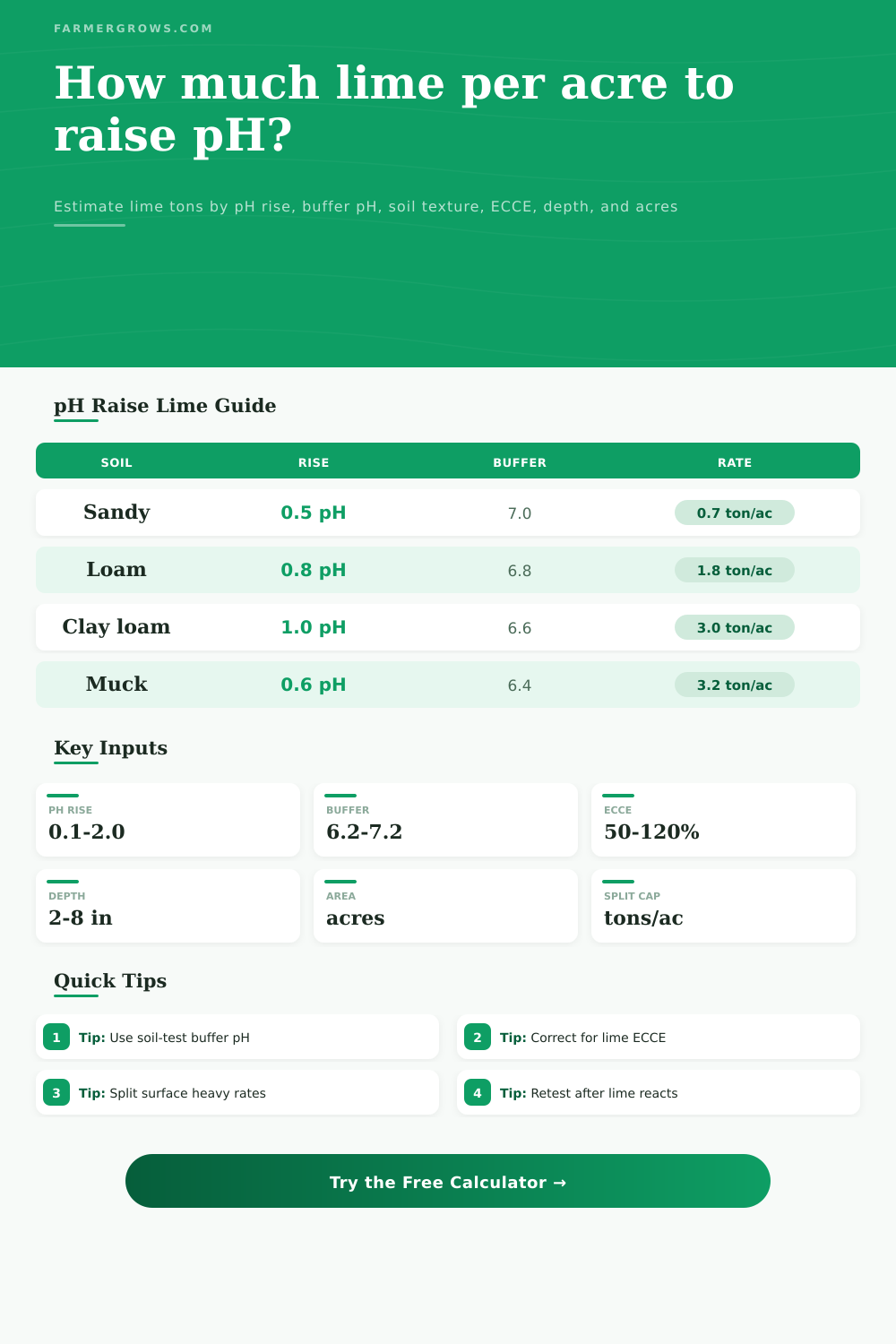
Lime per Acre to Raise pH Calculator
Estimate ag lime needed to raise soil pH from a current value by a selected pH rise, with buffer pH, texture, CEC, organic matter, ECCE, application depth, acreage, and split-rate limits.
Load a realistic soil-test situation, then tune the current pH, desired pH rise, buffer pH, soil texture, CEC, organic matter, lime quality, depth, acres, and split cap.
pH Raise Lime Results
Estimated product lime rate, total tons, target pH, and split application schedule will appear here.
Fine, high-ECCE lime mixed into moist soil usually reacts faster than coarse surface applications.
Clay, muck, high CEC, high organic matter, and low buffer pH increase tons per acre.
Rates above the selected pass cap are divided into multiple applications for safer spreading.
Use this estimator beside a lab recommendation when your report lists ECCE or ENM.
| Texture | 0.3 pH rise | 0.6 pH rise | 1.0 pH rise | Typical note |
|---|---|---|---|---|
| Sand or loamy sand | 0.3 ton/ac | 0.6 ton/ac | 1.0 ton/ac | Low buffering; avoid overshooting small gardens. |
| Sandy loam | 0.4 ton/ac | 0.8 ton/ac | 1.3 ton/ac | Moderate movement with fair drainage. |
| Loam | 0.5 ton/ac | 1.1 ton/ac | 1.8 ton/ac | Common mineral-soil planning baseline. |
| Silt loam | 0.7 ton/ac | 1.3 ton/ac | 2.2 ton/ac | Often productive but more buffered. |
| Clay loam | 0.8 ton/ac | 1.7 ton/ac | 2.8 ton/ac | Use buffer pH carefully. |
| Muck or high humus | 1.1 ton/ac | 2.2 ton/ac | 3.6 ton/ac | High reserve acidity and organic buffering. |
| Buffer pH | Reserve acidity | Rate effect | Best use |
|---|---|---|---|
| 7.2 | Very low | 0.80x | Sandy or lightly buffered soils. |
| 7.0 | Low | 0.92x | Small pH correction plans. |
| 6.8 | Medium | 1.00x | Balanced default when lab buffer is known. |
| 6.6 | Moderately high | 1.15x | Many loam and clay loam fields. |
| 6.4 | High | 1.32x | Large correction or high CEC soils. |
| 6.2 | Very high | 1.52x | Confirm with lab before heavy liming. |
| ECCE | Product needed for 2.0 ton/ac equivalent | Interpretation | Field note |
|---|---|---|---|
| 60% | 3.33 ton/ac | Low effective value | More product needed for the same neutralizing value. |
| 75% | 2.67 ton/ac | Moderate value | Common for coarser agricultural lime. |
| 90% | 2.22 ton/ac | Good value | Typical planning assumption for fine ag lime. |
| 100% | 2.00 ton/ac | Standard equivalent | Soil-test equivalent and product rate match. |
| 110% | 1.82 ton/ac | High value | Less product needed if analysis supports it. |
| Application depth | Depth factor | Where it fits | Planning caution |
|---|---|---|---|
| 2 inches | 0.33x | Surface correction or shallow bed mix. | Do not compare directly with 6-inch lab rates. |
| 4 inches | 0.67x | Garden tillage and shallow establishment. | Good for raised beds and renovation strips. |
| 6 inches | 1.00x | Common field soil-test basis. | Default for many agronomic samples. |
| 8 inches | 1.33x | Deep incorporation before long-term planting. | Needs enough mixing to avoid uneven pH. |
Use the buffer pH when available. Current pH tells how acidic the soil solution is, while buffer pH helps estimate how much lime is needed to change that pH.
Match the rate to lime quality. A soil test may assume 100% effective lime, so the ECCE correction is what turns that recommendation into real product tons per acre.
For example, perhaps your soil test says pH is five point four and you think “I better add some lime on each acre.” That’s the first mistake: treating lime as if it were fertilizer, assuming it will instantly increase pH. Actualy, lime takes months to years to react with the soil chemistry. With lime, you’re managing a chemical reserve; it doesn’t work the same way.
And what’s your math for how much product to apply? You don’t have to guess. The calculator above do it for you by calculating the effective neutralizing value and buffering capacity. The aim isn’t simply to bring up the number but rather to manage chemical reserve.
Why Lime Is Not Like Fertilizer
And then there’s question of what the soil contains. That’s where the buffer pH input comes into play. The buffer measures how acidic the humus and clay are, things that holds their own acid. A sandy soil with an initial pH of five (not uncommon) may require less lime to get up to pH 6 than a heavy clay loam at the same pH; why? Sand has a lower buffer capacity and lets go of hydrogen ions easily, whereas clay hold onto them tightly. You can see from the buffer column why texture makes a difference: sandy soils will get too much lime while heavier soils will not get enough if you don’t pay attention to it.
The page’s reference table clearly shows this, since soils such as muck typically require more lime per each pH unit different than do sands. That’s not arbitrary either; it has to do with physics.
But it’s not just the amount that counts; it’s quality of the lime. Don’t get me wrong: You can’t just grab a sack from the big box store and expect it to act the same way a lab-grade version would. That’s where the ECCE correction works. The correct Calcium Carbonate Equivalent takes purity and particle size into account. For example, a coarse, dusty stuff hauled in on a quarry truck may only be sixty percent as effective as fine ground agricultural lime. Without an ECCE adjustment, you’re spreading air rather than chemistry. By entering the actual ECCE of whatever lime you’re using, the calculator allow you to think through this part of the process. Sounds geeky? No: You aren’t just buying weight; you are also buying neutralizing power. Use more if your lime’s coarse.
It also shifts when things happen. Lining the soil with lime makes it come into contact more quickly with both clay particles and moisture, speeding up the neutralizing process. It is easier and less expensive to spread on the surface (particularly if you don’t till), but it will take longer to reach the soil below (unless you’re doing it with no-till). That can mean overloading top layer, so you may want to do half now and half later. The tool lets you figure out split applications based off your desired maximum rate per pass. This way, you don’t try to spread three tons at once and have all but one bounce away or just sit still on top. This is a real-world constraint that saves effort and money.
Results won’t be instantaneous: Soil pH doesn’t change quickly even if you apply amendments exactly as calculated. In the first year, perhaps you’ll witness an increase of half a unit (and then another half unit the following year or two). Remember that we’re trying to get things moving in the right direction, not turn off a light switch!
Azaleas and blueberries is acid-lovers; go lower than six. For pastures, corn or most vegetables, you’re aiming at a pH of six to six point five, which balances nutrients. Bacteria thrive here, iron is made available, and phosphorus becomes accessible.
The last step? Test again. A scientific estimation from the calculator is just that: an average representation of how the soils in general behave. Local climate, history of fertilizer use, micro-variation in drainage and more can shift the base line in each individual field. Use this as a starting place. Plan your purchase, including where and when to apply it. Then, confirm the outcome by getting another soil sample next year.
You’re no longer throwing powder on dirt; now you’ve got something you’re manipulating and managing. Adjusting the chemical environment to foster life takes some knowledge about chemistry, precision and patience. The math part is simple. The job is waiting for the soil to show results of your work.